Viewing as
Teaching this? The teacher view adds 2 files, the mark schemes and the model answers.
Business · Growing the business
Business and globalisation
Globalisation means the world's economies are becoming more connected. Businesses import and export, move production abroad and become multinationals - and they face barriers such as tariffs and trade blocs.
Last Lesson
Answer from memory before the answers appear.
-
Give two reasons why business objectives change.
Any two of: market conditions, technology, performance, legislation, internal reasons.
-
What does exiting a market mean?
Stopping selling in a location or segment.
-
What is profit maximisation?
Aiming to make as much profit as possible.
- From Topic 1: what does SPICED mean?
Learning Objectives
- 1Explain what globalisation is.
- 2Explain imports and exports and their impact on businesses.
- 3Explain why businesses change location and what multinationals are.
- 4Explain barriers to international trade: tariffs and trade blocs.
- 5Explain how businesses compete internationally.
What Is Globalisation?
Globalisation is the process by which the world's economies are becoming increasingly connected.
-
Trade
Goods and services are bought and sold between countries more than ever before.
-
Communication
The internet lets businesses sell and communicate worldwide instantly.
-
Transport
Container ships and air freight move goods around the world cheaply.
-
For businesses
Globalisation means new markets and cheaper supplies - but also new competition from around the world.
Imports and Exports
Imports
- Goods and services bought from other countries.
- Give businesses access to cheaper or better materials and products.
- Give customers more choice.
- But: UK businesses face competition from foreign imports.
Exports
- Goods and services sold to other countries.
- Give businesses access to much bigger markets.
- Can increase sales and allow growth.
- But: harder to understand foreign customers, and exchange rates add risk.
The World's Goods on the Move
Most of the goods traded between countries travel in shipping containers. Cheap, reliable shipping means a UK shop can sell products made on the other side of the world - and a UK manufacturer can sell to customers on every continent.
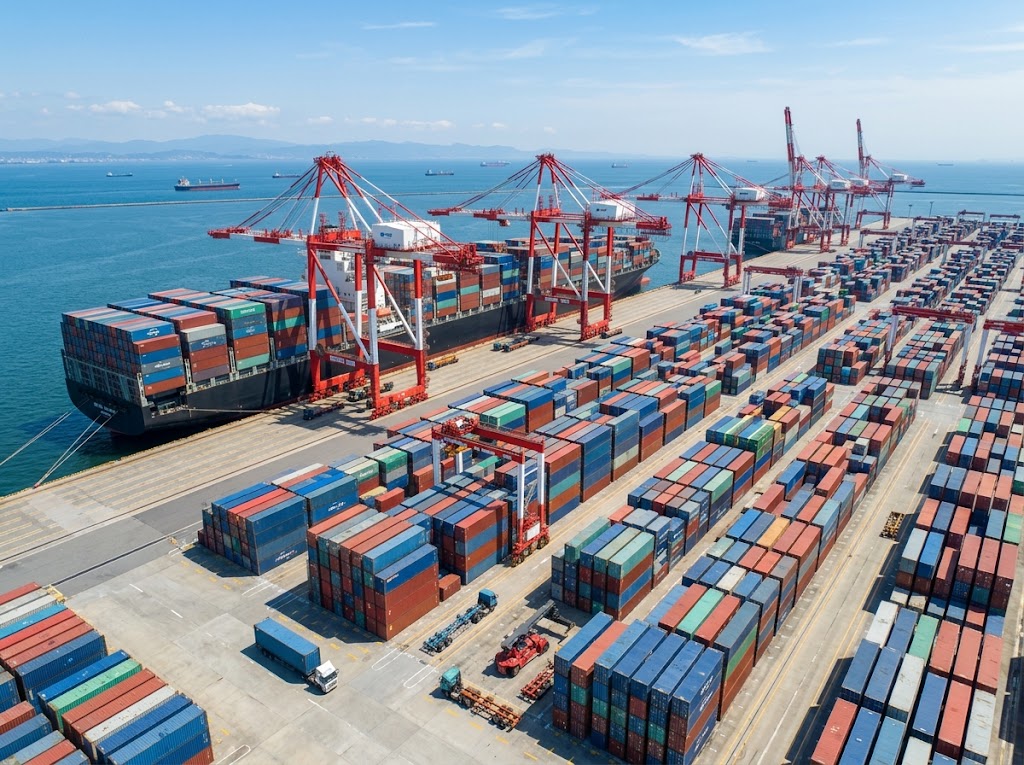
Container ships carry most of the world's traded goods.
Changing Business Location
Globalisation lets businesses locate parts of their operations abroad.
-
Lower costs
Wages, rent and taxes may be much lower in other countries.
-
Closer to customers
Producing near a big overseas market cuts transport costs and time.
-
Access to materials and skills
Some countries have raw materials or skilled workers the business needs.
-
The downsides
Jobs lost in the home country, longer supply chains, language and cultural differences, and damage to reputation if working conditions are poor.
Multinational Companies (MNCs)
A multinational company has its headquarters in one country and operates in several others.
-
Examples
Coca-Cola, Toyota, Unilever and McDonald's all make or sell products in many countries.
-
Benefits to MNCs
Huge markets, economies of scale, and the chance to locate each activity where it is cheapest.
-
Benefits to host countries
Jobs, investment, taxes and new skills and technology.
-
Drawbacks for host countries
Local businesses may struggle to compete, and profits may leave the country.
Tariffs and Trade Blocs
Governments can make international trade easier or harder.
-
Tariff
A tax on imported goods. It makes imports more expensive, protecting home businesses from foreign competition.
-
Impact of tariffs
A business importing materials pays more, raising its costs; a business exporting may sell less if other countries put tariffs on its goods.
-
Trade bloc
A group of countries that agree to trade freely with each other, with few or no tariffs between them, such as the European Union (EU).
-
Impact of trade blocs
Businesses inside the bloc trade easily with each other, but businesses outside may face tariffs and extra rules when selling into it.
Competing Internationally
How businesses win customers in other countries.
-
Using the internet
E-commerce lets even a small business sell worldwide from its own website or online marketplaces.
-
Changing the marketing mix
Adapting the product, price, promotion and place for each country - different flavours, sizes, languages and prices.
-
Understanding local culture
Names, colours and adverts that work in one country may offend or confuse in another.
-
Keeping costs down
Competing with businesses in low-cost countries means being efficient or offering something they cannot.
Case study
Dyson: Moving Production Abroad
James Dyson first made his vacuum cleaners in Malmesbury, Wiltshire. In 2002 Dyson moved most of its manufacturing to Malaysia, where costs were lower and it was closer to its suppliers and to fast-growing markets in Asia. Around 800 production jobs were lost in the UK, although Dyson kept its research and design in Britain. The move shows the trade-off of globalisation: lower costs and access to new markets, against job losses at home and criticism in the UK press.
Going Global
A UK company makes premium dog food and wants to start selling in Japan and the USA. Suggest how it should adapt each part of its marketing mix for these markets, and identify one barrier to trade it might face.
1. Product changes.
2. Price changes.
3. Promotion changes.
4. Place changes.
5. One barrier to trade.
A good answer shows: A specific change to each of the 4Ps for an overseas market, plus a trade barrier such as a tariff or product rules.
Can I...?
- 1Explain what globalisation is.
- 2Explain imports and their impact.
- 3Explain exports and their impact.
- 4Explain why businesses change location.
- 5Explain what a multinational is.
- 6Explain the impact of tariffs.
- 7Explain the impact of trade blocs.
- 8Explain how businesses compete internationally.
Summary & Exam Focus
- Globalisation connects the world's economies through trade, communication and transport.
- Imports give cheaper supplies but more competition; exports give bigger markets but more risk.
- Businesses move production abroad for lower costs and to be closer to markets; MNCs operate in many countries.
- Tariffs and trade blocs affect the cost of trade; businesses compete internationally online and by adapting the marketing mix.
Exam focus
Explain one impact on a UK business of a tariff being placed on the materials it imports. (3 marks) (3 marks)
Tariffs raise the price of imports. Take the chain through to costs, prices, sales and profit.
Key terms
The vocabulary this lesson expects you to use. Each one is linked from the first place it appears above.
- Globalisation
- The process by which the world's economies are becoming increasingly connected.
- Import
- A good or service bought from another country.
- Export
- A good or service sold to another country.
- Multinational company (MNC)
- A business with its headquarters in one country that operates in several countries.
- Tariff
- A tax on imported goods.
- Trade bloc
- A group of countries that trade freely with each other, with few or no tariffs between them.
- Free trade
- Trade between countries without barriers such as tariffs.
Downloads
Free to keep, print and annotate.
- Business and globalisation.pptx Built from the lesson script on 27 September 2026. View
- Business and globalisation - Completed Notes.docx The full notes for the lesson, to revise from. Built from the lesson script on 27 September 2026. View
- Business and globalisation - Exam Questions.docx Built from the lesson script on 27 September 2026. View
Something here looks wrong?
Tell us what and we will go and look. It goes to whoever writes these pages, nobody else, and we do not ask who you are — so there is nothing to sign and nothing comes back to you.