Exam questions · Biology · Cell Division
Using Stem Cells
- 8 exam questions
- 23 marks
- 8 quick checks
-
1 Name [1 mark]
Name one medical condition that stem cells may be able to help treat.
Show answerHide answer
Model answer
Diabetes, or paralysis (accept other suitable conditions).
Mark scheme
- Diabetes / paralysis — 1 mark
-
2 Explain [2 marks]
In therapeutic cloning, the stem cells are not rejected by the patient's body. Explain why.
Show answerHide answer
Model answer
The embryo is made with the same genes as the patient, so the cells made from it are not recognised as foreign by the patient's body.
Mark scheme
- The embryo has the same genes as the patient — 1 mark
- So the body does not see the cells as foreign / does not reject them — 1 mark
-
3 Describe [3 marks]
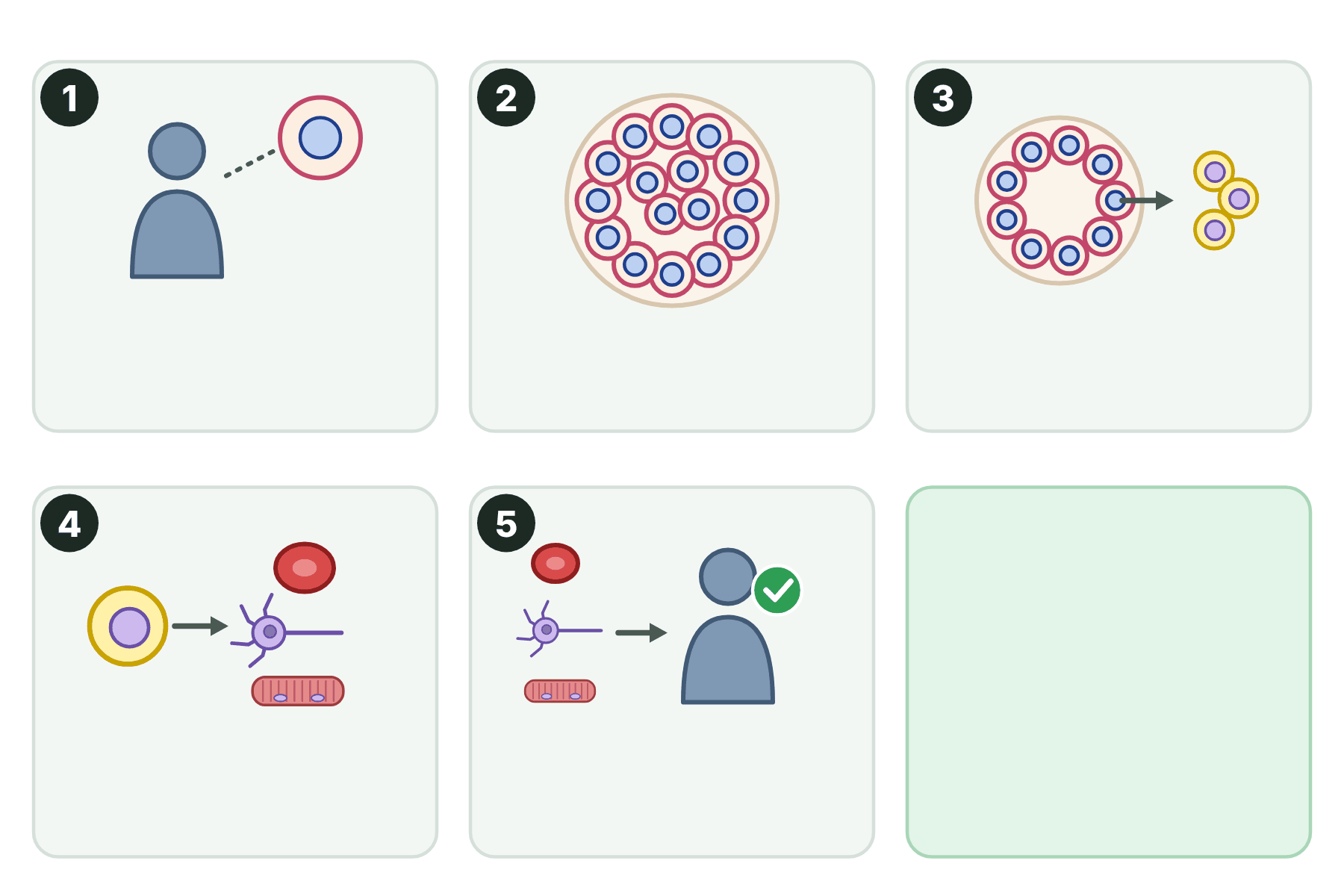
Figure 1 shows the stages of therapeutic cloning. Describe what happens in stages 2, 3 and 4.
Show answerHide answer
Model answer
In stage 2 an embryo is produced that has the same genes as the patient. In stage 3 stem cells are taken from the embryo. In stage 4 the stem cells are made to differentiate into the type of cell that is needed.
Mark scheme
- Stage 2: an embryo with the same genes as the patient — 1 mark
- Stage 3: stem cells taken from the embryo — 1 mark
- Stage 4: stem cells differentiate into the cells needed — 1 mark
-
4 State [2 marks]
State two risks or objections to the use of stem cells in medicine.
Show answerHide answer
Model answer
Any two from: a risk of transferring a viral infection; ethical objections, such as destroying an embryo; religious objections.
Mark scheme
- Risk of viral infection — 1 mark
- Ethical objections (an embryo is destroyed) — 1 mark
- Religious objections — 1 mark
-
5 Describe [3 marks]
Describe how stem cells from a plant's meristem can be used to produce clones of the plant.
Show answerHide answer
Model answer
A small piece of meristem tissue is taken from the parent plant. The stem cells in it divide and differentiate to grow into new plants. The new plants have the same genes as the parent, so they are all clones.
Mark scheme
- Meristem tissue is taken from the parent plant — 1 mark
- Cells divide and differentiate to grow into new plants — 1 mark
- New plants have the same genes as the parent (clones) — 1 mark
-
6 Give [2 marks]
Give two reasons why it is useful to clone plants from stem cells.
Show answerHide answer
Model answer
Any two from: rare species can be cloned to protect them from extinction; crop plants with special features such as disease resistance can be cloned to produce large numbers of identical plants for farmers; it is quick and economical.
Mark scheme
- To protect rare species from extinction — 1 mark
- To produce many identical crop plants with a useful feature (such as disease resistance) — 1 mark
- It is quick and economical — 1 mark
-
7 Explain [4 marks]
A farmer grows a crop of plants that were all cloned from one parent plant. Give one advantage and one disadvantage of growing a crop made of clones, and explain each.
Show answerHide answer
Model answer
Advantage: all the plants have the same useful features, for example disease resistance, so the crop is reliable and uniform. Disadvantage: all the plants have the same genes, so one new disease could harm every plant in the crop.
Mark scheme
- Advantage: all have the same useful feature — 1 mark
- Explained: for example disease resistance in every plant, so a uniform crop — 1 mark
- Disadvantage: all have the same genes, so no variety — 1 mark
- Explained: a new disease could harm the whole crop — 1 mark
-
8 Evaluate [6 marks]
Evaluate the use of stem cells in medicine.
Show answerHide answer
Model answer
Stem cells may be able to help conditions such as diabetes and paralysis by replacing the cells that have been lost, and with therapeutic cloning the cells are not rejected because they have the same genes as the patient. This could help many people who cannot be treated now. However, the use of stem cells has risks, such as the transfer of a viral infection, and the treatments are still being developed. Some people have ethical or religious objections to using embryonic stem cells, because the embryo is destroyed, although others think this is outweighed by the benefit to patients. Adult stem cells avoid this objection but can become fewer types of cell. On balance, the potential benefits are large, but the risks have to be controlled, and the decision depends on the views of society.
Mark scheme
- Benefit: could treat conditions such as diabetes and paralysis — 1 mark
- Therapeutic cloning gives cells that are not rejected — 1 mark
- Risk: transfer of viral infection — 1 mark
- Ethical or religious objection: an embryo is destroyed — 1 mark
- Counter-argument or adult stem cells as an alternative — 1 mark
- A reasoned conclusion (weighing the benefits against the risks) — 1 mark
Quick check
-
1
Which condition may stem cells help to treat?
Show answerHide answer
C: Diabetes
Treatment with stem cells may be able to help conditions such as diabetes and paralysis.
-
2
In therapeutic cloning, how is the embryo made?
Show answerHide answer
B: With the same genes as the patient
The embryo is produced with the same genes as the patient.
-
3
Why are the stem cells made by therapeutic cloning not rejected?
Show answerHide answer
A: They have the same genes as the patient
They have the same genes as the patient, so the patient's body does not see them as foreign.
-
4
Which of these is a risk of using stem cells in medicine?
Show answerHide answer
D: Transfer of a viral infection
A viral infection could be transferred to the patient with the stem cells.
-
5
Why do some people object to using embryonic stem cells?
Show answerHide answer
B: It involves destroying an embryo
Some people have ethical or religious objections, because taking stem cells from an embryo destroys the embryo.
-
6
Stem cells from meristems can be used to produce what?
Show answerHide answer
C: Clones of plants
Meristem stem cells can be used to produce clones of plants quickly and economically.
-
7
Which is a use of cloning plants from meristem tissue?
Show answerHide answer
A: Protecting a rare species from extinction
Rare species can be cloned to protect them from extinction, and crop plants with special features can be cloned in large numbers.
-
8
A farmer clones one disease-resistant plant to make a whole field of identical plants. What is a possible drawback?
Show answerHide answer
D: A new disease could affect them all
The plants have the same genes, so a new disease that they cannot resist could damage every plant in the field.