Exam questions · Biology · Digestion and Enzymes
Levels of Organisation and the Digestive System
- 10 exam questions
- 30 marks
- 10 quick checks
-
1 State [2 marks]
State what is meant by a tissue.
Show answerHide answer
Model answer
A group of similar cells that work together to do a particular job.
Mark scheme
- A group of similar cells — 1 mark
- That work together to do a (particular) job — 1 mark
-
2 Name [1 mark]
Name the type of tissue that contracts to churn food in the stomach.
Show answerHide answer
Model answer
Muscular tissue.
Mark scheme
- Muscular tissue — 1 mark
-
3 Name [4 marks]
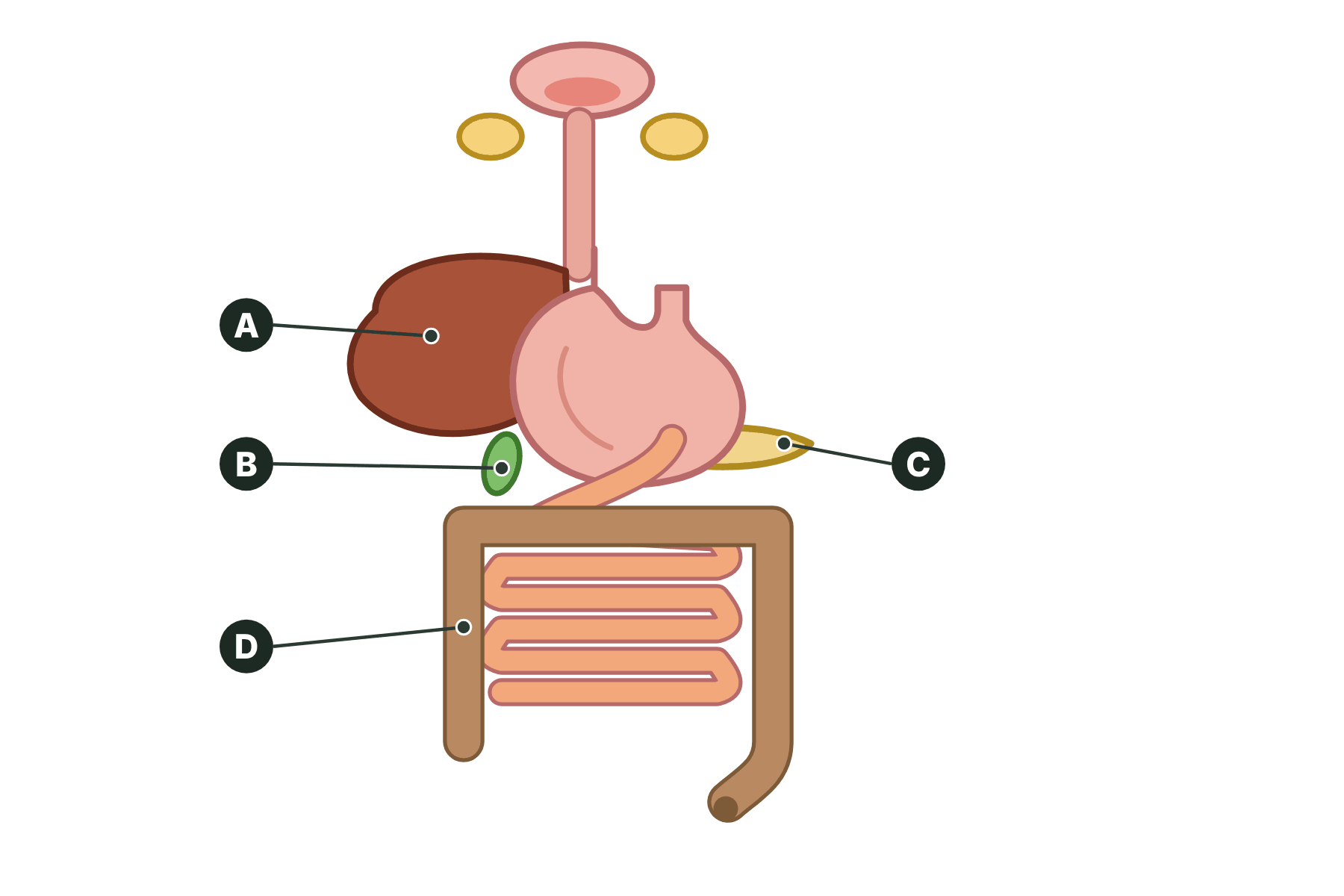
Figure 1 shows the human digestive system. Name the organs labelled A, B, C and D.
Show answerHide answer
Model answer
A is the liver. B is the gall bladder. C is the pancreas. D is the large intestine.
Mark scheme
- A: liver — 1 mark
- B: gall bladder — 1 mark
- C: pancreas — 1 mark
- D: large intestine — 1 mark
-
4 Describe [2 marks]
Describe the function of organ B in Figure 1.
Show answerHide answer
Model answer
It stores bile until it is needed, and releases it into the small intestine.
Mark scheme
- Stores bile — 1 mark
- Releases it into the small intestine / to digest fat — 1 mark
-
5 Explain [3 marks]
Explain why the stomach is an organ and not a tissue.
Show answerHide answer
Model answer
A tissue is made of just one type of cell. The stomach is made of several different tissues, such as muscular, glandular and epithelial tissue, which work together to digest food.
Mark scheme
- Made of more than one tissue — 1 mark
- Names two tissues, e.g. muscular and glandular — 1 mark
- The tissues work together to do a job / digest food — 1 mark
-
6 Describe [3 marks]
Describe the path taken by a mouthful of food through the digestive system, from the mouth to the point where it leaves the body.
Show answerHide answer
Model answer
The food goes down the oesophagus to the stomach, then into the small intestine, then into the large intestine, and the undigested remains leave through the anus.
Mark scheme
- Oesophagus then stomach — 1 mark
- Small intestine then large intestine — 1 mark
- Leaves through the anus — 1 mark
-
7 Explain [3 marks]
Explain why large food molecules, such as starch, have to be digested before they can be absorbed into the blood.
Show answerHide answer
Model answer
Starch molecules are too big to pass through the wall of the gut. Digestion breaks them down into small soluble molecules, such as sugars, which can pass through the wall of the small intestine into the blood.
Mark scheme
- Large molecules cannot pass through the gut wall — 1 mark
- Digestion breaks them into small soluble molecules — 1 mark
- Which can be absorbed into the blood — 1 mark
-
8 Calculate [2 marks]
A cell is 50 µm long. Calculate how many of these cells would fit end to end along a strip of tissue 2 mm long. (1 mm = 1000 µm)
Show answerHide answer
Model answer
2 mm = 2000 µm. 2000 ÷ 50 = 40 cells.
Mark scheme
- 2 mm converted to 2000 µm — 1 mark
- 2000 ÷ 50 = 40 — 1 mark
-
9 Describe [4 marks]
Describe the roles of the pancreas and of the small intestine in digestion.
Show answerHide answer
Model answer
The pancreas is a gland that makes digestive enzymes and releases them into the small intestine. The small intestine also makes digestive enzymes, so digestion is completed there. The small intestine then absorbs the soluble products of digestion into the blood.
Mark scheme
- Pancreas makes digestive enzymes — 1 mark
- Releases them into the small intestine — 1 mark
- Small intestine finishes digestion / makes enzymes — 1 mark
- Absorbs the digested food into the blood — 1 mark
-
10 Explain [6 marks]
Explain how cells, tissues, organs and organ systems are related. Use the stomach and the digestive system as examples.
Show answerHide answer
Model answer
Specialised cells that are similar form a tissue, for example muscle cells make muscular tissue. Different tissues work together to form an organ. The stomach is an organ made of muscular tissue, glandular tissue and epithelial tissue. Different organs work together to form an organ system. The digestive system is an organ system that includes the stomach, liver, pancreas and intestines, and it digests and absorbs food.
Mark scheme
- Similar cells form a tissue — 1 mark
- An example of a tissue, e.g. muscular tissue — 1 mark
- Different tissues work together to form an organ — 1 mark
- The stomach contains muscular, glandular and epithelial tissue — 1 mark
- Organs work together to form an organ system — 1 mark
- The digestive system includes several organs and digests food — 1 mark
Quick check
-
1
What is a group of similar cells that work together called?
Show answerHide answer
B: A tissue
A tissue is a group of similar cells that do a particular job together.
-
2
Which list shows the levels of organisation in the correct order, smallest first?
Show answerHide answer
D: Cell, tissue, organ, organ system
Cells form tissues, tissues form organs, organs form organ systems, and organ systems form an organism.
-
3
Which tissue makes digestive juices in the stomach?
Show answerHide answer
C: Glandular tissue
Glandular tissue makes the digestive juices, including hydrochloric acid and enzymes.
-
4
Which organ makes bile?
Show answerHide answer
A: The liver
Bile is made in the liver and stored in the gall bladder.
-
5
Which organ stores bile until it is needed?
Show answerHide answer
D: The gall bladder
The gall bladder stores bile. The liver makes it.
-
6
What is the job of the large intestine?
Show answerHide answer
B: To absorb water
The large intestine absorbs water from the undigested food that is left.
-
7
Why must starch be digested before it can be absorbed?
Show answerHide answer
C: Its molecules are too large to pass through the gut wall
Starch molecules are too large to pass through the gut wall. Digestion breaks them into small soluble molecules.
-
8
Which organs make digestive enzymes that are released into the small intestine?
Show answerHide answer
A: The pancreas and the small intestine
The pancreas makes enzymes and releases them into the small intestine, and the small intestine makes enzymes too.
-
9
A cell is 20 µm long. How many fit end to end along 1 mm? (1 mm = 1000 µm)
Show answerHide answer
D: 50
1000 ÷ 20 = 50 cells.
-
10
A student says that the stomach is a tissue. What is the best correction?
Show answerHide answer
B: It is an organ made of several tissues
The stomach is made of several tissues working together, so it is an organ.