Exam questions · Maths · Algebra
Sequences and the nth Term
- 7 exam questions
- 19 marks
- 10 quick checks
-
1 Write down [2 marks]
Here are the first five terms of a sequence. \(7\) \(11\) \(15\) \(19\) \(23\) (a) Write down the next term. [1 mark] (b) Describe the term-to-term rule. [1 mark]
Show answerHide answer
Model answer
(a) The sequence goes up by 4, so the next term is \(23 + 4 = 27\). (b) Add 4 each time.
Mark scheme
- (a) 27 — B1
- (b) Add 4 (to the previous term) — B1
-
2 Write down [2 marks]
Write down an expression for the nth term of the sequence \(6, 9, 12, 15, \ldots\)
Show answerHide answer
Model answer
The difference is 3, so the nth term begins \(3n\). \(3n\) is \(3, 6, 9, 12\), and each term is 3 more, so the nth term is \(3n + 3\).
Mark scheme
- \(3n\) seen — M1
- \(3n + 3\) — A1
-
3 Find [2 marks]
Find the nth term of the sequence \(20, 17, 14, 11, \ldots\)
Show answerHide answer
Model answer
The sequence goes down by 3, so it begins \(-3n\). \(-3n\) is \(-3, -6, -9, -12\), and each term is 23 more. So the nth term is \(-3n + 23\).
Mark scheme
- \(-3n\) seen — M1
- \(-3n + 23\) or \(23 - 3n\) — A1
-
4 Work out [3 marks]
The nth term of a sequence is \(5n - 2\). (a) Work out the 20th term. [1 mark] (b) Is 200 a term in the sequence? You must show how you decide. [2 marks]
Show answerHide answer
Model answer
(a) \(5 \times 20 - 2 = 98\). (b) \(5n - 2 = 200\) gives \(5n = 202\), so \(n = 40.4\). The position must be a whole number, so 200 is not a term.
Mark scheme
- (a) 98 — B1
- (b) \(5n - 2 = 200\) or \(n = 40.4\) — M1
- (b) No, with a correct reason — Q1
-
5 Work out [5 marks]
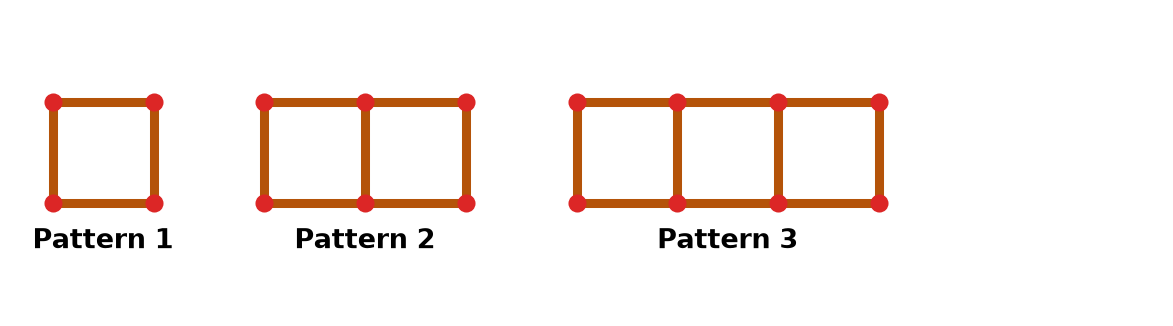
Here are the first three patterns in a sequence. Each pattern is made from matchsticks. (a) How many matchsticks are needed for Pattern 5? [1 mark] (b) Find an expression, in terms of \(n\), for the number of matchsticks in Pattern \(n\). [2 marks] (c) Is there a pattern that uses exactly 100 matchsticks? You must show how you decide. [2 marks]
Show answerHide answer
Model answer
(a) The numbers are 4, 7, 10, 13, 16, so Pattern 5 uses 16. (b) The nth term is \(3n + 1\). (c) \(3n + 1 = 100\) gives \(3n = 99\), so \(n = 33\). Yes, Pattern 33 uses exactly 100 matchsticks.
Mark scheme
- (a) 16 — B1
- (b) \(3n\) seen — M1
- (b) \(3n + 1\) — A1
- (c) \(3n + 1 = 100\) or \(n = 33\) — M1
- (c) Yes, Pattern 33 — Q1
-
6 Find [3 marks]
The first five terms of a quadratic sequence are \(2, 9, 20, 35, 54\). Find an expression for the nth term.
Show answerHide answer
Model answer
First differences: 7, 11, 15, 19. Second differences: 4, 4, 4. So the nth term starts \(2n^2\), which is 2, 8, 18, 32, 50. Subtracting from the terms leaves 0, 1, 2, 3, 4, which is \(n - 1\). The nth term is \(2n^2 + n - 1\).
Mark scheme
- Second difference 4 found, or \(2n^2\) seen — M1
- Subtracts \(2n^2\) to leave 0, 1, 2, 3, 4 or \(n - 1\) — M1
- \(2n^2 + n - 1\) — A1
-
7 Work out [2 marks]
The first two terms of a Fibonacci-type sequence are 3 and 5. Work out the 6th term.
Show answerHide answer
Model answer
Each term is the sum of the two before it: \(3, 5, 8, 13, 21, 34\). The 6th term is 34.
Mark scheme
- A correct continuation, such as 8 and 13 — M1
- 34 — A1
Quick check
-
1
The nth term of a sequence is \(3n + 2\). What is the first term that is greater than 100?
Show answerHide answer
C: 101
\(3n + 2 > 100\) gives \(n > 32.67\ldots\), so \(n = 33\) and the term is \(3 \times 33 + 2 = 101\).
-
2
What is the common ratio of the geometric sequence 5, 10, 20, 40, ...?
Show answerHide answer
B: 2
Each term is the previous term multiplied by 2.
-
3
What is the next term in the sequence 2, 5, 8, 11, ...?
Show answerHide answer
D: 14
The sequence goes up by 3 each time, so the next term is \(11 + 3 = 14\).
-
4
What is the nth term of the sequence 4, 7, 10, 13, ...?
Show answerHide answer
C: \(3n + 1\)
The difference is 3, so it begins \(3n\). The sequence is 1 more than \(3n\), so the nth term is \(3n + 1\).
-
5
Which sequence has nth term \(2n - 3\)?
Show answerHide answer
A: \(-1, 1, 3, 5\)
Substituting \(n = 1, 2, 3, 4\) gives \(-1, 1, 3, 5\).
-
6
What is the nth term of the sequence 20, 17, 14, 11, ...?
Show answerHide answer
A: \(-3n + 23\)
The sequence goes down by 3, so it begins \(-3n\). Adding 23 gives 20 when \(n = 1\).
-
7
Which of these numbers is a term in the sequence with nth term \(4n + 1\)?
Show answerHide answer
B: 61
\(4n + 1 = 61\) gives \(n = 15\). The other numbers do not give a whole number for \(n\).
-
8
Which of these is a geometric sequence?
Show answerHide answer
B: \(3, 6, 12, 24\)
Each term is multiplied by 2: \(3 \times 2 = 6\), \(6 \times 2 = 12\), \(12 \times 2 = 24\).
-
9
The first four terms of a Fibonacci-type sequence are 1, 3, 4, 7. What is the 5th term?
Show answerHide answer
A: 11
Each term is the sum of the two before it, so the 5th term is \(4 + 7 = 11\).
-
10
A sequence has a constant second difference of 2. Its nth term begins with which term?
Show answerHide answer
B: \(n^2\)
The coefficient of \(n^2\) is half the second difference, so it is \(1\), giving \(n^2\).