Exam questions · Maths · Circle Theorems
The Alternate Segment Theorem
- 6 exam questions
- 21 marks
- 9 quick checks
-
1 Work out [2 marks]
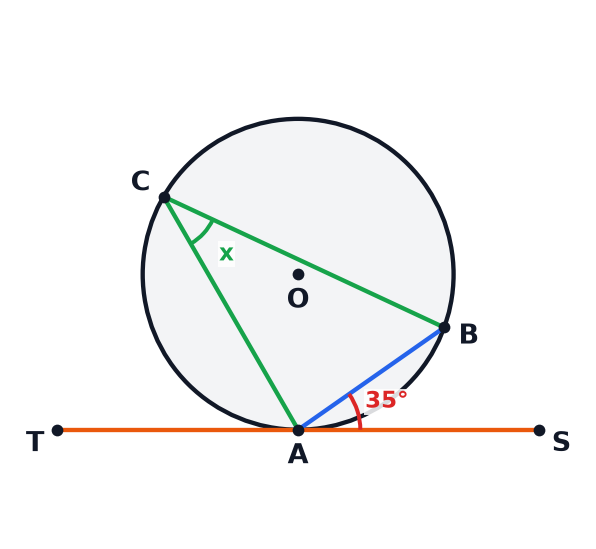
Not drawn accurately. \(TAS\) is a tangent to the circle at \(A\). \(B\) and \(C\) are points on the circumference. Angle \(SAB = 35^\circ\). Work out the size of angle \(ACB\). Give a reason for your answer. [2 marks]
Show answerHide answer
Model answer
Angle \(ACB = 35^\circ\), because the angle between a tangent and a chord equals the angle in the alternate segment.
Mark scheme
- \(35\) — B1
- The angle between a tangent and a chord equals the angle in the alternate segment — Q1
-
2 Work out [4 marks]
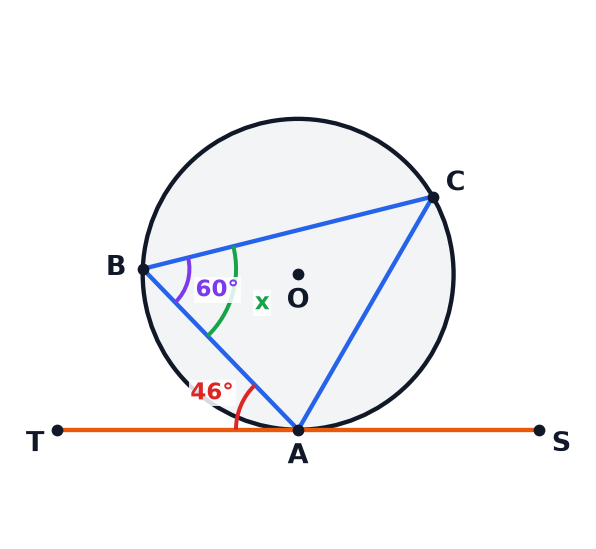
Not drawn accurately. \(TAS\) is a tangent to the circle at \(A\). \(B\) and \(C\) are points on the circumference. Angle \(TAB = 46^\circ\) and angle \(ABC = 60^\circ\). Work out the size of angle \(BAC\). Give reasons for your answer. [4 marks]
Show answerHide answer
Model answer
Angle \(ACB = 46^\circ\), because the angle between a tangent and a chord equals the angle in the alternate segment. Then \(BAC = 180 - 46 - 60 = 74^\circ\).
Mark scheme
- \(ACB = 46\) — B1
- \(180 - 46 - 60\) — M1
- \(74\) — A1
- Alternate segment theorem, and the angles in a triangle add up to 180 degrees — Q1
-
3 Work out [3 marks]
\(TA\) is a tangent to a circle at \(A\). \(B\) and \(C\) are points on the circumference, with \(C\) in the alternate segment. Angle \(TAB = 2x + 18\) and angle \(ACB = 4x - 12\). Work out the value of \(x\). [3 marks]
Show answerHide answer
Model answer
By the alternate segment theorem, \(2x + 18 = 4x - 12\). Then \(30 = 2x\), so \(x = 15\).
Mark scheme
- \(2x + 18 = 4x - 12\) — M1
- \(2x = 30\) — M1
- \(15\) — A1
-
4 Work out [4 marks]
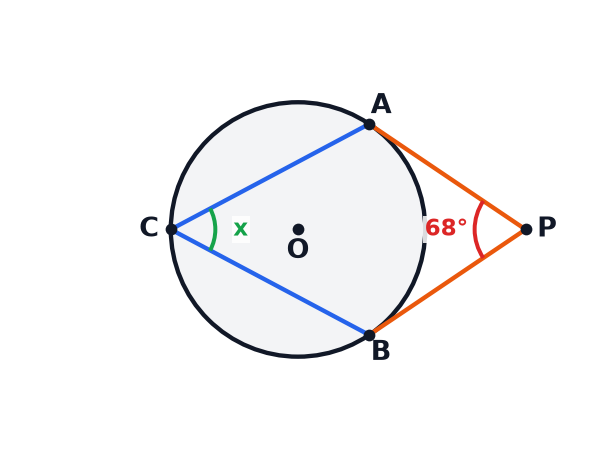
Not drawn accurately. \(PA\) and \(PB\) are tangents to a circle, centre \(O\). \(C\) is a point on the circumference. Angle \(APB = 68^\circ\). Work out the size of angle \(ACB\). Give reasons for your answer. [4 marks]
Show answerHide answer
Model answer
\(PA = PB\), so triangle \(PAB\) is isosceles and \(PAB = (180 - 68) \div 2 = 56^\circ\). By the alternate segment theorem, \(ACB = PAB = 56^\circ\).
Mark scheme
- \((180 - 68) \div 2\) — M1
- \(PAB = 56\) — A1
- \(ACB = 56\) — B1
- Alternate segment theorem stated — Q1
-
5 Work out [4 marks]
\(AD\) is a diameter of a circle. \(TA\) is a tangent at \(A\). \(B\) is a point on the circumference. Angle \(TAB = 33^\circ\). (a) Work out the size of angle \(ADB\). Give a reason for your answer. [2 marks] (b) Work out the size of angle \(DAB\). [2 marks]
Show answerHide answer
Model answer
(a) \(ADB = 33^\circ\), by the alternate segment theorem. (b) \(TAD = 90^\circ\), because a tangent is perpendicular to the radius, so \(DAB = 90 - 33 = 57^\circ\).
Mark scheme
- (a) \(33\) — B1
- (a) Alternate segment theorem stated — Q1
- (b) \(90 - 33\), using angle \(TAD = 90^\circ\) — M1
- (b) \(57\) — A1
-
6 Prove [4 marks]
\(TA\) is a tangent at \(A\) to a circle, centre \(O\). \(B\) and \(C\) are points on the circumference, with \(C\) in the alternate segment. Use the circle theorems for the centre and for tangents to prove that angle \(TAB\) equals angle \(ACB\). [4 marks]
Show answerHide answer
Model answer
\(OA\) is perpendicular to \(TA\), so \(OAB = 90^\circ - TAB\). \(OA = OB\), so \(OBA = OAB\) and \(AOB = 180 - 2(90 - TAB) = 2 \times TAB\). The angle at the centre is twice the angle at the circumference, so \(ACB = \dfrac{1}{2}AOB = TAB\).
Mark scheme
- \(OAB = 90^\circ - TAB\), because the tangent is perpendicular to the radius — B1
- Triangle \(OAB\) is isosceles, so \(OBA = OAB\) — B1
- \(AOB = 180 - 2(90 - TAB) = 2 \times TAB\) — M1
- \(ACB = \dfrac{1}{2}AOB = TAB\), as the angle at the centre is twice the angle at the circumference — Q1
Quick check
-
1
What does the alternate segment theorem say?
Show answerHide answer
A: The angle between a tangent and a chord equals the angle in the alternate segment
This is the alternate segment theorem.
-
2
Where must the chord start for the alternate segment theorem to apply?
Show answerHide answer
D: At the point of contact of the tangent
The chord starts at the point where the tangent touches the circle.
-
3
The angle between a tangent and a chord is \(58^\circ\). What is the angle in the alternate segment?
Show answerHide answer
C: \(58^\circ\)
They are equal.
-
4
What does “alternate” mean in the alternate segment theorem?
Show answerHide answer
B: On the other side of the chord
The alternate segment is the one on the opposite side of the chord from the angle.
-
5
\(TA\) is a tangent at \(A\). Angle \(TAB = 40^\circ\) and angle \(ABC = 75^\circ\), where \(C\) is in the alternate segment. What is angle \(BAC\)?
Show answerHide answer
A: \(65^\circ\)
\(ACB = 40^\circ\) by the alternate segment theorem, so \(BAC = 180 - 75 - 40 = 65^\circ\).
-
6
\(PA\) and \(PB\) are tangents and \(\angle APB = 64^\circ\). \(C\) is on the major arc. What is angle \(ACB\)?
Show answerHide answer
D: \(58^\circ\)
\(PAB = (180 - 64) \div 2 = 58^\circ\), and this equals the angle in the alternate segment.
-
7
The angle between the tangent and the chord is \(2x + 4\) and the angle in the alternate segment is \(3x - 10\). What is \(x\)?
Show answerHide answer
C: \(14\)
\(2x + 4 = 3x - 10\), so \(x = 14\).
-
8
\(AD\) is a diameter, \(TA\) is a tangent at \(A\) and \(B\) is on the circle. Angle \(TAB = 36^\circ\). What is angle \(DAB\)?
Show answerHide answer
B: \(54^\circ\)
\(TAD = 90^\circ\) because a tangent is perpendicular to the radius, so \(DAB = 90 - 36 = 54^\circ\).
-
9
A tangent at \(A\) makes an angle of \(x\) with the chord \(AB\). What is the angle \(AOB\) at the centre, on the same side as that angle?
Show answerHide answer
A: \(2x\)
The angle in the alternate segment is \(x\), and the angle at the centre is twice that.