Exam questions · Maths · Circle Theorems
Circle Theorem Proofs and Problems
- 6 exam questions
- 23 marks
- 9 quick checks
-
1 Prove [4 marks]
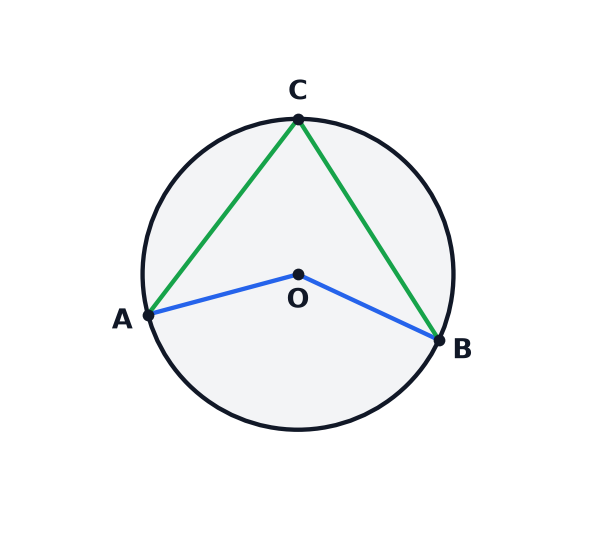
Not drawn accurately. \(A\), \(B\) and \(C\) are points on the circumference of a circle, centre \(O\). Prove that angle \(AOB\) is twice angle \(ACB\). You may add lines to the diagram. [4 marks]
Show answerHide answer
Model answer
Draw the line \(CO\) and extend it to meet the circle at \(D\). \(OA = OC = OB\), because they are radii. Triangles \(OAC\) and \(OBC\) are isosceles, so \(OAC = OCA\) and \(OBC = OCB\). The exterior angle \(AOD = 2 \times OCA\) and \(BOD = 2 \times OCB\). So \(AOB = 2(OCA + OCB) = 2 \times ACB\).
Mark scheme
- Draws CO extended to D and states OA = OB = OC as radii — B1
- Isosceles triangles, so OCA = OAC and OCB = OBC — M1
- Exterior angles: AOD = 2 x OCA and BOD = 2 x OCB — M1
- Concludes AOB = 2 x ACB — Q1
-
2 Work out [4 marks]
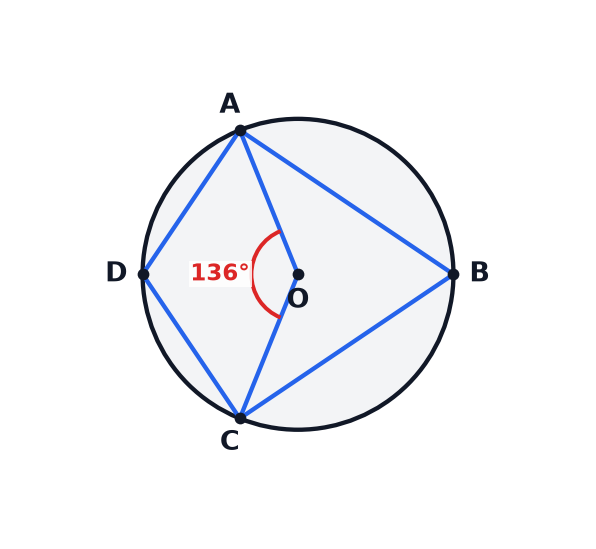
Not drawn accurately. \(A\), \(B\), \(C\) and \(D\) are points on the circumference of a circle, centre \(O\). Angle \(AOC = 136^\circ\). (a) Work out the size of angle \(ABC\). Give a reason for your answer. [2 marks] (b) Work out the size of angle \(ADC\). Give a reason for your answer. [2 marks]
Show answerHide answer
Model answer
(a) \(ABC = 136 \div 2 = 68^\circ\), because the angle at the centre is twice the angle at the circumference. (b) \(ADC = 180 - 68 = 112^\circ\), because opposite angles of a cyclic quadrilateral add up to \(180^\circ\).
Mark scheme
- (a) \(68\) — B1
- (a) The angle at the centre is twice the angle at the circumference — Q1
- (b) \(112\) — B1
- (b) Opposite angles of a cyclic quadrilateral add up to 180 degrees — Q1
-
3 Work out [4 marks]
The point \(P(-3, 4)\) is on the circle \(x^2 + y^2 = 25\). Work out an equation of the tangent to the circle at \(P\). [4 marks]
Show answerHide answer
Model answer
The radius \(OP\) has gradient \(\dfrac{4}{-3} = -\dfrac{4}{3}\), so the tangent has gradient \(\dfrac{3}{4}\). Then \(y - 4 = \dfrac{3}{4}(x + 3)\), which gives \(y = \dfrac{3}{4}x + \dfrac{25}{4}\).
Mark scheme
- Gradient of \(OP = -\dfrac{4}{3}\) — B1
- Gradient of the tangent \(= \dfrac{3}{4}\) — B1
- \(y - 4 = \dfrac{3}{4}(x + 3)\) or equivalent — M1
- \(y = \dfrac{3}{4}x + \dfrac{25}{4}\) or \(3x - 4y = -25\) — A1
-
4 Show that [3 marks]
Show that the line \(3x + 4y = 25\) is a tangent to the circle \(x^2 + y^2 = 25\) at the point \((3, 4)\). [3 marks]
Show answerHide answer
Model answer
\(3^2 + 4^2 = 25\), and \(3 \times 3 + 4 \times 4 = 25\), so \((3, 4)\) is on both. The line is \(y = -\dfrac{3}{4}x + \dfrac{25}{4}\), with gradient \(-\dfrac{3}{4}\). The radius to \((3, 4)\) has gradient \(\dfrac{4}{3}\), and \(\dfrac{4}{3} \times -\dfrac{3}{4} = -1\), so the line is perpendicular to the radius, and is a tangent.
Mark scheme
- Checks that \((3, 4)\) is on both the circle and the line — B1
- Gradient of line \(= -\dfrac{3}{4}\) and gradient of radius \(= \dfrac{4}{3}\) — B1
- Product of the gradients is -1, so the line is perpendicular to the radius, with a conclusion — Q1
-
5 Work out [5 marks]
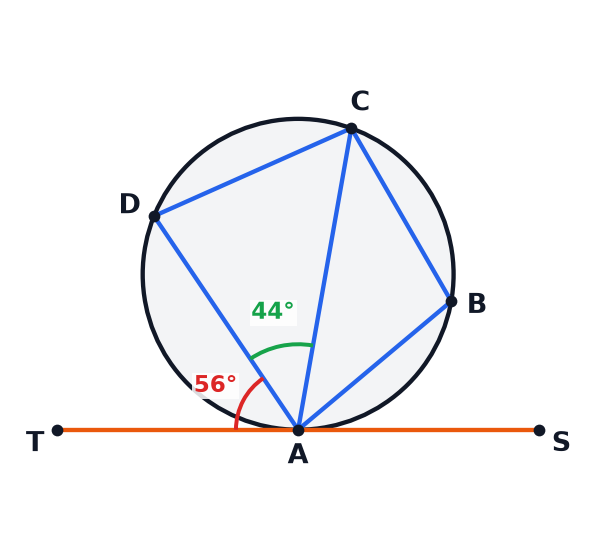
Not drawn accurately. \(TAS\) is a tangent to the circle at \(A\). \(A\), \(B\), \(C\) and \(D\) are points on the circumference. Angle \(TAD = 56^\circ\) and angle \(CAD = 44^\circ\). (a) Write down the size of angle \(ACD\). Give a reason for your answer. [2 marks] (b) Work out the size of angle \(ADC\). [2 marks] (c) Work out the size of angle \(ABC\). Give a reason for your answer. [1 mark]
Show answerHide answer
Model answer
(a) \(ACD = 56^\circ\), by the alternate segment theorem. (b) \(ADC = 180 - 56 - 44 = 80^\circ\). (c) \(ABC = 180 - 80 = 100^\circ\), because opposite angles of a cyclic quadrilateral add up to \(180^\circ\).
Mark scheme
- (a) \(56\) — B1
- (a) Alternate segment theorem stated — Q1
- (b) \(180 - 56 - 44\) — M1
- (b) \(80\) — A1
- (c) \(100\) with the cyclic quadrilateral reason — A1
-
6 Prove [3 marks]
\(A\), \(B\), \(C\) and \(D\) are points on the circumference of a circle, centre \(O\). \(C\) and \(D\) are on the same side of the chord \(AB\). Prove that angle \(ACB\) equals angle \(ADB\). [3 marks]
Show answerHide answer
Model answer
The angle at the centre, \(AOB\), is twice the angle at the circumference. So \(ACB = \dfrac{1}{2}AOB\) and \(ADB = \dfrac{1}{2}AOB\). Therefore \(ACB = ADB\).
Mark scheme
- States that the angle at the centre AOB is twice the angle at the circumference — B1
- \(ACB = \dfrac{1}{2}AOB\) and \(ADB = \dfrac{1}{2}AOB\) — M1
- Concludes that ACB = ADB — Q1
Quick check
-
1
Why is a triangle made by two radii and a chord isosceles?
Show answerHide answer
B: Two of its sides are radii, so they are equal
Two radii are always equal.
-
2
In a proof, what should be written next to every step?
Show answerHide answer
A: A reason
Each step needs a reason.
-
3
What does the exterior angle of a triangle equal?
Show answerHide answer
D: The sum of the two opposite interior angles
This is the exterior angle theorem.
-
4
The radius to a point on a circle has gradient \(\dfrac{2}{3}\). What is the gradient of the tangent at that point?
Show answerHide answer
C: \(-\dfrac{3}{2}\)
A tangent is perpendicular to the radius, so its gradient is the negative reciprocal.
-
5
What is the gradient of the radius from the origin to \((3, 4)\)?
Show answerHide answer
B: \(\dfrac{4}{3}\)
\(\dfrac{4 - 0}{3 - 0} = \dfrac{4}{3}\).
-
6
What is the gradient of the tangent to \(x^2 + y^2 = 25\) at \((3, 4)\)?
Show answerHide answer
A: \(-\dfrac{3}{4}\)
The radius has gradient \(\dfrac{4}{3}\), so the tangent has gradient \(-\dfrac{3}{4}\).
-
7
\(AOC\) is \(150^\circ\) at the centre, and \(D\) is on the minor arc \(AC\). What is angle \(ADC\)?
Show answerHide answer
D: \(105^\circ\)
\(B\) on the major arc gives \(ABC = 75^\circ\), and \(ADC = 180 - 75 = 105^\circ\).
-
8
Which line is the tangent to \(x^2 + y^2 = 25\) at \((3, 4)\)?
Show answerHide answer
C: \(3x + 4y = 25\)
Gradient \(-\dfrac{3}{4}\) through \((3, 4)\) gives \(y - 4 = -\dfrac{3}{4}(x - 3)\), which rearranges to \(3x + 4y = 25\).
-
9
Why must a proof not rely on measuring angles in a diagram?
Show answerHide answer
B: The proof must work for every case, not just the one drawn
A proof uses letters and reasons so that it works for any angle.