Exam questions · Maths · Circle Theorems
Tangents and Chords
- 6 exam questions
- 20 marks
- 9 quick checks
-
1 Work out [3 marks]
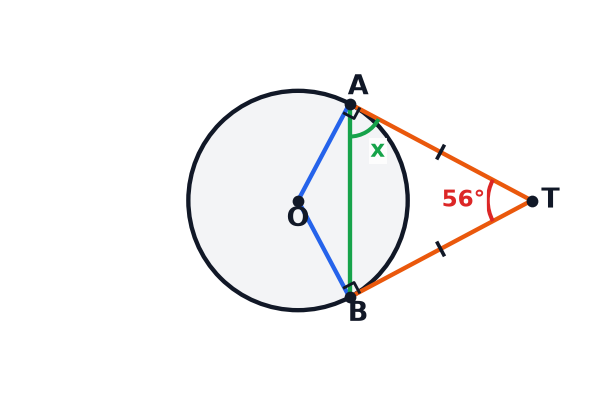
Not drawn accurately. \(TA\) and \(TB\) are tangents to a circle, centre \(O\). Angle \(ATB = 56^\circ\). Work out the size of angle \(TAB\). Give a reason for your answer. [3 marks]
Show answerHide answer
Model answer
\(TA = TB\), because tangents from a point to a circle are equal, so triangle \(TAB\) is isosceles. Angle \(TAB = (180 - 56) \div 2 = 62^\circ\).
Mark scheme
- Tangents from a point are equal, so triangle TAB is isosceles — Q1
- \((180 - 56) \div 2\) — M1
- \(62\) — A1
-
2 Work out [3 marks]
\(PT\) is a tangent to a circle, centre \(O\), touching the circle at \(T\). The radius of the circle is 9 cm and \(OP = 15\) cm. Work out the length of \(PT\). [3 marks]
Show answerHide answer
Model answer
The tangent is perpendicular to the radius, so angle \(OTP = 90^\circ\). \(PT^2 = 15^2 - 9^2 = 225 - 81 = 144\), so \(PT = 12\) cm.
Mark scheme
- Angle OTP is a right angle, as a tangent is perpendicular to the radius — Q1
- \(15^2 - 9^2\) or \(225 - 81\) — M1
- \(12\) — A1
-
3 Work out [3 marks]
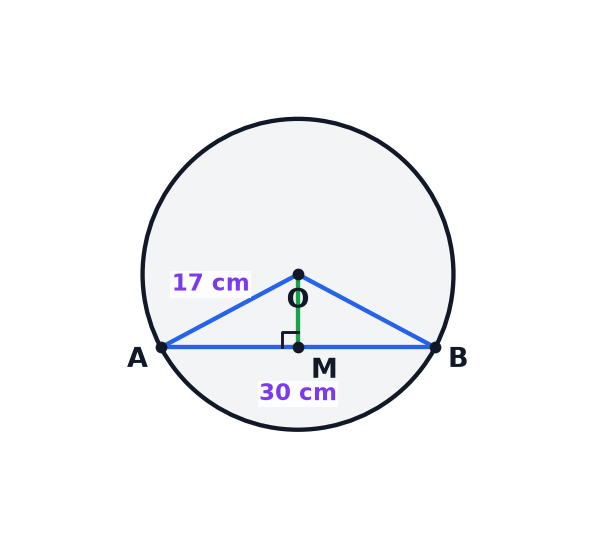
Not drawn accurately. \(AB\) is a chord of a circle, centre \(O\), with radius 17 cm. \(AB = 30\) cm. \(M\) is the point on \(AB\) where \(OM\) is perpendicular to \(AB\). Work out the length of \(OM\). [3 marks]
Show answerHide answer
Model answer
The perpendicular from the centre bisects the chord, so \(AM = 15\) cm. \(OM^2 = 17^2 - 15^2 = 289 - 225 = 64\), so \(OM = 8\) cm.
Mark scheme
- \(AM = 15\) — M1
- \(17^2 - 15^2\) — M1
- \(8\) — A1
-
4 Work out [4 marks]
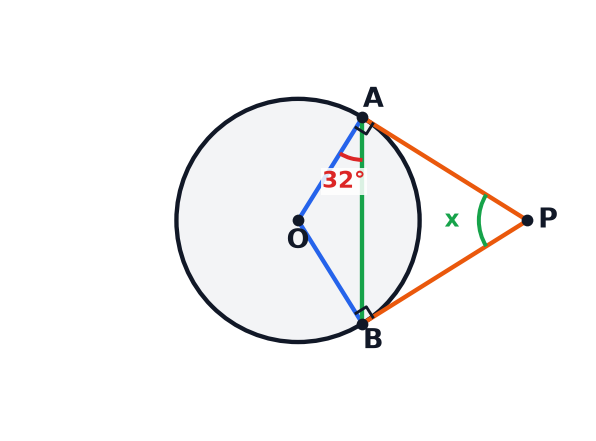
Not drawn accurately. \(PA\) and \(PB\) are tangents to a circle, centre \(O\). Angle \(OAB = 32^\circ\). Work out the size of angle \(APB\). Give reasons for your answer. [4 marks]
Show answerHide answer
Model answer
Angle \(OAP = 90^\circ\), because a tangent is perpendicular to the radius, so \(PAB = 90 - 32 = 58^\circ\). \(PA = PB\), so \(PBA = 58^\circ\) and \(APB = 180 - 58 - 58 = 64^\circ\).
Mark scheme
- Angle \(PAB = 90 - 32 = 58\) — M1
- \(180 - 58 - 58\) — M1
- \(64\) — A1
- Tangent perpendicular to the radius, and tangents from a point are equal — Q1
-
5 Work out [3 marks]
A circle has centre \(O\) and radius 5 cm. A chord is 3 cm from \(O\). Work out the length of the chord. [3 marks]
Show answerHide answer
Model answer
Half the chord is \(\sqrt{5^2 - 3^2} = \sqrt{16} = 4\) cm, so the chord is 8 cm.
Mark scheme
- \(5^2 - 3^2\) or \(25 - 9\) — M1
- \(4\) found as half the chord — M1
- \(8\) — A1
-
6 Prove [4 marks]
\(PA\) and \(PB\) are tangents to a circle, centre \(O\), touching the circle at \(A\) and \(B\). Prove that \(PA = PB\) using Pythagoras' theorem. [4 marks]
Show answerHide answer
Model answer
\(OA\) and \(OB\) are radii, and the tangents are perpendicular to them, so \(OAP\) and \(OBP\) are right-angled triangles. \(PA^2 = OP^2 - OA^2\) and \(PB^2 = OP^2 - OB^2\). Since \(OA = OB\) (radii), \(PA^2 = PB^2\), so \(PA = PB\).
Mark scheme
- Angles \(OAP\) and \(OBP\) are \(90^\circ\), because a tangent is perpendicular to the radius — B1
- \(PA^2 = OP^2 - OA^2\) — M1
- \(PB^2 = OP^2 - OB^2\) — M1
- OA = OB as radii, so PA = PB — Q1
Quick check
-
1
What is the angle between a tangent and the radius at the point of contact?
Show answerHide answer
D: \(90^\circ\)
A tangent is perpendicular to the radius.
-
2
Two tangents from the point \(P\) touch a circle at \(A\) and \(B\). \(PA = 9\) cm. What is \(PB\)?
Show answerHide answer
C: 9 cm
Tangents from the same point are equal in length.
-
3
A perpendicular from the centre of a circle meets a chord. What does it do to the chord?
Show answerHide answer
B: It bisects the chord
The perpendicular from the centre bisects the chord.
-
4
\(PT\) is a tangent, \(O\) is the centre, the radius is 3 cm and \(OP = 5\) cm. How long is \(PT\)?
Show answerHide answer
A: 4 cm
\(OTP\) is right-angled at \(T\), so \(PT^2 = 5^2 - 3^2 = 16\).
-
5
Tangents \(PA\) and \(PB\) touch a circle with centre \(O\). Angle \(AOB = 100^\circ\). What is angle \(APB\)?
Show answerHide answer
D: \(80^\circ\)
\(OAPB\) is a quadrilateral with two right angles, so \(APB = 360 - 90 - 90 - 100 = 80^\circ\).
-
6
A circle has radius 5 cm and a chord is 8 cm long. How far is the chord from the centre?
Show answerHide answer
C: 3 cm
Half the chord is 4 cm, so the distance is \(\sqrt{5^2 - 4^2} = 3\).
-
7
Tangents \(PA\) and \(PB\) touch a circle at \(A\) and \(B\). Angle \(APB = 50^\circ\). What is angle \(PAB\)?
Show answerHide answer
B: \(65^\circ\)
\(PA = PB\), so triangle \(PAB\) is isosceles and \(PAB = (180 - 50) \div 2 = 65^\circ\).
-
8
The distance from the centre of a circle of radius 13 cm to a chord is 5 cm. How long is the chord?
Show answerHide answer
A: 24 cm
Half the chord is \(\sqrt{13^2 - 5^2} = 12\), so the chord is 24 cm.
-
9
A line from the centre to a point \(P\) outside a circle of radius \(r\) has length \(d\). Which expression gives the tangent length from \(P\)?
Show answerHide answer
D: \(\sqrt{d^2 - r^2}\)
The radius and tangent make a right angle, with \(d\) as the hypotenuse.