Exam questions · Maths · Further Algebra
Inequalities and Regions
- 6 exam questions
- 17 marks
- 9 quick checks
-
1 Write down [2 marks]
Write down all the integers that satisfy \(2 < x \leq 6\).
Show answerHide answer
Model answer
The integers are 3, 4, 5, 6.
Mark scheme
- At least three correct and no more than one wrong — M1
- 3, 4, 5, 6 — A1
-
2 Write down [5 marks]
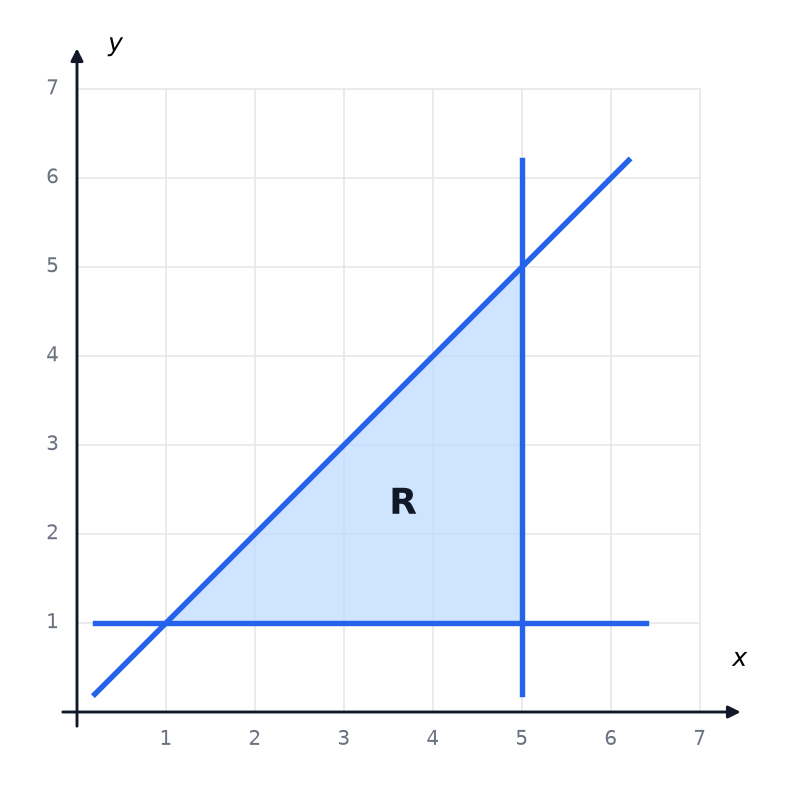
The diagram shows a shaded region \(R\). (a) Write down the three inequalities that define \(R\). [3 marks] (b) How many points with integer coordinates are inside \(R\) or on its boundary? [2 marks]
Show answerHide answer
Model answer
(a) \(y \geq 1\), \(y \leq x\) and \(x \leq 5\). (b) For \(x = 1, 2, 3, 4, 5\) there are \(1, 2, 3, 4, 5\) points, so the total is 15.
Mark scheme
- (a) \(y \geq 1\) — B1
- (a) \(y \leq x\) — B1
- (a) \(x \leq 5\) — B1
- (b) Counts by columns, such as 1, 2, 3, 4, 5 — M1
- (b) 15 — A1
-
3 Solve [2 marks]
Solve \(5x - 3 \leq 17\).
Show answerHide answer
Model answer
\(5x \leq 20\), so \(x \leq 4\).
Mark scheme
- \(5x \leq 20\) — M1
- \(x \leq 4\) — A1
-
4 Decide [2 marks]
Here are two points: \((1, 3)\) and \((2, 6)\). For each point, say whether it satisfies the inequality \(y \leq 2x + 1\). You must show your working.
Show answerHide answer
Model answer
For \((1, 3)\): \(2 \times 1 + 1 = 3\) and \(3 \leq 3\), so it does. For \((2, 6)\): \(2 \times 2 + 1 = 5\) and \(6 \leq 5\) is false, so it does not.
Mark scheme
- \((1, 3)\) satisfies it, with \(2 \times 1 + 1 = 3\) — B1
- \((2, 6)\) does not satisfy it, with \(2 \times 2 + 1 = 5\) — B1
-
5 Solve [3 marks]
Solve \(x^2 + x - 12 > 0\).
Show answerHide answer
Model answer
\(x^2 + x - 12 = (x + 4)(x - 3)\), with roots \(-4\) and 3. The curve is above the \(x\)-axis outside the roots, so \(x < -4\) or \(x > 3\).
Mark scheme
- \((x + 4)(x - 3)\) or the roots \(-4\) and 3 — M1
- A sketch or a clear statement of which regions are above the axis — M1
- \(x < -4\) or \(x > 3\) — A1
-
6 Solve [3 marks]
(a) Solve \(x^2 < 25\). [1 mark] (b) Solve \(x^2 - 3x - 10 \leq 0\). [2 marks]
Show answerHide answer
Model answer
(a) \(-5 < x < 5\). (b) \((x - 5)(x + 2) \leq 0\), so \(-2 \leq x \leq 5\).
Mark scheme
- (a) \(-5 < x < 5\) — B1
- (b) Roots \(-2\) and 5 — M1
- (b) \(-2 \leq x \leq 5\) — A1
Quick check
-
1
What does a dashed boundary line mean on a graph of an inequality?
Show answerHide answer
D: The line itself is not included
A dashed line goes with \(<\) or \(>\).
-
2
Which inequality describes the region to the right of the line \(x = 1\), including the line?
Show answerHide answer
C: \(x \geq 1\)
To the right means larger \(x\), and the line is included.
-
3
Which inequality describes the region on or below the line \(y = 2x\)?
Show answerHide answer
B: \(y \leq 2x\)
Below the line means smaller \(y\), and the line is included.
-
4
Which integers satisfy \(-2 < x \leq 3\)?
Show answerHide answer
A: \(-1, 0, 1, 2, 3\)
\(-2\) is not included but 3 is.
-
5
The origin is tested in \(x + y \leq 6\). What does this show?
Show answerHide answer
D: The origin is in the region, so shade that side
\(0 + 0 \leq 6\) is true.
-
6
How many points with whole-number coordinates satisfy \(x \geq 1\), \(y \geq 1\) and \(x + y \leq 6\)?
Show answerHide answer
C: \(15\)
The columns \(x = 1, 2, 3, 4, 5\) have \(5, 4, 3, 2, 1\) points.
-
7
Which kind of boundary line goes with the inequality \(y > 3\)?
Show answerHide answer
B: A dashed line
Strict inequalities do not include the boundary.
-
8
Solve \(x^2 - x - 6 < 0\).
Show answerHide answer
A: \(-2 < x < 3\)
The roots are \(-2\) and 3, and the curve is below the axis between them.
-
9
Solve \(x^2 > 9\).
Show answerHide answer
D: \(x < -3\) or \(x > 3\)
The curve is above the axis outside the roots \(-3\) and 3.