Exam questions · Maths · Transformations and Similarity
Combined Transformations
- 6 exam questions
- 19 marks
- 9 quick checks
-
1 Describe [4 marks]
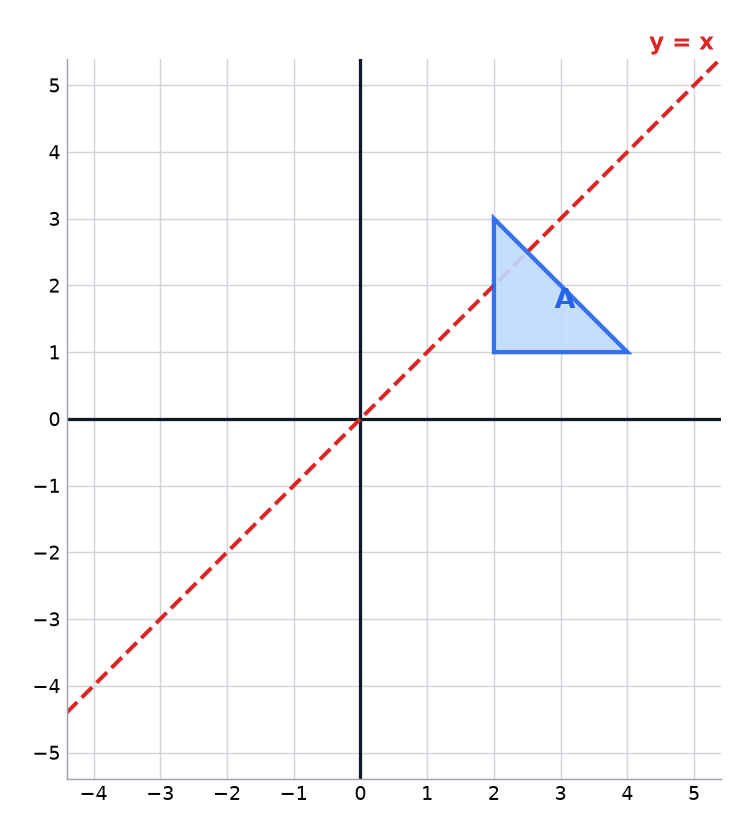
Triangle \(A\) is reflected in the line \(y = x\) to give triangle \(B\). Triangle \(B\) is reflected in the \(x\)-axis to give triangle \(C\). (a) Draw triangles \(B\) and \(C\). [2 marks] (b) Describe fully the single transformation that maps \(A\) onto \(C\). [2 marks]
Show answerHide answer
Model answer
(a) \(B\) has vertices \((1, 2)\), \((1, 4)\) and \((3, 2)\), and \(C\) has vertices \((1, -2)\), \((1, -4)\) and \((3, -2)\). (b) \((x, y)\) goes to \((y, x)\) and then to \((y, -x)\), which is a rotation of \(90^\circ\) clockwise about the origin.
Mark scheme
- (a) \(B\) correct — B1
- (a) \(C\) correct — B1
- (b) Rotation, \(90^\circ\) clockwise — B1
- (b) About the origin — B1
-
2 Describe [3 marks]
The point \((1, 4)\) is reflected in the line \(y = 2\), and the image is then reflected in the line \(y = 6\). Describe the single transformation that has the same effect. [3 marks]
Show answerHide answer
Model answer
The first reflection gives \((1, 0)\) and the second gives \((1, 12)\). The point has moved 8 up, which is twice the distance between the lines. It is a translation by \(\begin{pmatrix} 0 \\ 8 \end{pmatrix}\).
Mark scheme
- \((1, 0)\) seen — M1
- \((1, 12)\) seen — M1
- Translation by \(\begin{pmatrix} 0 \\ 8 \end{pmatrix}\) — A1
-
3 Write down [2 marks]
(a) A shape is rotated through \(180^\circ\) about the origin. Write down the coordinates of the point that does not move. [1 mark] (b) A shape is translated. How many points stay in the same place? [1 mark]
Show answerHide answer
Model answer
(a) The centre of rotation, \((0, 0)\). (b) None, because every point moves by the same vector.
Mark scheme
- (a) \((0, 0)\) — B1
- (b) None — B1
-
4 Work out [3 marks]
The point \((2, 1)\) is translated by the vector \(\begin{pmatrix} 1 \\ 2 \end{pmatrix}\) and the image is then rotated through \(180^\circ\) about the origin. Write down the coordinates of the final image. [3 marks]
Show answerHide answer
Model answer
The translation gives \((3, 3)\), and the rotation changes the sign of both coordinates, giving \((-3, -3)\).
Mark scheme
- \((3, 3)\) — B1
- Changes the sign of both coordinates of their image — M1
- \((-3, -3)\) — A1
-
5 Describe [4 marks]
The point \((3, 1)\) is reflected in the \(x\)-axis, and the image is then reflected in the line \(y = x\). (a) Write down the coordinates of the final image. [2 marks] (b) Describe the single transformation that maps \((3, 1)\) onto the final image, and explain how you know it is a rotation. [2 marks]
Show answerHide answer
Model answer
(a) The first reflection gives \((3, -1)\), and the second swaps the coordinates, giving \((-1, 3)\). (b) \((x, y)\) goes to \((-y, x)\), which is a rotation of \(90^\circ\) anticlockwise about the origin.
Mark scheme
- (a) \((3, -1)\) — B1
- (a) \((-1, 3)\) — B1
- (b) Rotation, \(90^\circ\) anticlockwise — B1
- (b) About the origin — B1
-
6 Work out [3 marks]
A shape is rotated through \(90^\circ\) clockwise about the origin and then through \(90^\circ\) clockwise about the origin again. Describe the single transformation that has the same effect, and use the point \((2, 3)\) to check. [3 marks]
Show answerHide answer
Model answer
The first rotation sends \((2, 3)\) to \((3, -2)\) and the second sends it to \((-2, -3)\). This is the same as a rotation of \(180^\circ\) about the origin.
Mark scheme
- \((3, -2)\) seen — M1
- \((-2, -3)\) seen — M1
- Rotation of \(180^\circ\) about the origin — A1
Quick check
-
1
What single transformation is a reflection in the \(x\)-axis followed by a reflection in the \(y\)-axis?
Show answerHide answer
A: A rotation of \(180^\circ\) about the origin
\((x, y)\) goes to \((x, -y)\) and then to \((-x, -y)\), which is a half turn.
-
2
What do two reflections in parallel lines give?
Show answerHide answer
D: A translation
The shape is moved in a straight line, at right angles to the mirror lines.
-
3
The point \((1, 1)\) is reflected in \(x = 2\) and then in \(x = 5\). Which translation has the same effect?
Show answerHide answer
C: \(\begin{pmatrix} 6 \\ 0 \end{pmatrix}\)
The lines are 3 apart, and the translation is twice that distance, 6, at right angles to them.
-
4
Which points are invariant in a reflection?
Show answerHide answer
B: The points on the mirror line
Points on the mirror line do not move.
-
5
Which point is invariant in a rotation?
Show answerHide answer
A: The centre of rotation
The centre stays fixed while everything else turns around it.
-
6
The point \((2, 1)\) is reflected in the line \(y = x\) and then in the \(x\)-axis. What is the final image?
Show answerHide answer
D: \((1, -2)\)
Swapping gives \((1, 2)\), and changing the sign of \(y\) gives \((1, -2)\).
-
7
Two mirror lines cross at a point, with an angle of \(30^\circ\) between them. What single transformation is a reflection in one followed by the other?
Show answerHide answer
C: A rotation of \(60^\circ\) about the crossing point
The rotation is through twice the angle between the lines.
-
8
Does a translation have an invariant point?
Show answerHide answer
B: No, every point moves
A translation moves every point by the same vector.
-
9
Two rotations of \(90^\circ\) clockwise about the same centre are carried out one after the other. What single transformation is this?
Show answerHide answer
A: A rotation of \(180^\circ\) about that centre
\(90^\circ + 90^\circ = 180^\circ\).