Exam questions · Maths · Transformations and Similarity
Rotations
- 6 exam questions
- 16 marks
- 9 quick checks
-
1 Write down [2 marks]
Write down the coordinates of the image of the point \((-4, 1)\) after a rotation of \(90^\circ\) anticlockwise about the origin. [2 marks]
Show answerHide answer
Model answer
A \(90^\circ\) anticlockwise turn sends \((x, y)\) to \((-y, x)\), so \((-4, 1)\) goes to \((-1, -4)\).
Mark scheme
- Uses \((x, y) \to (-y, x)\) — M1
- \((-1, -4)\) — A1
-
2 Rotate [3 marks]
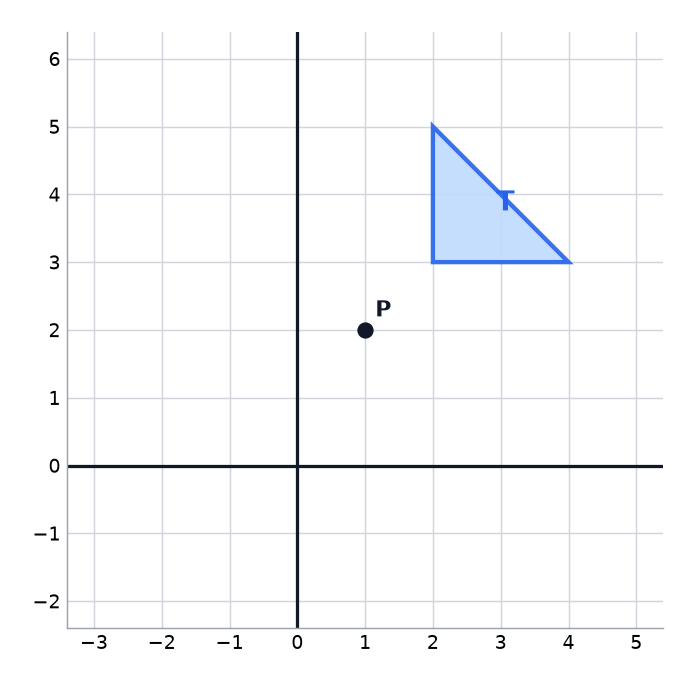
Rotate triangle \(T\) through \(180^\circ\) about the point \(P\). [3 marks]
Show answerHide answer
Model answer
The vertices are 1 right and 1 up, 3 right and 1 up, and 1 right and 3 up from \(P\). Turning through \(180^\circ\) puts them 1 left and 1 down, 3 left and 1 down, and 1 left and 3 down. The image has vertices \((0, 1)\), \((-2, 1)\) and \((0, -1)\).
Mark scheme
- Rotates at least two vertices about \(P\) — M1
- At least two vertices correct — A1
- Triangle with vertices \((0, 1)\), \((-2, 1)\) and \((0, -1)\) — A1
-
3 Describe [3 marks]
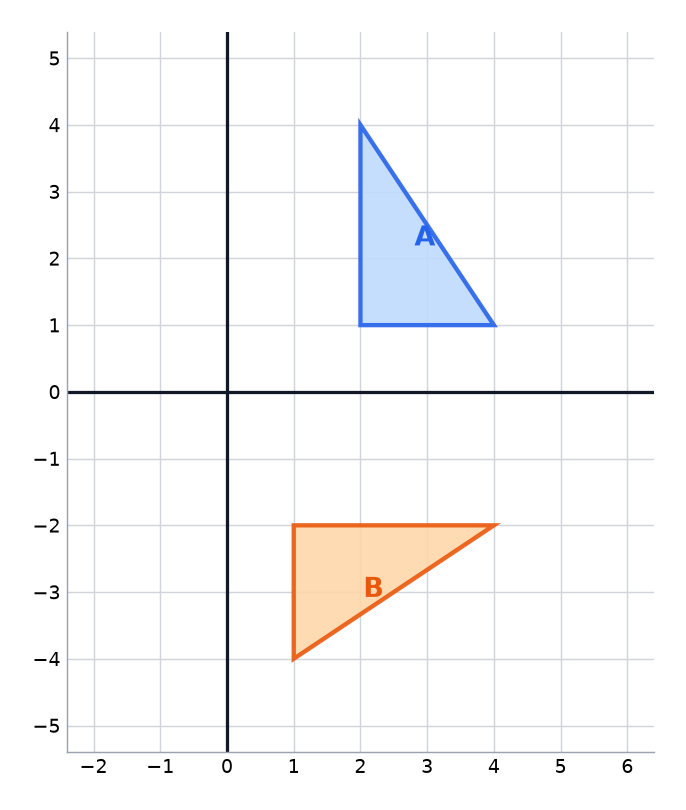
Describe fully the single transformation that maps triangle \(A\) onto triangle \(B\). [3 marks]
Show answerHide answer
Model answer
The point \((2, 1)\) goes to \((1, -2)\), and \((4, 1)\) goes to \((1, -4)\). This is \((x, y) \to (y, -x)\), a rotation of \(90^\circ\) clockwise about the origin.
Mark scheme
- Rotation — B1
- \(90^\circ\) clockwise — B1
- About the origin — B1
-
4 Find [2 marks]
A rotation of \(180^\circ\) maps the point \((2, 6)\) onto the point \((-4, 0)\). Find the coordinates of the centre of the rotation. [2 marks]
Show answerHide answer
Model answer
The centre is the midpoint: \(\left(\dfrac{2 + (-4)}{2}, \dfrac{6 + 0}{2}\right) = (-1, 3)\).
Mark scheme
- \(\dfrac{2 + (-4)}{2}\) or \(\dfrac{6 + 0}{2}\) — M1
- \((-1, 3)\) — A1
-
5 Work out [3 marks]
Triangle \(ABC\) has vertices \(A(1, 2)\), \(B(4, 2)\) and \(C(1, 5)\). It is rotated through \(90^\circ\) clockwise about the origin. Write down the coordinates of the images of \(B\) and \(C\). [3 marks]
Show answerHide answer
Model answer
A \(90^\circ\) clockwise turn sends \((x, y)\) to \((y, -x)\). \(B(4, 2)\) goes to \((2, -4)\) and \(C(1, 5)\) goes to \((5, -1)\).
Mark scheme
- Uses \((x, y) \to (y, -x)\) — M1
- \((2, -4)\) — A1
- \((5, -1)\) — A1
-
6 Find [3 marks]
A rotation of \(90^\circ\) clockwise about the origin maps the point \(P\) onto the point \(Q(5, -2)\). Work out the coordinates of \(P\). [3 marks]
Show answerHide answer
Model answer
The rotation sends \((x, y)\) to \((y, -x)\). So \(y = 5\) and \(-x = -2\), which gives \(x = 2\). \(P\) is \((2, 5)\). Check: \((2, 5)\) goes to \((5, -2)\).
Mark scheme
- \(y = 5\) or \(-x = -2\) — M1
- \(x = 2\) — A1
- \((2, 5)\) — A1
Quick check
-
1
What three details describe a rotation?
Show answerHide answer
C: The centre, the angle and the direction
A rotation is described by its centre, its angle and its direction.
-
2
What is the image of \((3, -2)\) in a \(180^\circ\) rotation about the origin?
Show answerHide answer
B: \((-3, 2)\)
A \(180^\circ\) turn about the origin changes the sign of both coordinates.
-
3
What is the image of \((2, 5)\) in a \(90^\circ\) anticlockwise rotation about the origin?
Show answerHide answer
A: \((-5, 2)\)
A \(90^\circ\) anticlockwise turn sends \((x, y)\) to \((-y, x)\).
-
4
What is the image of \((3, 1)\) in a \(90^\circ\) clockwise rotation about the origin?
Show answerHide answer
D: \((1, -3)\)
A \(90^\circ\) clockwise turn sends \((x, y)\) to \((y, -x)\).
-
5
Why is no direction needed to describe a \(180^\circ\) rotation?
Show answerHide answer
C: A half turn is the same in both directions
A half turn clockwise ends in the same place as a half turn anticlockwise.
-
6
Is the image of a rotation congruent to the object?
Show answerHide answer
B: Yes, it has the same size and shape
A rotation does not change lengths or angles.
-
7
What is the image of \((-2, 4)\) in a \(90^\circ\) clockwise rotation about the origin?
Show answerHide answer
A: \((4, 2)\)
\((x, y)\) goes to \((y, -x)\), so \((-2, 4)\) goes to \((4, 2)\).
-
8
The point \((4, 3)\) is rotated through \(180^\circ\) about the point \((1, 1)\). What is the image?
Show answerHide answer
D: \((-2, -1)\)
The point is 3 right and 2 up from the centre, so the image is 3 left and 2 down: \((1 - 3, 1 - 2) = (-2, -1)\).
-
9
A \(180^\circ\) rotation takes \((1, 5)\) to \((5, 1)\). What is the centre of rotation?
Show answerHide answer
C: \((3, 3)\)
The centre is the midpoint of a point and its image: \(\left(\dfrac{1 + 5}{2}, \dfrac{5 + 1}{2}\right) = (3, 3)\).