Exam questions · Maths · Further Algebra
Simultaneous Equations
- 6 exam questions
- 21 marks
- 9 quick checks
-
1 Use [2 marks]
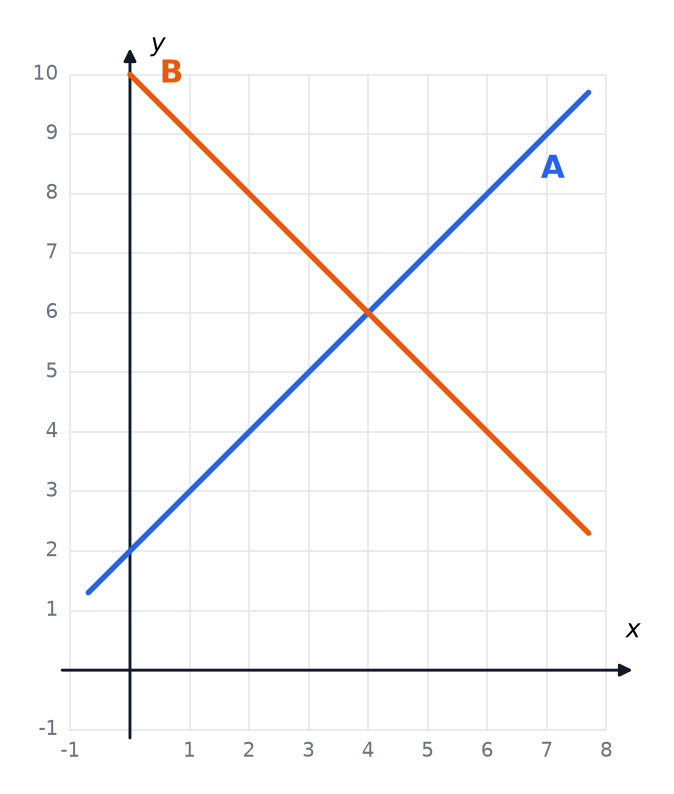
Here are the graphs of the straight lines \(A\) and \(B\). Use the graphs to solve the simultaneous equations \(y = x + 2\) and \(x + y = 10\).
Show answerHide answer
Model answer
The lines cross at \((4, 6)\), so \(x = 4\) and \(y = 6\).
Mark scheme
- \(x = 4\) — B1
- \(y = 6\) — B1
-
2 Solve [3 marks]
Solve the simultaneous equations \(x + y = 11\) and \(x - y = 3\).
Show answerHide answer
Model answer
Adding gives \(2x = 14\), so \(x = 7\). Then \(y = 11 - 7 = 4\). Check: \(7 - 4 = 3\).
Mark scheme
- Adds or eliminates \(y\) correctly — M1
- \(x = 7\) — A1
- \(y = 4\) — A1
-
3 Solve [3 marks]
Solve the simultaneous equations \(3x + y = 14\) and \(2x - y = 6\).
Show answerHide answer
Model answer
Adding gives \(5x = 20\), so \(x = 4\). Then \(12 + y = 14\), so \(y = 2\). Check: \(8 - 2 = 6\).
Mark scheme
- \(5x = 20\) — M1
- \(x = 4\) — A1
- \(y = 2\) — A1
-
4 Solve [4 marks]
Solve the simultaneous equations \(2x + 3y = 12\) and \(4x - y = 10\).
Show answerHide answer
Model answer
Multiply the second equation by 3: \(12x - 3y = 30\). Adding to the first gives \(14x = 42\), so \(x = 3\). Then \(6 + 3y = 12\), so \(y = 2\). Check: \(12 - 2 = 10\).
Mark scheme
- Multiplies to match the coefficients, such as \(12x - 3y = 30\) — M1
- Adds or subtracts correctly, \(14x = 42\) — M1
- \(x = 3\) — A1
- \(y = 2\) — A1
-
5 Work out [4 marks]
3 adults and 2 children go to the cinema. The total cost is \(\pounds 29\). 2 adults and 4 children go to the cinema. The total cost is \(\pounds 30\). Work out the cost of an adult ticket and the cost of a child ticket.
Show answerHide answer
Model answer
\(3a + 2c = 29\) and \(2a + 4c = 30\), so \(a + 2c = 15\). Subtracting this from the first equation gives \(2a = 14\), so \(a = 7\). Then \(2c = 8\) and \(c = 4\). An adult ticket costs \(\pounds 7\) and a child ticket \(\pounds 4\).
Mark scheme
- Two correct equations — M1
- A correct elimination step — M1
- Adult ticket \(\pounds 7\) — A1
- Child ticket \(\pounds 4\) — A1
-
6 Solve [5 marks]
Solve the simultaneous equations \(y = x^2 - 4\) and \(y = 2x - 1\).
Show answerHide answer
Model answer
Setting them equal gives \(x^2 - 4 = 2x - 1\), so \(x^2 - 2x - 3 = 0\) and \((x - 3)(x + 1) = 0\). So \(x = 3\) or \(x = -1\). Then \(y = 5\) when \(x = 3\), and \(y = -3\) when \(x = -1\).
Mark scheme
- \(x^2 - 4 = 2x - 1\) — M1
- \(x^2 - 2x - 3 = 0\) — M1
- \(x = 3\) and \(x = -1\) — A1
- One correct \(y\)-value — M1
- \((3, 5)\) and \((-1, -3)\) — A1
Quick check
-
1
Solve \(x + y = 9\) and \(x - y = 1\).
Show answerHide answer
C: \(x = 5\), \(y = 4\)
Adding gives \(2x = 10\), so \(x = 5\) and \(y = 4\).
-
2
When do you add the two equations in elimination?
Show answerHide answer
B: When the terms in one letter are opposites
Opposites such as \(+3y\) and \(-3y\) cancel when added.
-
3
Solve \(3x + 2y = 16\) and \(x + 2y = 8\).
Show answerHide answer
A: \(x = 4\), \(y = 2\)
Subtract: \(2x = 8\), so \(x = 4\). Then \(4 + 2y = 8\) gives \(y = 2\).
-
4
Solve \(2x + 3y = 13\) and \(3x - y = 3\).
Show answerHide answer
D: \(x = 2\), \(y = 3\)
Multiply the second equation by 3 and add: \(11x = 22\), so \(x = 2\), \(y = 3\).
-
5
Solve \(y = 2x + 1\) and \(3x + y = 16\).
Show answerHide answer
C: \(x = 3\), \(y = 7\)
\(3x + 2x + 1 = 16\), so \(x = 3\) and \(y = 7\).
-
6
Two straight lines are parallel. How many solutions do their simultaneous equations have?
Show answerHide answer
B: None
Parallel lines never meet, so there is no point on both.
-
7
2 adult and 3 child tickets cost \(\pounds 19\). 3 adult and 1 child ticket cost \(\pounds 18\). What does an adult ticket cost?
Show answerHide answer
A: \(\pounds 5\)
\(2a + 3c = 19\) and \(3a + c = 18\) give \(a = 5\), \(c = 3\).
-
8
Solve \(y = x^2\) and \(y = x + 6\).
Show answerHide answer
D: \((3, 9)\) and \((-2, 4)\)
\(x^2 = x + 6\) gives \((x - 3)(x + 2) = 0\).
-
9
Solve \(x^2 + y^2 = 25\) and \(y = x + 1\).
Show answerHide answer
C: \((3, 4)\) and \((-4, -3)\)
\(x^2 + (x + 1)^2 = 25\) gives \(x^2 + x - 12 = 0\), so \(x = 3\) or \(x = -4\).