Exam questions · Maths
Geometry and Measures
- 31 exam questions
- 104 marks
- 45 quick checks
Angles in Parallel Lines and Polygons
Just this lesson-
1 Work out [2 marks]
Three angles at a point are \(130^\circ\), \(95^\circ\) and \(x^\circ\). Work out the value of \(x\). Give a reason for your answer.
Show answerHide answer
Model answer
Angles around a point add up to \(360^\circ\), so \(x = 360 - 130 - 95 = 135\).
Mark scheme
- \(360 - 130 - 95\) or \(130 + 95 = 225\) — M1
- \(x = 135\) with the reason angles around a point add up to \(360^\circ\) — A1
-
2 Work out [3 marks]
Triangle \(ABC\) is isosceles with \(AB = AC\). Angle \(BAC = 40^\circ\). Work out the size of angle \(ABC\). Give a reason for each step of your working.
Show answerHide answer
Model answer
The angles in a triangle add up to \(180^\circ\), so angles \(B\) and \(C\) add up to \(180 - 40 = 140^\circ\). The base angles of an isosceles triangle are equal, so angle \(ABC = 140 \div 2 = 70^\circ\).
Mark scheme
- \(180 - 40 = 140\) — M1
- \(140 \div 2 = 70\) — A1
- Reasons given: angles in a triangle add up to 180 degrees and base angles of an isosceles triangle are equal — C1
-
3 Work out [4 marks]
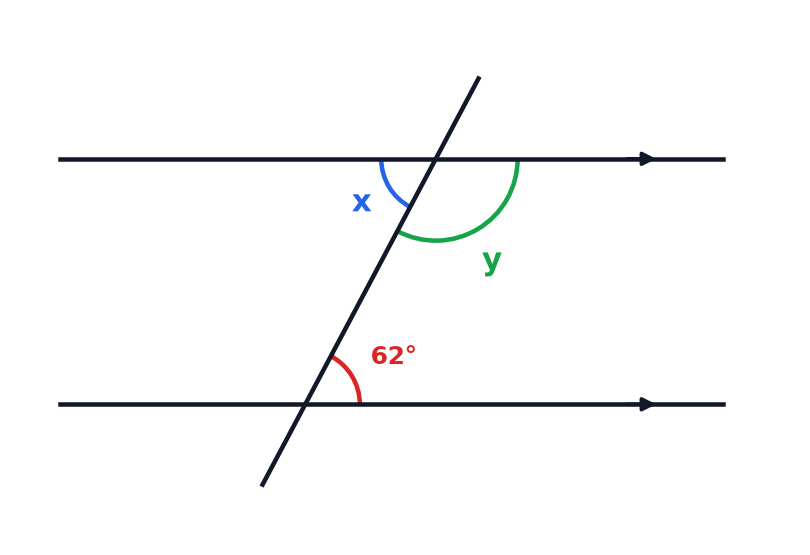
The diagram shows two parallel lines crossed by a straight line. (a) Write down the size of angle \(x\). Give a reason for your answer. (2 marks) (b) Work out the size of angle \(y\). (2 marks)
Show answerHide answer
Model answer
(a) \(x = 62^\circ\) because alternate angles are equal. (b) \(x\) and \(y\) lie on a straight line, so \(y = 180 - 62 = 118^\circ\).
Mark scheme
- (a) \(62^\circ\) — B1
- (a) Alternate angles are equal — C1
- (b) \(180 - 62\) or \(180 - x\) — M1
- (b) \(118^\circ\) — A1
-
4 Work out [3 marks]
Work out the size of one interior angle of a regular hexagon. You must show your working.
Show answerHide answer
Model answer
The exterior angle is \(360 \div 6 = 60^\circ\), so the interior angle is \(180 - 60 = 120^\circ\). Alternatively the sum of the angles is \((6 - 2) \times 180 = 720^\circ\) and \(720 \div 6 = 120^\circ\).
Mark scheme
- \(360 \div 6 = 60\) or \((6 - 2) \times 180 = 720\) — M1
- \(180 - 60\) or \(720 \div 6\) — M1
- \(120^\circ\) — A1
-
5 Work out [3 marks]
Each exterior angle of a regular polygon is \(20^\circ\). (a) Work out the number of sides of the polygon. (2 marks) (b) Work out the size of one interior angle. (1 mark)
Show answerHide answer
Model answer
(a) \(360 \div 20 = 18\) sides. (b) \(180 - 20 = 160^\circ\).
Mark scheme
- (a) \(360 \div 20\) — M1
- (a) 18 — A1
- (b) \(160^\circ\) — B1
-
6 Work out [4 marks]
The angles of a quadrilateral are \(x^\circ\), \(2x^\circ\), \((3x - 10)^\circ\) and \(4x^\circ\). Work out the size of the largest angle of the quadrilateral.
Show answerHide answer
Model answer
The angles add up to \(360^\circ\), so \(x + 2x + 3x - 10 + 4x = 360\). That gives \(10x - 10 = 360\), so \(x = 37\). The largest angle is \(4x = 148^\circ\).
Mark scheme
- \(x + 2x + 3x - 10 + 4x = 360\) — M1
- \(10x = 370\) or \(10x - 10 = 360\) — M1
- \(x = 37\) — A1
- \(148^\circ\) — A1
Quick check
-
1
Three angles on a straight line are \(47^\circ\), \(68^\circ\) and \(x\). What is \(x\)?
Show answerHide answer
B: \(65^\circ\)
Angles on a straight line add up to \(180^\circ\). \(180 - 47 - 68 = 65\).
-
2
Three angles of a quadrilateral are \(80^\circ\), \(95^\circ\) and \(110^\circ\). What is the fourth angle?
Show answerHide answer
A: \(75^\circ\)
The angles of a quadrilateral add up to \(360^\circ\). \(80 + 95 + 110 = 285\) and \(360 - 285 = 75\).
-
3
Which type of angles are equal and form a Z shape between parallel lines?
Show answerHide answer
D: Alternate angles
Alternate angles are on opposite sides of the transversal, and make a Z shape.
-
4
Two co-interior angles lie between parallel lines. One is \(72^\circ\). What is the other?
Show answerHide answer
C: \(108^\circ\)
Co-interior angles add up to \(180^\circ\), so \(180 - 72 = 108\).
-
5
What is the sum of the interior angles of a hexagon?
Show answerHide answer
B: \(720^\circ\)
A hexagon has 6 sides, so the sum is \((6 - 2) \times 180 = 720\).
-
6
What is each exterior angle of a regular octagon?
Show answerHide answer
A: \(45^\circ\)
\(360 \div 8 = 45\). The interior angle is \(135^\circ\).
-
7
Each exterior angle of a regular polygon is \(24^\circ\). How many sides does it have?
Show answerHide answer
D: 15
\(360 \div 24 = 15\). The number 156 is the interior angle.
-
8
An exterior angle of a triangle is \(118^\circ\). One of the interior opposite angles is \(54^\circ\). What is the other interior opposite angle?
Show answerHide answer
C: \(64^\circ\)
The exterior angle equals the sum of the two interior opposite angles, so \(118 - 54 = 64\).
-
9
The angles of a triangle are \(x\), \(2x + 10\) and \(3x - 10\) degrees. What is the size of the largest angle?
Show answerHide answer
B: \(80^\circ\)
\(6x = 180\), so \(x = 30\). The angles are \(30^\circ\), \(70^\circ\) and \(80^\circ\).
Area, Perimeter and Circles
Just this lesson-
1 Work out [5 marks]
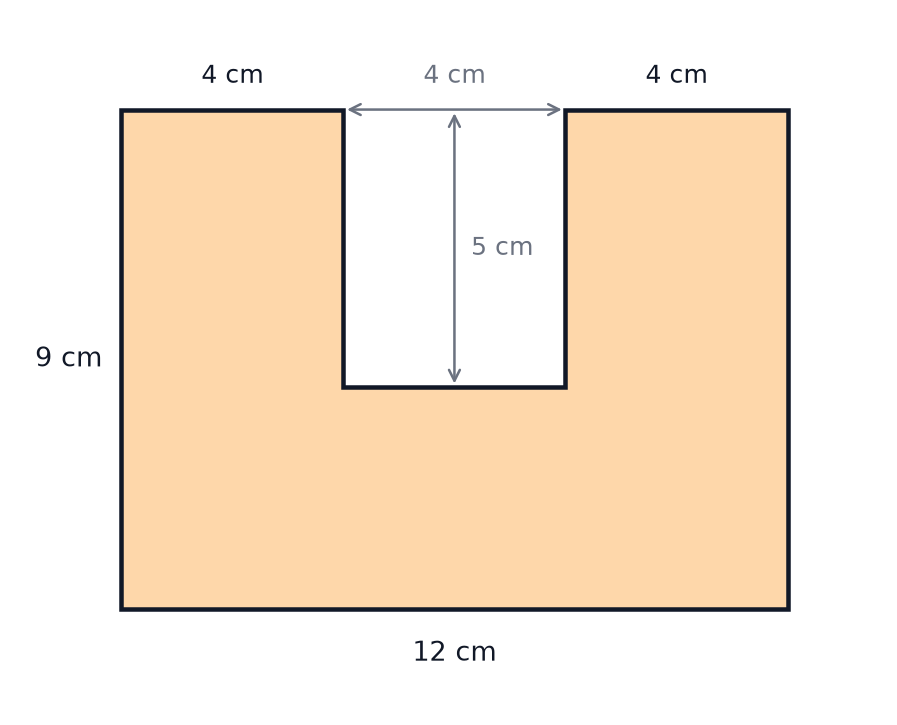
The diagram shows a U-shaped metal plate. (a) Work out the area of the plate. (3 marks) (b) Work out the perimeter of the plate. (2 marks)
Show answerHide answer
Model answer
(a) The whole rectangle is \(12 \times 9 = 108\) cm\(^2\) and the gap is \(4 \times 5 = 20\) cm\(^2\), so the area is \(108 - 20 = 88\) cm\(^2\). (b) The edges are \(12 + 9 + 4 + 5 + 4 + 5 + 4 + 9 = 52\) cm.
Mark scheme
- (a) \(12 \times 9\) or \(4 \times 5\) — M1
- (a) \(108 - 20\) — M1
- (a) 88 cm\(^2\) — A1
- (b) All the outside edges added, with at most one error — M1
- (b) 52 cm — A1
-
2 Work out [2 marks]
A trapezium has parallel sides of length 8 cm and 14 cm. The distance between the parallel sides is 5 cm. Work out the area of the trapezium.
Show answerHide answer
Model answer
Area \(= \dfrac{1}{2}(8 + 14) \times 5 = 11 \times 5 = 55\) cm\(^2\).
Mark scheme
- \(\dfrac{1}{2}(8 + 14) \times 5\) or \(11 \times 5\) — M1
- 55 cm\(^2\) — A1
-
3 Work out [2 marks]
A triangle has a base of 12 cm and an area of 54 cm\(^2\). Work out the perpendicular height of the triangle.
Show answerHide answer
Model answer
\(\dfrac{1}{2} \times 12 \times h = 54\), so \(6h = 54\) and \(h = 9\) cm.
Mark scheme
- \(\dfrac{1}{2} \times 12 \times h = 54\) or \(54 \times 2 \div 12\) — M1
- 9 cm — A1
-
4 Work out [4 marks]
Give your answers to this question in terms of \(\pi\). (a) A circle has radius 6 cm. Work out the area of the circle. (2 marks) (b) A circle has diameter 10 cm. Work out the circumference of the circle. (2 marks)
Show answerHide answer
Model answer
(a) \(\pi \times 6^2 = 36\pi\) cm\(^2\). (b) \(\pi \times 10 = 10\pi\) cm.
Mark scheme
- (a) \(\pi \times 6^2\) — M1
- (a) \(36\pi\) — A1
- (b) \(\pi \times 10\) or \(2 \times \pi \times 5\) — M1
- (b) \(10\pi\) — A1
-
5 Work out [3 marks]
The area of a circle is \(49\pi\) cm\(^2\). Work out the circumference of the circle. Give your answer in terms of \(\pi\).
Show answerHide answer
Model answer
\(\pi r^2 = 49\pi\), so \(r^2 = 49\) and \(r = 7\) cm. The circumference is \(2 \times \pi \times 7 = 14\pi\) cm.
Mark scheme
- \(r^2 = 49\) or \(r = 7\) — M1
- \(2 \times \pi \times 7\) — M1
- \(14\pi\) cm — A1
-
6 Work out [4 marks]
A sector of a circle has radius 12 cm and angle \(150^\circ\). Give your answers in terms of \(\pi\). (a) Work out the length of the arc of the sector. (2 marks) (b) Work out the area of the sector. (2 marks)
Show answerHide answer
Model answer
\(\dfrac{150}{360} = \dfrac{5}{12}\). (a) The circumference is \(2 \times \pi \times 12 = 24\pi\), so the arc is \(\dfrac{5}{12} \times 24\pi = 10\pi\) cm. (b) The area of the circle is \(\pi \times 144 = 144\pi\), so the sector is \(\dfrac{5}{12} \times 144\pi = 60\pi\) cm\(^2\).
Mark scheme
- (a) \(\dfrac{150}{360} \times 24\pi\) — M1
- (a) \(10\pi\) — A1
- (b) \(\dfrac{150}{360} \times 144\pi\) — M1
- (b) \(60\pi\) — A1
Quick check
-
1
A triangle has base 10 cm and perpendicular height 6 cm. What is its area?
Show answerHide answer
C: 30 cm\(^2\)
\(\dfrac{1}{2} \times 10 \times 6 = 30\) cm\(^2\).
-
2
A trapezium has parallel sides of 7 cm and 13 cm, and a height of 6 cm. What is its area?
Show answerHide answer
B: 60 cm\(^2\)
\(\dfrac{1}{2}(7 + 13) \times 6 = 60\). Forgetting the half gives 120.
-
3
A parallelogram has base 9 cm, slanted side 5 cm and perpendicular height 4 cm. What is its area?
Show answerHide answer
A: 36 cm\(^2\)
\(\text{base} \times \text{perpendicular height} = 9 \times 4 = 36\). The slanted side is not used.
-
4
A circle has radius 5 cm. What is its area, in terms of \(\pi\)?
Show answerHide answer
D: \(25\pi\) cm\(^2\)
\(\pi r^2 = \pi \times 25 = 25\pi\).
-
5
A circle has diameter 14 cm. What is its circumference, in terms of \(\pi\)?
Show answerHide answer
C: \(14\pi\) cm
\(C = \pi d = 14\pi\).
-
6
A circle has diameter 10 cm. What is its area, in terms of \(\pi\)?
Show answerHide answer
B: \(25\pi\) cm\(^2\)
The radius is \(10 \div 2 = 5\), so \(A = \pi \times 5^2 = 25\pi\). Using 10 as the radius gives \(100\pi\).
-
7
A rectangle measures 12 cm by 7 cm. A rectangle 5 cm by 3 cm is cut from one corner. What is the area of the remaining shape?
Show answerHide answer
A: 69 cm\(^2\)
\(12 \times 7 = 84\) and \(5 \times 3 = 15\), so \(84 - 15 = 69\).
-
8
A sector has radius 9 cm and angle \(80^\circ\). What is its area, in terms of \(\pi\)?
Show answerHide answer
D: \(18\pi\) cm\(^2\)
\(\dfrac{80}{360} \times \pi \times 81 = \dfrac{2}{9} \times 81\pi = 18\pi\).
-
9
A sector has radius 6 cm and angle \(60^\circ\). What is the length of its arc, in terms of \(\pi\)?
Show answerHide answer
C: \(2\pi\) cm
\(\dfrac{60}{360} \times 2 \times \pi \times 6 = \dfrac{1}{6} \times 12\pi = 2\pi\).
Volume and Surface Area
Just this lesson-
1 Work out [5 marks]
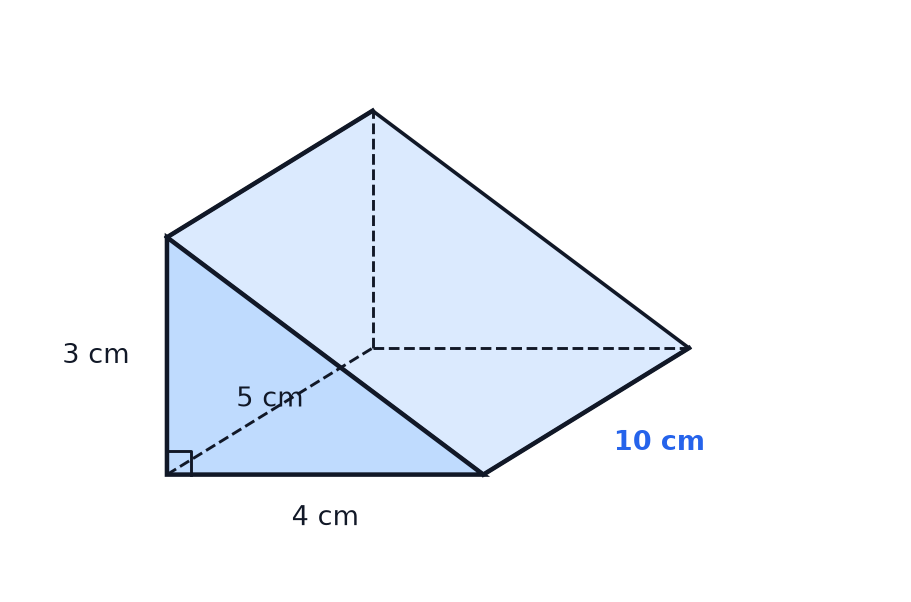
The diagram shows a prism. The cross-section of the prism is a right-angled triangle. (a) Work out the volume of the prism. (2 marks) (b) Work out the total surface area of the prism. (3 marks)
Show answerHide answer
Model answer
(a) The area of the triangle is \(\dfrac{1}{2} \times 4 \times 3 = 6\) cm\(^2\), so the volume is \(6 \times 10 = 60\) cm\(^3\). (b) The two triangles have area \(2 \times 6 = 12\). The three rectangles have areas \(4 \times 10 = 40\), \(3 \times 10 = 30\) and \(5 \times 10 = 50\), which total 120. The total surface area is \(12 + 120 = 132\) cm\(^2\).
Mark scheme
- (a) \(\dfrac{1}{2} \times 4 \times 3 = 6\) — M1
- (a) 60 cm\(^3\) — A1
- (b) \(40\), \(30\) and \(50\) found, or \(12 \times 10\) — M1
- (b) \(12\) for the triangles added to their rectangles — M1
- (b) 132 cm\(^2\) — A1
-
2 Work out [2 marks]
A cuboid has a volume of 240 cm\(^3\). Its length is 10 cm and its width is 6 cm. Work out its height.
Show answerHide answer
Model answer
\(10 \times 6 \times h = 240\), so \(60h = 240\) and \(h = 4\) cm.
Mark scheme
- \(240 \div (10 \times 6)\) or \(60h = 240\) — M1
- 4 cm — A1
-
3 Work out [4 marks]
A cylinder has radius 5 cm and height 8 cm. Give your answers in terms of \(\pi\). (a) Work out the volume of the cylinder. (2 marks) (b) Work out the curved surface area of the cylinder. (2 marks)
Show answerHide answer
Model answer
(a) \(\pi \times 5^2 \times 8 = 200\pi\) cm\(^3\). (b) \(2 \times \pi \times 5 \times 8 = 80\pi\) cm\(^2\).
Mark scheme
- (a) \(\pi \times 5^2 \times 8\) — M1
- (a) \(200\pi\) — A1
- (b) \(2 \times \pi \times 5 \times 8\) — M1
- (b) \(80\pi\) — A1
-
4 Work out [3 marks]
A tank is in the shape of a cuboid measuring 80 cm by 50 cm by 40 cm. The tank is full of water. Work out the volume of water in the tank in litres.
Show answerHide answer
Model answer
\(80 \times 50 \times 40 = 160\,000\) cm\(^3\). Since \(1000\text{ cm}^3 = 1\) litre, the volume is \(160\) litres.
Mark scheme
- \(80 \times 50 \times 40\) — M1
- \(160\,000\) cm\(^3\) — A1
- 160 litres — A1
-
5 Show that [3 marks]
A cylinder has radius \(x\) cm and height \(2x\) cm. Show that the volume of the cylinder is \(2\pi x^3\) cm\(^3\).
Show answerHide answer
Model answer
Volume \(= \pi r^2 h = \pi \times x^2 \times 2x = 2\pi x^3\), as required.
Mark scheme
- \(\pi \times x^2 \times h\) with \(h = 2x\) substituted — M1
- \(\pi x^2 \times 2x\) — M1
- \(2\pi x^3\) with a conclusion — C1
-
6 Work out [4 marks]
Give your answers in terms of \(\pi\). (a) A sphere has radius 6 cm. Work out the volume of the sphere. (2 marks) (b) Work out the curved surface area of a hemisphere of radius 6 cm. (2 marks)
Show answerHide answer
Model answer
(a) \(\dfrac{4}{3} \times \pi \times 6^3 = \dfrac{4}{3} \times 216\pi = 288\pi\) cm\(^3\). (b) The surface area of a sphere is \(4\pi r^2 = 144\pi\), so half of it is \(72\pi\) cm\(^2\).
Mark scheme
- (a) \(\dfrac{4}{3} \times \pi \times 216\) — M1
- (a) \(288\pi\) — A1
- (b) \(\dfrac{1}{2} \times 4\pi \times 36\) or \(2\pi r^2\) — M1
- (b) \(72\pi\) — A1
Quick check
-
1
A cuboid measures 8 cm by 5 cm by 3 cm. What is its volume?
Show answerHide answer
D: 120 cm\(^3\)
\(8 \times 5 \times 3 = 120\) cm\(^3\).
-
2
The cross-section of a prism has area 12 cm\(^2\). The prism is 15 cm long. What is its volume?
Show answerHide answer
C: 180 cm\(^3\)
Volume \(=\) area of cross-section \(\times\) length \(= 12 \times 15 = 180\).
-
3
A cylinder has radius 3 cm and height 10 cm. What is its volume, in terms of \(\pi\)?
Show answerHide answer
B: \(90\pi\) cm\(^3\)
\(\pi r^2 h = \pi \times 9 \times 10 = 90\pi\).
-
4
A cylinder has radius 3 cm and height 10 cm. What is its curved surface area, in terms of \(\pi\)?
Show answerHide answer
A: \(60\pi\) cm\(^2\)
\(2\pi r h = 2 \times \pi \times 3 \times 10 = 60\pi\).
-
5
What is the total surface area of a cube with side 4 cm?
Show answerHide answer
D: 96 cm\(^2\)
A cube has 6 faces, each of area \(4 \times 4 = 16\). So \(6 \times 16 = 96\).
-
6
A tank holds 2500 cm\(^3\) of water. How many litres is this?
Show answerHide answer
C: 2.5 litres
\(1000\text{ cm}^3 = 1\) litre, so \(2500 \div 1000 = 2.5\).
-
7
A cylinder has radius 2 cm and height 7 cm. What is its volume, in terms of \(\pi\)?
Show answerHide answer
B: \(28\pi\) cm\(^3\)
\(\pi \times 2^2 \times 7 = 28\pi\). Using the diameter instead of the radius would give \(98\pi\).
-
8
A sphere has radius 3 cm. What is its volume, in terms of \(\pi\)?
Show answerHide answer
A: \(36\pi\) cm\(^3\)
\(\dfrac{4}{3}\pi r^3 = \dfrac{4}{3} \times \pi \times 27 = 36\pi\).
-
9
A cone has radius 3 cm and vertical height 4 cm. What is its volume, in terms of \(\pi\)?
Show answerHide answer
D: \(12\pi\) cm\(^3\)
\(\dfrac{1}{3}\pi r^2 h = \dfrac{1}{3} \times \pi \times 9 \times 4 = 12\pi\). Using the slant height 5 gives \(15\pi\), which is wrong.
Pythagoras' Theorem
Just this lesson-
1 Work out [3 marks]
A right-angled triangle has shorter sides of length 20 cm and 21 cm. Work out the length of the hypotenuse of the triangle.
Show answerHide answer
Model answer
\(20^2 + 21^2 = 400 + 441 = 841\), and \(\sqrt{841} = 29\) cm.
Mark scheme
- \(20^2 + 21^2\) — M1
- \(841\) — M1
- 29 cm — A1
-
2 Work out [3 marks]
A right-angled triangle has a hypotenuse of length 25 cm. One of the shorter sides has length 7 cm. Work out the length of the other shorter side.
Show answerHide answer
Model answer
\(25^2 - 7^2 = 625 - 49 = 576\), and \(\sqrt{576} = 24\) cm.
Mark scheme
- \(25^2 - 7^2\) — M1
- \(576\) — M1
- 24 cm — A1
-
3 Work out [4 marks]
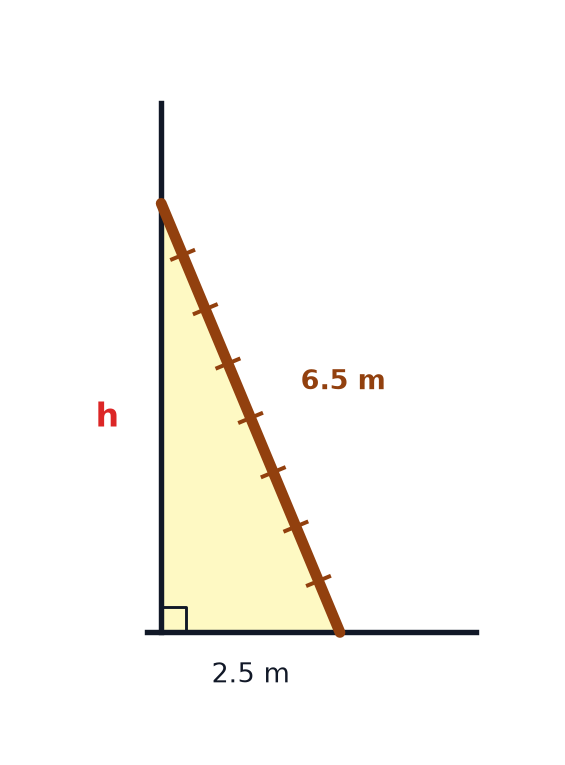
A ladder is 6.5 m long. It leans against a vertical wall. The foot of the ladder is on horizontal ground, 2.5 m from the wall. (a) Work out the height, \(h\), that the ladder reaches up the wall. (3 marks) (b) A safety rule says that the distance from the foot of the ladder to the wall should be one quarter of the height reached. Does the ladder follow this rule? (1 mark)
Show answerHide answer
Model answer
(a) \(h^2 = 6.5^2 - 2.5^2 = 42.25 - 6.25 = 36\), so \(h = 6\) m. (b) One quarter of 6 is 1.5 m, but the foot is 2.5 m from the wall, so the ladder does not follow the rule.
Mark scheme
- (a) \(6.5^2 - 2.5^2\) — M1
- (a) \(36\) — M1
- (a) 6 m — A1
- (b) No, with \(6 \div 4 = 1.5\) compared with 2.5 — C1
-
4 Show that [3 marks]
A triangle has sides of length 8 cm, 11 cm and 13 cm. Is the triangle right-angled? You must show your working.
Show answerHide answer
Model answer
The longest side is 13, so \(13^2 = 169\). The other two give \(8^2 + 11^2 = 64 + 121 = 185\). Since \(185 \neq 169\), the triangle is not right-angled.
Mark scheme
- \(8^2 + 11^2 = 185\) — M1
- \(13^2 = 169\) — M1
- Not right-angled, with the two values compared — C1
-
5 Work out [4 marks]
A rectangle has a diagonal of length 25 cm and a width of 7 cm. Work out the area of the rectangle.
Show answerHide answer
Model answer
The length is \(\sqrt{25^2 - 7^2} = \sqrt{576} = 24\) cm, so the area is \(24 \times 7 = 168\) cm\(^2\).
Mark scheme
- \(25^2 - 7^2\) — M1
- \(\sqrt{576} = 24\) — A1
- \(24 \times 7\) — M1
- 168 cm\(^2\) — A1
-
6 Work out [4 marks]
An isosceles triangle has a base of 16 cm and two equal sides of 17 cm. Work out the area of the triangle.
Show answerHide answer
Model answer
The height splits the base into two lots of 8 cm, so \(h = \sqrt{17^2 - 8^2} = \sqrt{289 - 64} = \sqrt{225} = 15\) cm. The area is \(\dfrac{1}{2} \times 16 \times 15 = 120\) cm\(^2\).
Mark scheme
- Half of the base \(= 8\) used — M1
- \(17^2 - 8^2 = 225\) — M1
- \(h = 15\) — A1
- 120 cm\(^2\) — A1
-
7 Work out [3 marks]
Point \(A\) has coordinates \((-3, 2)\) and point \(B\) has coordinates \((2, 14)\). Work out the length of the line \(AB\).
Show answerHide answer
Model answer
The horizontal difference is \(2 - (-3) = 5\) and the vertical difference is \(14 - 2 = 12\). So \(AB = \sqrt{5^2 + 12^2} = \sqrt{169} = 13\).
Mark scheme
- Differences 5 and 12 found — M1
- \(5^2 + 12^2 = 169\) — M1
- 13 — A1
Quick check
-
1
A right-angled triangle has shorter sides of 9 cm and 12 cm. What is the hypotenuse?
Show answerHide answer
A: 15 cm
\(9^2 + 12^2 = 81 + 144 = 225\), and \(\sqrt{225} = 15\).
-
2
A right-angled triangle has hypotenuse 13 cm and one shorter side 5 cm. What is the other shorter side?
Show answerHide answer
D: 12 cm
\(13^2 - 5^2 = 169 - 25 = 144\), and \(\sqrt{144} = 12\).
-
3
Which set of lengths makes a right-angled triangle?
Show answerHide answer
C: 6 cm, 8 cm, 10 cm
\(6^2 + 8^2 = 36 + 64 = 100 = 10^2\). The other sets do not satisfy \(a^2 + b^2 = c^2\).
-
4
Which side of a right-angled triangle is the hypotenuse?
Show answerHide answer
B: The longest side, opposite the right angle
The hypotenuse is always the longest side, and it is opposite the right angle.
-
5
A rectangle is 15 cm long and 8 cm wide. How long is its diagonal?
Show answerHide answer
A: 17 cm
\(15^2 + 8^2 = 225 + 64 = 289\), and \(\sqrt{289} = 17\).
-
6
A ladder 6.5 m long leans against a wall. Its foot is 2.5 m from the wall. How high up the wall does it reach?
Show answerHide answer
D: 6 m
\(6.5^2 - 2.5^2 = 42.25 - 6.25 = 36\), and \(\sqrt{36} = 6\).
-
7
An isosceles triangle has base 10 cm and equal sides of 13 cm. What is its height?
Show answerHide answer
C: 12 cm
The height splits the base into two lots of 5 cm. \(13^2 - 5^2 = 144\), so the height is 12 cm.
-
8
A right-angled triangle has shorter sides of 2 cm and 4 cm. What is the hypotenuse?
Show answerHide answer
B: \(2\sqrt{5}\) cm
\(2^2 + 4^2 = 20\), and \(\sqrt{20} = \sqrt{4 \times 5} = 2\sqrt{5}\).
-
9
What is the distance between the points \((1, 2)\) and \((7, 10)\)?
Show answerHide answer
A: 10
The horizontal difference is 6 and the vertical difference is 8, so the distance is \(\sqrt{6^2 + 8^2} = \sqrt{100} = 10\).
Trigonometry in Right-Angled Triangles
Just this lesson-
1 Work out [5 marks]
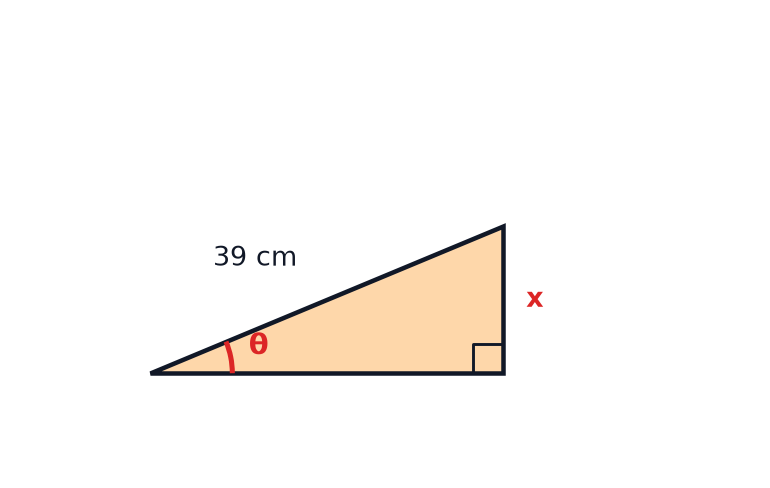
The diagram shows a right-angled triangle. \(\sin\theta = \dfrac{5}{13}\). (a) Work out the value of \(x\). (3 marks) (b) Work out the length of the side next to angle \(\theta\). (2 marks)
Show answerHide answer
Model answer
(a) \(\sin\theta = \dfrac{x}{39}\), so \(\dfrac{x}{39} = \dfrac{5}{13}\) and \(x = \dfrac{5}{13} \times 39 = 15\) cm. (b) By Pythagoras, \(39^2 - 15^2 = 1521 - 225 = 1296\), so the side is \(\sqrt{1296} = 36\) cm.
Mark scheme
- (a) \(\dfrac{x}{39} = \dfrac{5}{13}\) — M1
- (a) \(39 \div 13 = 3\) or \(\dfrac{5 \times 39}{13}\) — M1
- (a) 15 — A1
- (b) \(39^2 - 15^2\) — M1
- (b) 36 — A1
-
2 Write down [2 marks]
(a) Write down the exact value of \(\sin 30^\circ\). (1 mark) (b) Write down the exact value of \(\tan 45^\circ\). (1 mark)
Show answerHide answer
Model answer
(a) \(\sin 30^\circ = \dfrac{1}{2}\). (b) \(\tan 45^\circ = 1\).
Mark scheme
- (a) \(\dfrac{1}{2}\) — B1
- (b) 1 — B1
-
3 Work out [3 marks]
A right-angled triangle has a hypotenuse of 14 cm and an angle of \(30^\circ\). Work out the length of the side opposite the \(30^\circ\) angle.
Show answerHide answer
Model answer
\(\sin 30^\circ = \dfrac{x}{14}\) and \(\sin 30^\circ = \dfrac{1}{2}\), so \(x = 7\) cm.
Mark scheme
- \(\sin 30^\circ = \dfrac{x}{14}\) — M1
- \(\dfrac{1}{2} = \dfrac{x}{14}\) — M1
- 7 cm — A1
-
4 Work out [3 marks]
In a right-angled triangle, the side opposite angle \(\theta\) is 7 cm and the side adjacent to angle \(\theta\) is also 7 cm. Work out the size of angle \(\theta\).
Show answerHide answer
Model answer
\(\tan\theta = \dfrac{7}{7} = 1\), so \(\theta = 45^\circ\).
Mark scheme
- \(\tan\theta = \dfrac{O}{A}\) or \(\dfrac{7}{7}\) — M1
- \(\tan\theta = 1\) — M1
- \(45^\circ\) — A1
-
5 Work out [3 marks]
Triangle \(ABC\) is right-angled at \(B\). \(AC = 20\) cm and angle \(BAC = 60^\circ\). Work out the length of \(AB\).
Show answerHide answer
Model answer
\(AB\) is adjacent to the \(60^\circ\) angle, so \(\cos 60^\circ = \dfrac{AB}{20}\). Since \(\cos 60^\circ = \dfrac{1}{2}\), \(AB = 10\) cm.
Mark scheme
- \(\cos 60^\circ = \dfrac{AB}{20}\) — M1
- \(\dfrac{1}{2} = \dfrac{AB}{20}\) — M1
- 10 cm — A1
-
6 Work out [4 marks]
A right-angled triangle has an angle of \(45^\circ\) and a hypotenuse of 12 cm. (a) Show that the length of the side opposite the \(45^\circ\) angle is \(6\sqrt{2}\) cm. (2 marks) (b) Work out the area of the triangle. (2 marks)
Show answerHide answer
Model answer
(a) \(\sin 45^\circ = \dfrac{x}{12}\), so \(x = 12 \times \dfrac{\sqrt{2}}{2} = 6\sqrt{2}\). (b) The triangle is isosceles, so both shorter sides are \(6\sqrt{2}\). The area is \(\dfrac{1}{2} \times 6\sqrt{2} \times 6\sqrt{2} = \dfrac{1}{2} \times 72 = 36\) cm\(^2\).
Mark scheme
- (a) \(\sin 45^\circ = \dfrac{x}{12}\) and \(12 \times \dfrac{\sqrt{2}}{2}\) — M1
- (a) \(6\sqrt{2}\) shown — C1
- (b) \(\dfrac{1}{2} \times 6\sqrt{2} \times 6\sqrt{2}\) — M1
- (b) 36 cm\(^2\) — A1
Quick check
-
1
What is the formula for \(\sin\theta\) in a right-angled triangle?
Show answerHide answer
B: \(\dfrac{\text{Opposite}}{\text{Hypotenuse}}\)
SOH: sine is opposite over hypotenuse.
-
2
Which ratio links the opposite side and the adjacent side?
Show answerHide answer
A: Tangent
TOA: tangent is opposite over adjacent.
-
3
What is the exact value of \(\sin 30^\circ\)?
Show answerHide answer
D: \(\dfrac{1}{2}\)
This is one of the exact values you must learn: \(\sin 30^\circ = \dfrac{1}{2}\).
-
4
What is the exact value of \(\tan 45^\circ\)?
Show answerHide answer
C: 1
At \(45^\circ\) the opposite and adjacent sides are equal, so \(\tan 45^\circ = 1\).
-
5
A right-angled triangle has a hypotenuse of 8 cm and an angle of \(30^\circ\). What is the length of the side opposite the \(30^\circ\) angle?
Show answerHide answer
B: 4 cm
\(\sin 30^\circ = \dfrac{x}{8}\), so \(x = \dfrac{1}{2} \times 8 = 4\).
-
6
A right-angled triangle has opposite side 5 cm and adjacent side 5 cm. What is the angle?
Show answerHide answer
A: \(45^\circ\)
\(\tan\theta = \dfrac{5}{5} = 1\), so \(\theta = 45^\circ\).
-
7
In a right-angled triangle, \(\sin\theta = \dfrac{5}{13}\) and the hypotenuse is 39 cm. What is the opposite side?
Show answerHide answer
D: 15 cm
\(x = \dfrac{5}{13} \times 39 = 5 \times 3 = 15\).
-
8
A right-angled triangle has an angle of \(60^\circ\) and an adjacent side of 5 cm. What is the opposite side? (\(\tan 60^\circ = \sqrt{3}\))
Show answerHide answer
C: \(5\sqrt{3}\) cm
\(\tan 60^\circ = \dfrac{x}{5}\), so \(x = 5\sqrt{3}\).
-
9
A right-angled triangle has an angle of \(45^\circ\) and a hypotenuse of 10 cm. What is the opposite side?
Show answerHide answer
B: \(5\sqrt{2}\) cm
\(x = 10 \sin 45^\circ = 10 \times \dfrac{\sqrt{2}}{2} = 5\sqrt{2}\).