Exam questions · Maths · Graphs
Cubic, Reciprocal and Other Graphs
- 6 exam questions
- 16 marks
- 9 quick checks
-
1 Match [3 marks]
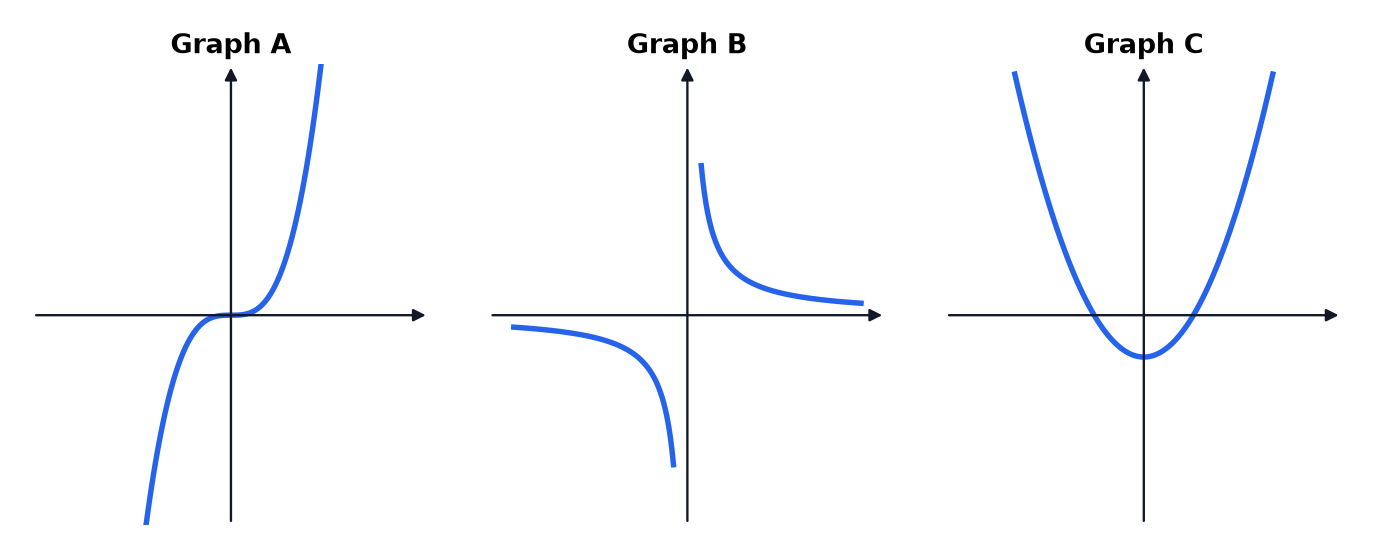
Here are three graphs, \(A\), \(B\) and \(C\). The three equations are \(y = \dfrac{1}{x}\), \(y = x^3\) and \(y = x^2 - 1\). Match each equation to the correct graph.
Show answerHide answer
Model answer
Graph \(A\) is an S-shaped curve through the origin, so it is \(y = x^3\). Graph \(B\) has two branches, so it is \(y = \dfrac{1}{x}\). Graph \(C\) is a U shape with its lowest point at \((0, -1)\), so it is \(y = x^2 - 1\).
Mark scheme
- \(A\) is \(y = x^3\) — B1
- \(B\) is \(y = \dfrac{1}{x}\) — B1
- \(C\) is \(y = x^2 - 1\) — B1
-
2 Complete [2 marks]
Complete the table of values for \(y = x^3\). \(x = -2, -1, 0, 1, 2\)
Show answerHide answer
Model answer
The values are \(-8, -1, 0, 1, 8\).
Mark scheme
- At least three correct values — M1
- \(-8, -1, 0, 1, 8\) — A1
-
3 Complete [3 marks]
(a) Complete the table of values for \(y = \dfrac{8}{x}\). \(x = 1, 2, 4, 8, -2, -4\) (2 marks) (b) Explain why there is no point on the graph with \(x = 0\). (1 mark)
Show answerHide answer
Model answer
(a) The values are \(8, 4, 2, 1, -4, -2\). (b) You cannot divide by zero, so \(\dfrac{8}{0}\) has no value.
Mark scheme
- (a) At least four correct values — M1
- (a) \(8, 4, 2, 1, -4, -2\) — A1
- (b) You cannot divide by zero — C1
-
4 Complete [3 marks]
(a) Complete the table of values for \(y = 2^x\). \(x = -1, 0, 1, 2, 3\) (2 marks) (b) Write down the coordinates of the point where the graph of \(y = 2^x\) crosses the \(y\)-axis. (1 mark)
Show answerHide answer
Model answer
(a) The values are \(\dfrac{1}{2}, 1, 2, 4, 8\). (b) When \(x = 0\), \(y = 2^0 = 1\), so the point is \((0, 1)\).
Mark scheme
- (a) At least three correct values — M1
- (a) \(\dfrac{1}{2}, 1, 2, 4, 8\) — A1
- (b) \((0, 1)\) — B1
-
5 Work out [2 marks]
Work out the value of \(y\) when \(x = -3\) for \(y = x^3 - x\).
Show answerHide answer
Model answer
\((-3)^3 - (-3) = -27 + 3 = -24\).
Mark scheme
- \((-3)^3 = -27\) — M1
- \(-24\) — A1
-
6 Show that [3 marks]
(a) Write down the equation of the circle with centre \((0, 0)\) and radius 6. (1 mark) (b) Show that the point \((4, 5)\) lies on the circle \(x^2 + y^2 = 41\). (2 marks)
Show answerHide answer
Model answer
(a) \(x^2 + y^2 = 36\). (b) \(4^2 + 5^2 = 16 + 25 = 41\), so the point lies on the circle.
Mark scheme
- (a) \(x^2 + y^2 = 36\) — B1
- (b) \(4^2 + 5^2\) or \(16 + 25\) — M1
- (b) 41 with a conclusion — C1
Quick check
-
1
What shape is the graph of \(y = x^3\)?
Show answerHide answer
A: An S-shaped curve through the origin
Cubic graphs have an S shape.
-
2
What is special about the graph of \(y = \dfrac{1}{x}\)?
Show answerHide answer
D: It has two branches and never touches either axis
You cannot divide by 0, and \(\dfrac{1}{x}\) is never 0.
-
3
Where does the graph of \(y = 3^x\) cross the \(y\)-axis?
Show answerHide answer
C: \((0, 1)\)
\(3^0 = 1\).
-
4
What is the value of \(x^3\) when \(x = -3\)?
Show answerHide answer
B: \(-27\)
\((-3) \times (-3) \times (-3) = -27\).
-
5
Which of these equations gives a cubic graph?
Show answerHide answer
A: \(y = x^3 + 1\)
A cubic has \(x^3\) as its highest power.
-
6
Work out \(y\) when \(x = 2\) on \(y = x^3 - 3x\).
Show answerHide answer
D: \(2\)
\(8 - 6 = 2\).
-
7
What is \(2^3\)?
Show answerHide answer
C: \(8\)
\(2 \times 2 \times 2 = 8\).
-
8
What shape is the graph of \(y = -x^2\)?
Show answerHide answer
B: An upside-down U
A negative \(x^2\) term turns the parabola upside down.
-
9
What is the radius of the circle \(x^2 + y^2 = 36\)?
Show answerHide answer
A: \(6\)
The radius is \(\sqrt{36} = 6\).