Exam questions · Maths · Graphs
Straight-Line Graphs
- 6 exam questions
- 18 marks
- 9 quick checks
-
1 Write down [2 marks]
(a) Write down the gradient of the line with equation \(y = 4x + 7\). (1 mark) (b) Write down the coordinates of the point where this line crosses the \(y\)-axis. (1 mark)
Show answerHide answer
Model answer
(a) The gradient is the number multiplying \(x\), which is 4. (b) The line crosses the \(y\)-axis where \(x = 0\), at \((0, 7)\).
Mark scheme
- (a) 4 — B1
- (b) \((0, 7)\) — B1
-
2 Complete [3 marks]
(a) Complete the table of values for \(y = 3x - 2\) for \(x = -1, 0, 1, 2, 3\). (2 marks) (b) Does the point \((5, 12)\) lie on the line \(y = 3x - 2\)? You must give a reason for your answer. (1 mark)
Show answerHide answer
Model answer
(a) The values are \(-5, -2, 1, 4, 7\). (b) When \(x = 5\), \(y = 3 \times 5 - 2 = 13\), not 12, so the point does not lie on the line.
Mark scheme
- (a) At least three correct values — M1
- (a) \(-5, -2, 1, 4, 7\) — A1
- (b) No, with \(3 \times 5 - 2 = 13\) or equivalent — C1
-
3 Work out [4 marks]
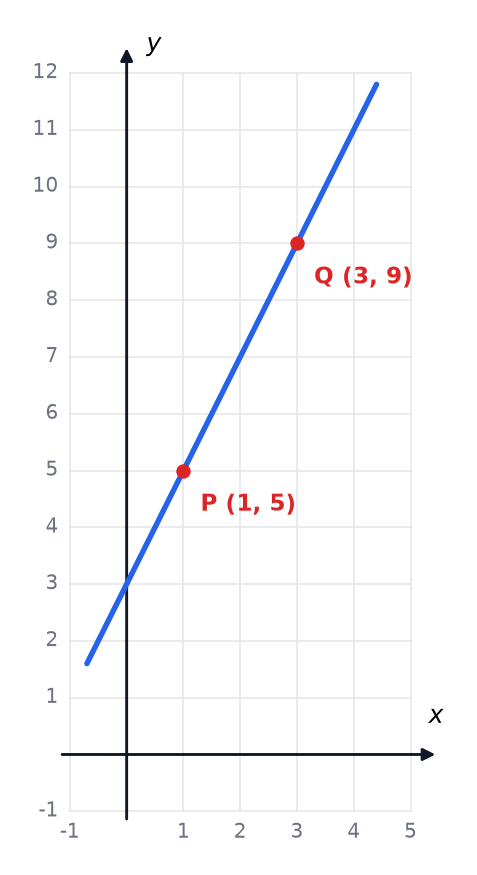
The diagram shows a straight line. The points \(P\) and \(Q\) are on the line. (a) Work out the gradient of the line. (2 marks) (b) Write down the equation of the line. (2 marks)
Show answerHide answer
Model answer
(a) The gradient is \(\dfrac{9 - 5}{3 - 1} = \dfrac{4}{2} = 2\). (b) The line crosses the \(y\)-axis at 3, so the equation is \(y = 2x + 3\).
Mark scheme
- (a) \(\dfrac{9 - 5}{3 - 1}\) — M1
- (a) 2 — A1
- (b) \(y = 2x + c\) or \(y = mx + 3\) — M1
- (b) \(y = 2x + 3\) — A1
-
4 Work out [3 marks]
A line \(L\) has equation \(y = 5 - 2x\). (a) Write down the gradient of \(L\). (1 mark) (b) Work out the coordinates of the point where \(L\) crosses the \(x\)-axis. (2 marks)
Show answerHide answer
Model answer
(a) Written as \(y = -2x + 5\), the gradient is \(-2\). (b) On the \(x\)-axis \(y = 0\), so \(0 = 5 - 2x\) and \(x = 2.5\). The point is \((2.5, 0)\).
Mark scheme
- (a) \(-2\) — B1
- (b) \(y = 0\) used, or \(5 - 2x = 0\) — M1
- (b) \((2.5, 0)\) — A1
-
5 Work out [2 marks]
Work out the gradient of the straight line that passes through \((-2, 3)\) and \((4, -9)\).
Show answerHide answer
Model answer
\(\dfrac{-9 - 3}{4 - (-2)} = \dfrac{-12}{6} = -2\).
Mark scheme
- \(\dfrac{-9 - 3}{4 - (-2)}\) or \(\dfrac{-12}{6}\) — M1
- \(-2\) — A1
-
6 Show that [4 marks]
Line \(L_1\) has equation \(y = 2x + 3\). Line \(L_2\) passes through \((0, -1)\) and \((4, 7)\). (a) Show that \(L_1\) and \(L_2\) are parallel. (3 marks) (b) Does the point \((3, 9)\) lie on \(L_1\)? (1 mark)
Show answerHide answer
Model answer
(a) The gradient of \(L_2\) is \(\dfrac{7 - (-1)}{4 - 0} = \dfrac{8}{4} = 2\). This is the same as the gradient of \(L_1\), so the lines are parallel. (b) \(2 \times 3 + 3 = 9\), so yes.
Mark scheme
- (a) \(\dfrac{7 - (-1)}{4 - 0}\) — M1
- (a) Gradient of \(L_2\) is 2 — A1
- (a) States that equal gradients mean the lines are parallel — C1
- (b) Yes, because \(2 \times 3 + 3 = 9\) — B1
Quick check
-
1
What is the equation of the \(x\)-axis?
Show answerHide answer
B: \(y = 0\)
Every point on the \(x\)-axis has \(y = 0\).
-
2
Which point is on the line \(y = 3x - 2\)?
Show answerHide answer
A: \((4, 10)\)
Put in the coordinates: \(3 \times 4 - 2 = 10\), so \((4, 10)\) fits.
-
3
Work out the gradient of the line through \((1, 7)\) and \((4, 1)\).
Show answerHide answer
D: \(-2\)
\(\dfrac{1 - 7}{4 - 1} = \dfrac{-6}{3} = -2\).
-
4
Which line is parallel to \(y = 3x + 1\)?
Show answerHide answer
C: \(y = 3x - 5\)
Parallel lines have the same gradient, 3.
-
5
What is the equation of the vertical line through 4 on the \(x\)-axis?
Show answerHide answer
B: \(x = 4\)
Every point on the line has \(x = 4\).
-
6
What is the gradient of the line \(y = 5 - 3x\)?
Show answerHide answer
A: \(-3\)
Written as \(y = -3x + 5\), the number multiplying \(x\) is \(-3\).
-
7
What is the value of \(y\) on the line \(y = 2x - 1\) when \(x = -1\)?
Show answerHide answer
D: \(-3\)
\(2 \times (-1) - 1 = -2 - 1 = -3\).
-
8
Where does the line \(y = 3x + 2\) cross the \(y\)-axis?
Show answerHide answer
C: \((0, 2)\)
The number on its own, 2, is the \(y\)-intercept.
-
9
Work out the gradient of the line through \((-2, 3)\) and \((4, -9)\).
Show answerHide answer
B: \(-2\)
\(\dfrac{-9 - 3}{4 - (-2)} = \dfrac{-12}{6} = -2\).