Exam questions · Maths · Probability
Conditional Probability
- 6 exam questions
- 22 marks
- 9 quick checks
-
1 Work out [2 marks]
There are 3 red sweets and 5 blue sweets in a bag. Tom takes a sweet at random and eats it. He then takes a second sweet. Given that the first sweet was red, work out the probability that the second sweet is blue.
Show answerHide answer
Model answer
After the red sweet is eaten there are 7 sweets left, 5 of them blue, so the probability is \(\dfrac{5}{7}\).
Mark scheme
- 7 sweets remaining, or the denominator 7 — M1
- \(\dfrac{5}{7}\) — A1
-
2 Work out [5 marks]
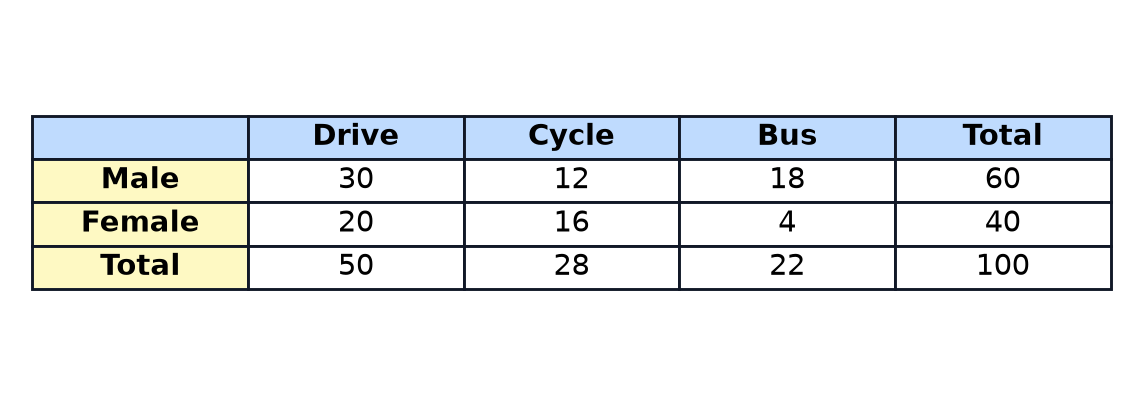
The two-way table shows how 100 people travel to work. (a) One of the people is chosen at random. Work out the probability that the person drives. (1 mark) (b) One of the females is chosen at random. Work out the probability that she cycles. (2 marks) (c) One of the people who take the bus is chosen at random. Work out the probability that the person is male. (2 marks)
Show answerHide answer
Model answer
(a) \(\dfrac{50}{100} = \dfrac{1}{2}\). (b) There are 40 females and 16 cycle, so \(\dfrac{16}{40} = \dfrac{2}{5}\). (c) There are 22 people who take the bus and 18 of them are male, so \(\dfrac{18}{22} = \dfrac{9}{11}\).
Mark scheme
- (a) \(\dfrac{50}{100}\) or \(\dfrac{1}{2}\) — B1
- (b) \(\dfrac{16}{40}\) — M1
- (b) \(\dfrac{2}{5}\) — A1
- (c) \(\dfrac{18}{22}\) — M1
- (c) \(\dfrac{9}{11}\) — A1
-
3 Work out [3 marks]
\(A\) and \(B\) are two events. \(P(A) = 0.4\), \(P(B) = 0.5\) and \(P(A \text{ and } B) = 0.2\). (a) Work out \(P(A \text{ given } B)\). (2 marks) (b) Are \(A\) and \(B\) independent? Give a reason for your answer. (1 mark)
Show answerHide answer
Model answer
(a) \(P(A \text{ given } B) = \dfrac{0.2}{0.5} = 0.4\). (b) Yes, because \(P(A \text{ given } B) = 0.4 = P(A)\), so knowing \(B\) happened does not change the probability of \(A\).
Mark scheme
- (a) \(\dfrac{0.2}{0.5}\) or \(0.2 = P(A \text{ given } B) \times 0.5\) — M1
- (a) \(0.4\) — A1
- (b) Yes, with the reason that \(P(A \text{ given } B) = P(A)\) — C1
-
4 Work out [4 marks]
There are 40 students in a class. 22 play football (F) and 19 play tennis (T). 6 play both and 5 play neither. (a) A student who plays tennis is chosen at random. Work out the probability that the student also plays football. (2 marks) (b) A student who does not play football is chosen at random. Work out the probability that the student plays tennis. (2 marks)
Show answerHide answer
Model answer
(a) 19 play tennis and 6 of them also play football, so \(\dfrac{6}{19}\). (b) \(40 - 22 = 18\) do not play football, and 13 of them play tennis, so \(\dfrac{13}{18}\).
Mark scheme
- (a) \(\dfrac{6}{19}\) with 19 as the denominator — M1
- (a) \(\dfrac{6}{19}\) — A1
- (b) \(\dfrac{13}{18}\) with 18 as the denominator — M1
- (b) \(\dfrac{13}{18}\) — A1
-
5 Work out [4 marks]
A bag contains 5 red counters and 3 blue counters. Two counters are taken at random without replacement. Given that the two counters are different colours, work out the probability that the first counter is red.
Show answerHide answer
Model answer
\(P(\text{red then blue}) = \dfrac{5}{8} \times \dfrac{3}{7} = \dfrac{15}{56}\) and \(P(\text{blue then red}) = \dfrac{3}{8} \times \dfrac{5}{7} = \dfrac{15}{56}\). The probability that they are different is \(\dfrac{30}{56}\), so the probability that the first is red is \(\dfrac{15}{56} \div \dfrac{30}{56} = \dfrac{1}{2}\).
Mark scheme
- \(\dfrac{5}{8} \times \dfrac{3}{7}\) — M1
- \(\dfrac{3}{8} \times \dfrac{5}{7}\) and the two added — M1
- \(\dfrac{15}{56} \div \dfrac{30}{56}\) or \(\dfrac{15}{30}\) — M1
- \(\dfrac{1}{2}\) — A1
-
6 Work out [4 marks]
Machine \(X\) makes 60% of the items in a factory and machine \(Y\) makes 40%. 5% of the items from \(X\) are faulty and 10% of the items from \(Y\) are faulty. An item is chosen at random and is found to be faulty. Work out the probability that it was made by machine \(X\).
Show answerHide answer
Model answer
\(P(X \text{ and faulty}) = 0.6 \times 0.05 = 0.03\) and \(P(Y \text{ and faulty}) = 0.4 \times 0.1 = 0.04\). So \(P(\text{faulty}) = 0.07\), and the probability is \(\dfrac{0.03}{0.07} = \dfrac{3}{7}\).
Mark scheme
- \(0.6 \times 0.05 = 0.03\) — M1
- \(0.4 \times 0.1 = 0.04\) — M1
- \(\dfrac{0.03}{0.07}\) — M1
- \(\dfrac{3}{7}\) — A1
Quick check
-
1
What does \(P(A \mid B)\) mean?
Show answerHide answer
B: The probability of \(A\) given that \(B\) has happened
The vertical line means “given that”.
-
2
14 students play tennis, and 6 of them also play football. What is the probability that a tennis player also plays football?
Show answerHide answer
A: \(\dfrac{3}{7}\)
The group is the 14 tennis players: \(\dfrac{6}{14} = \dfrac{3}{7}\).
-
3
Of 50 people who drive to work, 20 are female. A driver is chosen at random. What is the probability that the person is male?
Show answerHide answer
D: \(\dfrac{3}{5}\)
\(\dfrac{30}{50} = \dfrac{3}{5}\). The group is the 50 drivers.
-
4
Of 100 people, 36 male drivers and 24 female drivers drive to work. A driver is chosen at random. What is the probability that the driver is female?
Show answerHide answer
C: \(\dfrac{2}{5}\)
The group is \(36 + 24 = 60\) drivers, and \(\dfrac{24}{60} = \dfrac{2}{5}\).
-
5
A bag has 3 red and 2 blue counters. One red counter is taken and not replaced. What is the probability that the next counter is red?
Show answerHide answer
B: \(\dfrac{1}{2}\)
2 red counters are left among 4, so \(\dfrac{2}{4} = \dfrac{1}{2}\).
-
6
Is \(P(A \mid B)\) always equal to \(P(B \mid A)\)?
Show answerHide answer
A: No, because they use different groups
The group on the bottom is different in each.
-
7
\(P(A) = 0.5\), \(P(B) = 0.4\) and \(P(A \text{ and } B) = 0.2\). Are \(A\) and \(B\) independent?
Show answerHide answer
D: Yes, because \(0.5 \times 0.4 = 0.2\)
Independent events have \(P(A \text{ and } B) = P(A) \times P(B)\).
-
8
\(P(A \text{ and } B) = 0.1\) and \(P(B) = 0.4\). What is \(P(A \mid B)\)?
Show answerHide answer
C: \(0.25\)
\(\dfrac{0.1}{0.4} = 0.25\).
-
9
\(P(A \mid B) = 0.5\) and \(P(B) = 0.6\). What is \(P(A \text{ and } B)\)?
Show answerHide answer
B: \(0.3\)
\(P(A \text{ and } B) = P(A \mid B) \times P(B) = 0.5 \times 0.6 = 0.3\).