Exam questions · Maths · Ratio and Proportion
Units, Conversions and Scale
- 6 exam questions
- 20 marks
- 9 quick checks
-
1 Change [2 marks]
(a) Change 4.5 km to metres. (1 mark) (b) Change 2750 ml to litres. (1 mark)
Show answerHide answer
Model answer
(a) \(4.5 \times 1000 = 4500\) m. (b) \(2750 \div 1000 = 2.75\) litres.
Mark scheme
- (a) 4500 m — B1
- (b) 2.75 litres — B1
-
2 Work out [3 marks]
A cake needs 125 g of butter. Maria has a 2 kg block of butter. Work out how many cakes she can make.
Show answerHide answer
Model answer
\(2\text{ kg} = 2000\) g, and \(2000 \div 125 = 16\) cakes.
Mark scheme
- 2 kg changed to 2000 g — M1
- \(2000 \div 125\) — M1
- 16 — A1
-
3 Work out [5 marks]
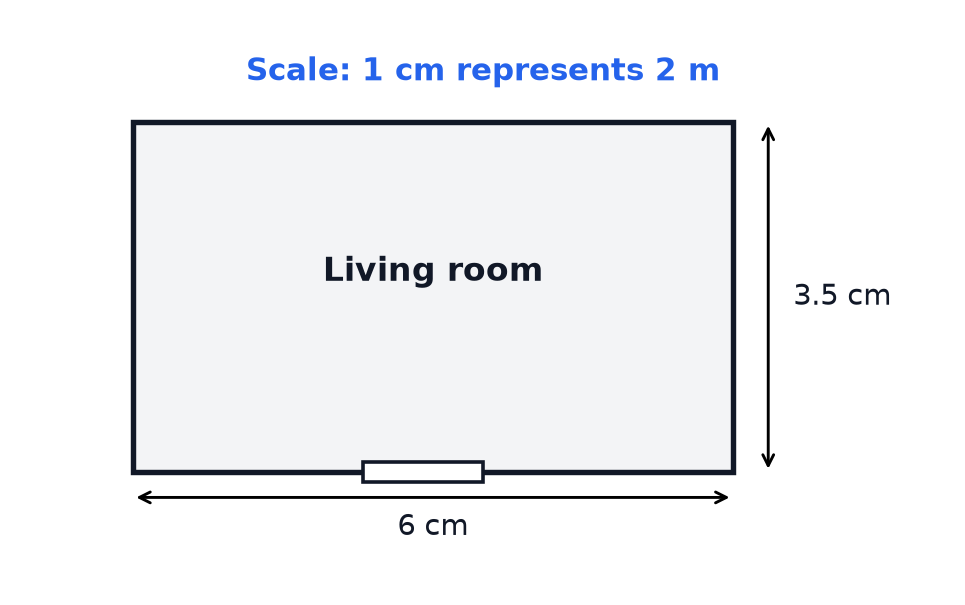
The diagram shows a scale drawing of the floor of a living room. The scale is 1 cm represents 2 m. (a) Work out the real length of the room. (1 mark) (b) Work out the real width of the room. (1 mark) Carpet costs \(\pounds 15\) per square metre. (c) Work out the cost of carpet to cover the whole floor. (3 marks)
Show answerHide answer
Model answer
(a) \(6 \times 2 = 12\) m. (b) \(3.5 \times 2 = 7\) m. (c) The area is \(12 \times 7 = 84\) m\(^2\), so the cost is \(84 \times 15 = \pounds 1260\).
Mark scheme
- (a) 12 m — B1
- (b) 7 m — B1
- (c) \(12 \times 7 = 84\) — M1
- (c) \(84 \times 15\) — M1
- (c) \(\pounds 1260\) — A1
-
4 Work out [3 marks]
A map has a scale of \(1 : 25\,000\). Two villages are 6.4 cm apart on the map. Work out the real distance between the villages in kilometres.
Show answerHide answer
Model answer
\(6.4 \times 25\,000 = 160\,000\) cm. This is \(1600\) m, which is 1.6 km.
Mark scheme
- \(6.4 \times 25\,000\) — M1
- \(160\,000\) cm or \(1600\) m — M1
- 1.6 km — A1
-
5 Work out [3 marks]
A rectangle measures 2.5 m by 40 cm. Work out the area of the rectangle in cm\(^2\).
Show answerHide answer
Model answer
\(2.5\text{ m} = 250\) cm, so the area is \(250 \times 40 = 10\,000\) cm\(^2\).
Mark scheme
- 2.5 m changed to 250 cm, or 40 cm changed to 0.4 m — M1
- \(250 \times 40\) — M1
- \(10\,000\) cm\(^2\) — A1
-
6 Change [4 marks]
(a) Change 3.5 m\(^2\) to cm\(^2\). (2 marks) (b) Change \(4\,000\,000\) cm\(^3\) to m\(^3\). (2 marks)
Show answerHide answer
Model answer
(a) \(1\text{ m}^2 = 100 \times 100 = 10\,000\) cm\(^2\), so \(3.5 \times 10\,000 = 35\,000\) cm\(^2\). (b) \(1\text{ m}^3 = 1\,000\,000\) cm\(^3\), so \(4\,000\,000 \div 1\,000\,000 = 4\) m\(^3\).
Mark scheme
- (a) \(3.5 \times 10\,000\) or \(350 \times 100\) — M1
- (a) \(35\,000\) — A1
- (b) \(4\,000\,000 \div 1\,000\,000\) — M1
- (b) 4 — A1
Quick check
-
1
Change 3.6 km to metres.
Show answerHide answer
A: 3600 m
Multiply by 1000: \(3.6 \times 1000 = 3600\).
-
2
Change 2450 g to kilograms.
Show answerHide answer
D: 2.45 kg
Divide by 1000: \(2450 \div 1000 = 2.45\).
-
3
Change 0.75 litres to millilitres.
Show answerHide answer
C: 750 ml
Multiply by 1000: \(0.75 \times 1000 = 750\).
-
4
Change 250 cm to metres.
Show answerHide answer
B: 2.5 m
Divide by 100: \(250 \div 100 = 2.5\).
-
5
A map has a scale of \(1 : 50\,000\). Two towns are 4 cm apart on the map. What is the real distance?
Show answerHide answer
A: 2 km
\(4 \times 50\,000 = 200\,000\) cm. Divide by 100 to get 2000 m, then by 1000 to get 2 km.
-
6
A scale drawing uses 1 cm to represent 2 m. A line on the drawing is 7 cm. How long is it in real life?
Show answerHide answer
D: 14 m
Multiply by the scale: \(7 \times 2 = 14\) m.
-
7
A cake uses 250 g of flour. How many cakes can be made from a 2 kg bag?
Show answerHide answer
C: 8
\(2\text{ kg} = 2000\) g, and \(2000 \div 250 = 8\).
-
8
How many cm\(^2\) are in 1 m\(^2\)?
Show answerHide answer
B: 10 000
A square metre is a square of side 100 cm, so its area is \(100 \times 100 = 10\,000\) cm\(^2\).
-
9
Change 5 m\(^3\) to cm\(^3\).
Show answerHide answer
A: 5 000 000 cm\(^3\)
\(1\text{ m}^3 = 100^3 = 1\,000\,000\) cm\(^3\), so \(5\text{ m}^3 = 5\,000\,000\) cm\(^3\).