Exam questions · Maths · Transformations and Similarity
Reflections and Translations
- 6 exam questions
- 18 marks
- 9 quick checks
-
1 Write down [2 marks]
Write down the coordinates of the image of the point \((3, 4)\) after a reflection in the \(y\)-axis.
Show answerHide answer
Model answer
A reflection in the \(y\)-axis changes the sign of the \(x\)-coordinate, so the image is \((-3, 4)\).
Mark scheme
- The \(x\)-coordinate changes sign — M1
- \((-3, 4)\) — A1
-
2 Reflect [4 marks]
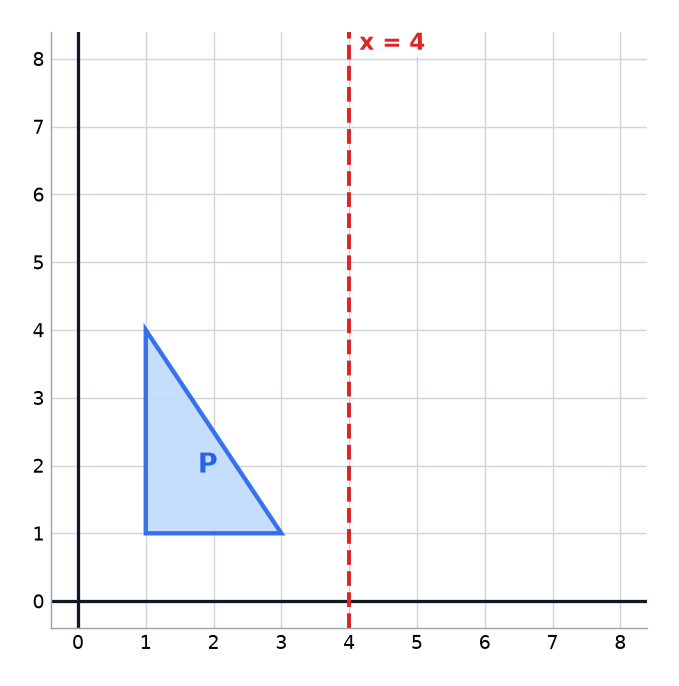
Triangle \(P\) is drawn on the grid. (a) Reflect triangle \(P\) in the line \(x = 4\). Label the image \(Q\). (2 marks) (b) Translate triangle \(P\) by the vector \(\begin{pmatrix} 2 \\ 3 \end{pmatrix}\). Label the image \(R\). (2 marks)
Show answerHide answer
Model answer
(a) The vertices of \(P\) are \((1, 1)\), \((3, 1)\) and \((1, 4)\), which are 3, 1 and 3 units to the left of \(x = 4\). So \(Q\) has vertices \((7, 1)\), \((5, 1)\) and \((7, 4)\). (b) Adding 2 to each \(x\) and 3 to each \(y\) gives \(R\) with vertices \((3, 4)\), \((5, 4)\) and \((3, 7)\).
Mark scheme
- (a) Reflects at least two vertices correctly — M1
- (a) \(Q\) with vertices \((7, 1)\), \((5, 1)\) and \((7, 4)\) — A1
- (b) Translates at least two vertices correctly — M1
- (b) \(R\) with vertices \((3, 4)\), \((5, 4)\) and \((3, 7)\) — A1
-
3 Describe [3 marks]
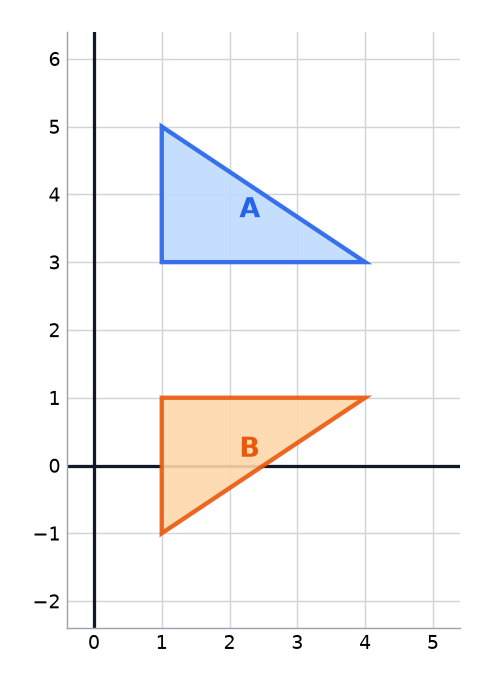
Triangle \(B\) is the image of triangle \(A\) after a single transformation. (a) Describe fully the single transformation that maps \(A\) onto \(B\). (2 marks) (b) Triangle \(A\) has an area of 3 square units. Write down the area of triangle \(B\). (1 mark)
Show answerHide answer
Model answer
(a) Corresponding points are the same distance from the line \(y = 2\) on opposite sides, so it is a reflection in the line \(y = 2\). (b) A reflection does not change the size, so the area of \(B\) is also 3 square units.
Mark scheme
- (a) Reflection — B1
- (a) In the line \(y = 2\) — B1
- (b) 3 — B1
-
4 Write down [3 marks]
\(A\) is the point \((2, 3)\). \(A\) is translated by the vector \(\begin{pmatrix} -4 \\ 1 \end{pmatrix}\) to give the point \(B\). \(B\) is reflected in the \(x\)-axis to give the point \(C\). Write down the coordinates of (a) \(B\), (b) \(C\). (3 marks)
Show answerHide answer
Model answer
(a) \(B = (2 - 4, 3 + 1) = (-2, 4)\). (b) A reflection in the \(x\)-axis changes the sign of the \(y\)-coordinate, so \(C = (-2, -4)\).
Mark scheme
- (a) \((-2, 4)\) — B1
- (b) Changes the sign of the \(y\)-coordinate of their \(B\) — M1
- (b) \((-2, -4)\) — A1 (follow through from (a))
-
5 Work out [3 marks]
A translation maps the point \((-1, 4)\) onto the point \((5, -2)\). (a) Write down the column vector of the translation. (2 marks) (b) The same translation maps \((3, 3)\) onto the point \(Q\). Write down the coordinates of \(Q\). (1 mark)
Show answerHide answer
Model answer
(a) The change in \(x\) is \(5 - (-1) = 6\) and the change in \(y\) is \(-2 - 4 = -6\), so the vector is \(\begin{pmatrix} 6 \\ -6 \end{pmatrix}\). (b) \(Q = (3 + 6, 3 - 6) = (9, -3)\).
Mark scheme
- (a) \(5 - (-1)\) or \(-2 - 4\) — M1
- (a) \(\begin{pmatrix} 6 \\ -6 \end{pmatrix}\) — A1
- (b) \((9, -3)\) — B1 (follow through from (a))
-
6 Work out [3 marks]
The point \(P\) is \((3, 1)\). \(P\) is reflected in the line \(y = x\) to give \(Q\). \(Q\) is reflected in the \(y\)-axis to give \(R\). Write down the coordinates of \(R\).
Show answerHide answer
Model answer
Reflecting in \(y = x\) swaps the coordinates, so \(Q = (1, 3)\). Reflecting in the \(y\)-axis changes the sign of \(x\), so \(R = (-1, 3)\).
Mark scheme
- \(Q = (1, 3)\) — B1
- Changes the sign of the \(x\)-coordinate of their \(Q\) — M1
- \((-1, 3)\) — A1
Quick check
-
1
What is the image of the point \((3, 5)\) in the \(x\)-axis?
Show answerHide answer
B: \((3, -5)\)
A reflection in the \(x\)-axis changes the sign of the \(y\)-coordinate.
-
2
What is the image of the point \((2, 3)\) in the \(y\)-axis?
Show answerHide answer
A: \((-2, 3)\)
A reflection in the \(y\)-axis changes the sign of the \(x\)-coordinate.
-
3
What is the image of \((4, 1)\) in the line \(y = x\)?
Show answerHide answer
D: \((1, 4)\)
In the line \(y = x\) the coordinates swap.
-
4
The point \((5, 2)\) is reflected in the line \(x = 3\). What is the image?
Show answerHide answer
C: \((1, 2)\)
\((5, 2)\) is 2 right of the line, so the image is 2 left of it, at \((1, 2)\).
-
5
What does the column vector \(\begin{pmatrix} -2 \\ 5 \end{pmatrix}\) mean?
Show answerHide answer
B: 2 left and 5 up
The top number is left or right, and the bottom number is up or down.
-
6
The point \((4, 1)\) is translated by \(\begin{pmatrix} -3 \\ 2 \end{pmatrix}\). What is the image?
Show answerHide answer
A: \((1, 3)\)
\((4 - 3, 1 + 2) = (1, 3)\).
-
7
A translation takes \((2, 5)\) to \((7, 3)\). What is the column vector?
Show answerHide answer
D: \(\begin{pmatrix} 5 \\ -2 \end{pmatrix}\)
The change in \(x\) is \(7 - 2 = 5\) and the change in \(y\) is \(3 - 5 = -2\).
-
8
What must you give to describe a reflection fully?
Show answerHide answer
C: The equation of the mirror line
A reflection is described by its mirror line, such as \(x = 1\).
-
9
What is the image of \((4, 1)\) in the line \(y = -x\)?
Show answerHide answer
B: \((-1, -4)\)
In the line \(y = -x\) the coordinates swap and both change sign.