Exam questions · Maths · Vectors, Constructions and Loci
Column Vectors and Vector Arithmetic
- 6 exam questions
- 17 marks
- 9 quick checks
-
1 Write down [2 marks]
Write down the column vector for a move of 2 to the left and 4 up.
Show answerHide answer
Model answer
Left is negative and up is positive, so the vector is \(\begin{pmatrix} -2 \\ 4 \end{pmatrix}\).
Mark scheme
- \(-2\) as the top number — B1
- \(\begin{pmatrix} -2 \\ 4 \end{pmatrix}\) — B1
-
2 Work out [4 marks]
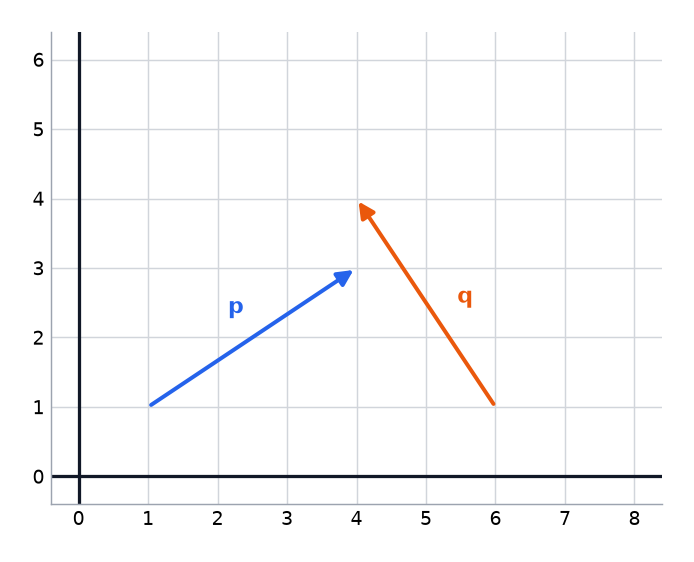
The vectors \(\mathbf{p}\) and \(\mathbf{q}\) are drawn on the grid. (a) Write \(\mathbf{p}\) and \(\mathbf{q}\) as column vectors. (2 marks) (b) Work out \(2\mathbf{p} + \mathbf{q}\). (2 marks)
Show answerHide answer
Model answer
(a) \(\mathbf{p}\) goes 3 right and 2 up, so \(\mathbf{p} = \begin{pmatrix} 3 \\ 2 \end{pmatrix}\). \(\mathbf{q}\) goes 2 left and 3 up, so \(\mathbf{q} = \begin{pmatrix} -2 \\ 3 \end{pmatrix}\). (b) \(2\mathbf{p} = \begin{pmatrix} 6 \\ 4 \end{pmatrix}\), so \(2\mathbf{p} + \mathbf{q} = \begin{pmatrix} 4 \\ 7 \end{pmatrix}\).
Mark scheme
- (a) \(\mathbf{p} = \begin{pmatrix} 3 \\ 2 \end{pmatrix}\) — B1
- (a) \(\mathbf{q} = \begin{pmatrix} -2 \\ 3 \end{pmatrix}\) — B1
- (b) \(2\mathbf{p} = \begin{pmatrix} 6 \\ 4 \end{pmatrix}\) or a correct method — M1
- (b) \(\begin{pmatrix} 4 \\ 7 \end{pmatrix}\) — A1 (follow through from (a))
-
3 Work out [3 marks]
\(A\) is the point \((-1, 2)\) and \(B\) is the point \((4, -3)\). (a) Write \(\overrightarrow{AB}\) as a column vector. (2 marks) (b) Write \(\overrightarrow{BA}\) as a column vector. (1 mark)
Show answerHide answer
Model answer
(a) \((4 - (-1), -3 - 2) = (5, -5)\), so \(\overrightarrow{AB} = \begin{pmatrix} 5 \\ -5 \end{pmatrix}\). (b) \(\overrightarrow{BA} = -\overrightarrow{AB} = \begin{pmatrix} -5 \\ 5 \end{pmatrix}\).
Mark scheme
- (a) \(4 - (-1)\) or \(-3 - 2\) — M1
- (a) \(\begin{pmatrix} 5 \\ -5 \end{pmatrix}\) — A1
- (b) \(\begin{pmatrix} -5 \\ 5 \end{pmatrix}\) — B1 (follow through from (a))
-
4 Work out [3 marks]
\(\mathbf{a} = \begin{pmatrix} 3 \\ -2 \end{pmatrix}\) and \(\mathbf{b} = \begin{pmatrix} 1 \\ 4 \end{pmatrix}\). (a) Work out \(\mathbf{a} + 2\mathbf{b}\). (2 marks) (b) Write down a vector that is parallel to \(\mathbf{a}\). (1 mark)
Show answerHide answer
Model answer
(a) \(2\mathbf{b} = \begin{pmatrix} 2 \\ 8 \end{pmatrix}\), so \(\mathbf{a} + 2\mathbf{b} = \begin{pmatrix} 5 \\ 6 \end{pmatrix}\). (b) Any multiple of \(\mathbf{a}\), such as \(\begin{pmatrix} 6 \\ -4 \end{pmatrix}\).
Mark scheme
- (a) \(2\mathbf{b} = \begin{pmatrix} 2 \\ 8 \end{pmatrix}\) or a correct method — M1
- (a) \(\begin{pmatrix} 5 \\ 6 \end{pmatrix}\) — A1
- (b) A multiple of \(\begin{pmatrix} 3 \\ -2 \end{pmatrix}\), such as \(\begin{pmatrix} 6 \\ -4 \end{pmatrix}\) — B1
-
5 Show that [2 marks]
Show that the vectors \(\begin{pmatrix} 2 \\ -3 \end{pmatrix}\) and \(\begin{pmatrix} -6 \\ 9 \end{pmatrix}\) are parallel.
Show answerHide answer
Model answer
\(\begin{pmatrix} -6 \\ 9 \end{pmatrix} = -3 \times \begin{pmatrix} 2 \\ -3 \end{pmatrix}\). One vector is a multiple of the other, so they are parallel.
Mark scheme
- \(-3 \times \begin{pmatrix} 2 \\ -3 \end{pmatrix}\) or \(\begin{pmatrix} -6 \\ 9 \end{pmatrix} = -3 \times\) the first — M1
- One is a multiple of the other, so they are parallel — C1
-
6 Work out [3 marks]
(a) Work out the length of the vector \(\begin{pmatrix} 6 \\ 8 \end{pmatrix}\). (2 marks) (b) \(A\) is the point \((1, 2)\) and \(B\) is the point \((5, 5)\). Work out the length of \(AB\). (1 mark)
Show answerHide answer
Model answer
(a) \(\sqrt{6^2 + 8^2} = \sqrt{100} = 10\). (b) \(\overrightarrow{AB} = \begin{pmatrix} 4 \\ 3 \end{pmatrix}\), and \(\sqrt{4^2 + 3^2} = 5\).
Mark scheme
- (a) \(\sqrt{6^2 + 8^2}\) or \(\sqrt{100}\) — M1
- (a) 10 — A1
- (b) 5 — B1
Quick check
-
1
What does the column vector \(\begin{pmatrix} -2 \\ 5 \end{pmatrix}\) mean?
Show answerHide answer
B: 2 left and 5 up
The top number is the horizontal move, and the bottom number is the vertical move.
-
2
\(A\) is \((2, 5)\) and \(B\) is \((6, 2)\). What is \(\overrightarrow{AB}\)?
Show answerHide answer
A: \(\begin{pmatrix} 4 \\ -3 \end{pmatrix}\)
Subtract the start from the end: \((6 - 2, 2 - 5) = (4, -3)\).
-
3
What is \(\begin{pmatrix} 3 \\ 2 \end{pmatrix} + \begin{pmatrix} 1 \\ 4 \end{pmatrix}\)?
Show answerHide answer
D: \(\begin{pmatrix} 4 \\ 6 \end{pmatrix}\)
Add the top numbers and add the bottom numbers.
-
4
What is \(\begin{pmatrix} 3 \\ 2 \end{pmatrix} - \begin{pmatrix} 1 \\ 4 \end{pmatrix}\)?
Show answerHide answer
C: \(\begin{pmatrix} 2 \\ -2 \end{pmatrix}\)
\((3 - 1, 2 - 4) = (2, -2)\).
-
5
What is \(3\begin{pmatrix} 2 \\ -1 \end{pmatrix}\)?
Show answerHide answer
B: \(\begin{pmatrix} 6 \\ -3 \end{pmatrix}\)
Multiply both numbers by 3.
-
6
\(\mathbf{p} = \begin{pmatrix} 2 \\ 3 \end{pmatrix}\) and \(\mathbf{q} = \begin{pmatrix} -1 \\ 4 \end{pmatrix}\). What is \(2\mathbf{p} - \mathbf{q}\)?
Show answerHide answer
A: \(\begin{pmatrix} 5 \\ 2 \end{pmatrix}\)
\(2\mathbf{p} = \begin{pmatrix} 4 \\ 6 \end{pmatrix}\), then \((4 - (-1), 6 - 4) = (5, 2)\).
-
7
Which vector is parallel to \(\begin{pmatrix} 2 \\ 3 \end{pmatrix}\)?
Show answerHide answer
D: \(\begin{pmatrix} 6 \\ 9 \end{pmatrix}\)
\(\begin{pmatrix} 6 \\ 9 \end{pmatrix} = 3\begin{pmatrix} 2 \\ 3 \end{pmatrix}\), so it is parallel.
-
8
\(\overrightarrow{AB} = \begin{pmatrix} 4 \\ -3 \end{pmatrix}\). What is \(\overrightarrow{BA}\)?
Show answerHide answer
C: \(\begin{pmatrix} -4 \\ 3 \end{pmatrix}\)
\(\overrightarrow{BA} = -\overrightarrow{AB}\), so both signs change.
-
9
What is the length of the vector \(\begin{pmatrix} 3 \\ 4 \end{pmatrix}\)?
Show answerHide answer
B: \(5\)
The length is \(\sqrt{3^2 + 4^2} = \sqrt{25} = 5\).