Exam questions · Maths · Functions, Sequences and Rates of Change
Transformations of Graphs
- 6 exam questions
- 18 marks
- 9 quick checks
-
1 Write down [2 marks]
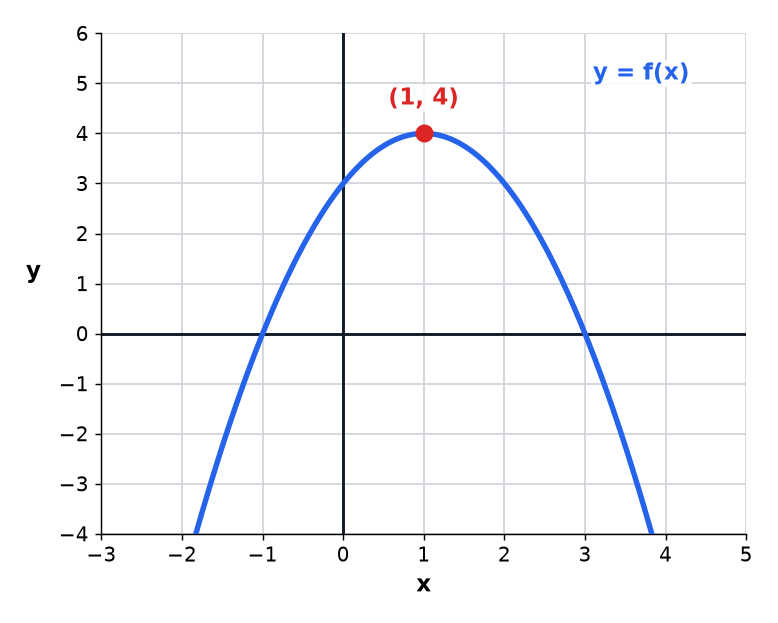
The graph of \(y = f(x)\) is shown. The turning point is \((1, 4)\). (a) Write down the coordinates of the turning point of the graph of \(y = f(x) + 3\). [1 mark] (b) Write down the coordinates of the turning point of the graph of \(y = f(x + 2)\). [1 mark]
Show answerHide answer
Model answer
(a) \((1, 7)\). (b) \((-1, 4)\).
Mark scheme
- (a) \((1, 7)\) — B1
- (b) \((-1, 4)\) — B1
-
2 Write down [2 marks]
The graph of \(y = g(x)\) has a minimum point at \((4, -1)\). (a) Write down the coordinates of the minimum point of \(y = g(x) - 2\). [1 mark] (b) Write down the coordinates of the minimum point of \(y = g(-x)\). [1 mark]
Show answerHide answer
Model answer
(a) \((4, -3)\). (b) \((-4, -1)\).
Mark scheme
- (a) \((4, -3)\) — B1
- (b) \((-4, -1)\) — B1
-
3 Write down [3 marks]
The graph of \(y = x^2\) is transformed. Write down the equation of the new graph after (a) a translation of 6 units to the right, [1 mark] (b) a translation of 1 unit down, [1 mark] (c) a translation by the vector \(\begin{pmatrix} -1 \\ 4 \end{pmatrix}\). [1 mark]
Show answerHide answer
Model answer
(a) \(y = (x - 6)^2\). (b) \(y = x^2 - 1\). (c) \(y = (x + 1)^2 + 4\).
Mark scheme
- (a) \(y = (x - 6)^2\) — B1
- (b) \(y = x^2 - 1\) — B1
- (c) \(y = (x + 1)^2 + 4\) — B1
-
4 Write down [4 marks]
The graph of \(y = f(x)\) has a minimum point at \((1, -2)\). Write down the coordinates of the minimum point of the graph of (a) \(y = f(x - 3)\) [1 mark] (b) \(y = f(x) + 5\) [1 mark] (c) \(y = -f(x)\) [1 mark] (d) \(y = f(-x)\) [1 mark]
Show answerHide answer
Model answer
(a) \((4, -2)\). (b) \((1, 3)\). (c) \((1, 2)\), which is now a maximum. (d) \((-1, -2)\).
Mark scheme
- (a) \((4, -2)\) — B1
- (b) \((1, 3)\) — B1
- (c) \((1, 2)\) — B1
- (d) \((-1, -2)\) — B1
-
5 Write down [3 marks]
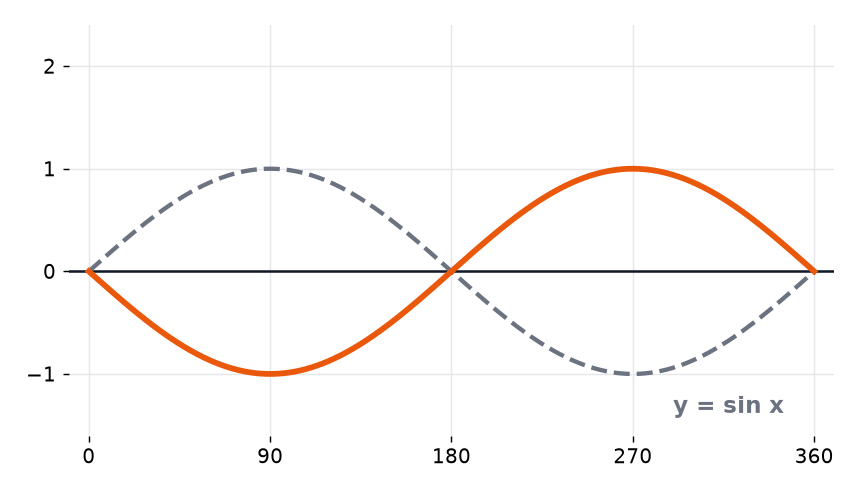
The diagram shows the graph of \(y = \sin x\) and a transformation of it, for \(0^\circ \le x \le 360^\circ\). (a) Write down the equation of the transformed graph. [1 mark] (b) Describe fully the single transformation. [2 marks]
Show answerHide answer
Model answer
(a) \(y = -\sin x\). (b) A reflection in the \(x\)-axis.
Mark scheme
- (a) \(y = -\sin x\) — B1
- (b) Reflection — B1
- (b) In the \(x\)-axis — B1
-
6 Calculate [4 marks]
\(f(x) = x^2 - 2x - 3\). Solve \(f(x) + 3 = 0\). [4 marks]
Show answerHide answer
Model answer
\(f(x) + 3 = x^2 - 2x - 3 + 3 = x^2 - 2x\). Then \(x(x - 2) = 0\), so \(x = 0\) or \(x = 2\).
Mark scheme
- \(x^2 - 2x - 3 + 3\) — M1
- \(x^2 - 2x\) — A1
- \(x(x - 2) = 0\) — M1
- \(x = 0\) and \(x = 2\) — A1
Quick check
-
1
What does \(y = f(x) + 3\) do to the graph of \(y = f(x)\)?
Show answerHide answer
B: Moves it up 3
Adding to the function moves the graph up.
-
2
What does \(y = f(x + 2)\) do to the graph of \(y = f(x)\)?
Show answerHide answer
A: Moves it left 2
A plus inside the bracket moves the graph left.
-
3
What does \(y = -f(x)\) do to the graph of \(y = f(x)\)?
Show answerHide answer
D: Reflects it in the \(x\)-axis
A minus outside changes the \(y\)-values.
-
4
What does \(y = f(-x)\) do to the graph of \(y = f(x)\)?
Show answerHide answer
C: Reflects it in the \(y\)-axis
A minus inside changes the \(x\)-values.
-
5
The maximum of \(y = f(x)\) is at \((3, 5)\). Where is the maximum of \(y = f(x - 2)\)?
Show answerHide answer
B: \((5, 5)\)
The graph moves right 2.
-
6
The maximum of \(y = f(x)\) is at \((3, 5)\). Where is the turning point of \(y = -f(x)\)?
Show answerHide answer
A: \((3, -5)\)
The \(y\)-coordinate changes sign.
-
7
What is the equation of \(y = x^2\) after a translation of 3 units to the right?
Show answerHide answer
D: \(y = (x - 3)^2\)
Moving right replaces \(x\) with \(x - 3\).
-
8
What is the maximum value of \(y = \sin x + 1\)?
Show answerHide answer
C: 2
The sine graph is moved up by 1, so its maximum is \(1 + 1 = 2\).
-
9
Which equation gives the same graph as \(y = \cos x\)?
Show answerHide answer
B: \(y = \sin(x + 90^\circ)\)
Moving the sine graph left by \(90^\circ\) gives the cosine graph.