Exam questions · Maths · Geometry and Measures
Volume and Surface Area
- 6 exam questions
- 21 marks
- 9 quick checks
-
1 Calculate [4 marks]
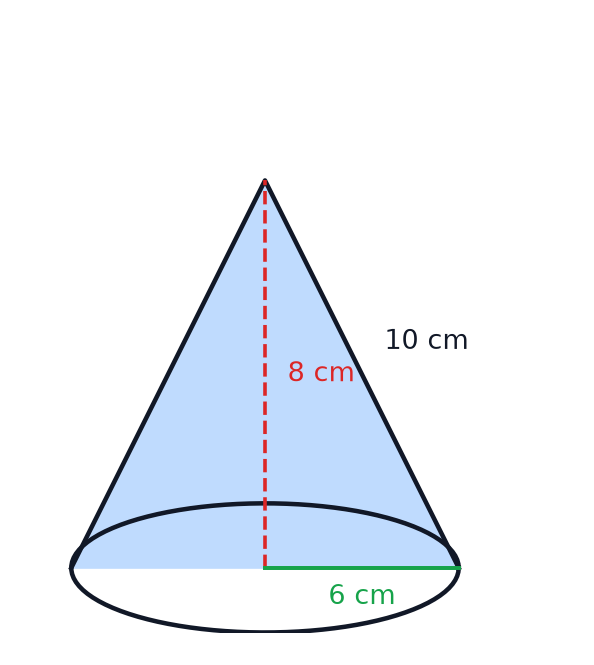
The diagram shows a cone. Give your answers in terms of \(\pi\). (a) Calculate the volume of the cone. [2 marks] (b) Calculate the curved surface area of the cone. [2 marks]
Show answerHide answer
Model answer
(a) \(\dfrac{1}{3} \times \pi \times 6^2 \times 8 = \dfrac{1}{3} \times 288\pi = 96\pi\) cm\(^3\). (b) The curved surface area is \(\pi r l = \pi \times 6 \times 10 = 60\pi\) cm\(^2\).
Mark scheme
- (a) \(\dfrac{1}{3} \times \pi \times 6^2 \times 8\) — M1
- (a) \(96\pi\) — A1
- (b) \(\pi \times 6 \times 10\) — M1
- (b) \(60\pi\) — A1
-
2 Calculate [3 marks]
A cuboid measures 9 cm by 4 cm by 5 cm. Calculate the total surface area of the cuboid.
Show answerHide answer
Model answer
The faces are \(9 \times 4 = 36\), \(9 \times 5 = 45\) and \(4 \times 5 = 20\) cm\(^2\). The total area is \(2 \times (36 + 45 + 20) = 2 \times 101 = 202\) cm\(^2\).
Mark scheme
- \(36\), \(45\) and \(20\) found — M1
- \(2 \times (36 + 45 + 20)\) — M1
- 202 cm\(^2\) — A1
-
3 Calculate [3 marks]
A prism has a cross-section that is a trapezium. The parallel sides of the trapezium are 6 cm and 10 cm and the distance between them is 4 cm. The prism is 12 cm long. Calculate the volume of the prism.
Show answerHide answer
Model answer
The area of the trapezium is \(\dfrac{1}{2}(6 + 10) \times 4 = 32\) cm\(^2\). The volume is \(32 \times 12 = 384\) cm\(^3\).
Mark scheme
- \(\dfrac{1}{2}(6 + 10) \times 4\) — M1
- \(32 \times 12\) — M1
- 384 cm\(^3\) — A1
-
4 Calculate [4 marks]
A cylinder has radius 3 cm and height 7 cm. Give your answers in terms of \(\pi\). (a) Calculate the volume of the cylinder. [2 marks] (b) Calculate the curved surface area of the cylinder. [2 marks]
Show answerHide answer
Model answer
(a) \(\pi \times 3^2 \times 7 = 63\pi\) cm\(^3\). (b) \(2 \times \pi \times 3 \times 7 = 42\pi\) cm\(^2\).
Mark scheme
- (a) \(\pi \times 3^2 \times 7\) — M1
- (a) \(63\pi\) — A1
- (b) \(2 \times \pi \times 3 \times 7\) — M1
- (b) \(42\pi\) — A1
-
5 Calculate [4 marks]
A swimming pool is a cuboid, 25 m long, 10 m wide and 2 m deep. It is filled using a pump that delivers 25 000 litres of water each hour. 1 m\(^3\) \(= 1000\) litres. Calculate the time taken to fill the pool completely.
Show answerHide answer
Model answer
The volume is \(25 \times 10 \times 2 = 500\) m\(^3\), which is \(500 \times 1000 = 500\,000\) litres. The time is \(500\,000 \div 25\,000 = 20\) hours.
Mark scheme
- \(25 \times 10 \times 2 = 500\) — M1
- \(500\,000\) litres — M1
- \(500\,000 \div 25\,000\) — M1
- 20 hours — A1
-
6 Calculate [3 marks]
A sphere has a volume of \(288\pi\) cm\(^3\). Calculate the radius of the sphere.
Show answerHide answer
Model answer
\(\dfrac{4}{3}\pi r^3 = 288\pi\), so \(r^3 = 288 \times \dfrac{3}{4} = 216\) and \(r = 6\) cm.
Mark scheme
- \(\dfrac{4}{3}\pi r^3 = 288\pi\) — M1
- \(r^3 = 216\) — M1
- 6 cm — A1
Quick check
-
1
A cuboid measures 8 cm by 5 cm by 3 cm. What is its volume?
Show answerHide answer
D: 120 cm\(^3\)
\(8 \times 5 \times 3 = 120\) cm\(^3\).
-
2
The cross-section of a prism has area 12 cm\(^2\). The prism is 15 cm long. What is its volume?
Show answerHide answer
C: 180 cm\(^3\)
Volume \(=\) area of cross-section \(\times\) length \(= 12 \times 15 = 180\).
-
3
A cylinder has radius 3 cm and height 10 cm. What is its volume, in terms of \(\pi\)?
Show answerHide answer
B: \(90\pi\) cm\(^3\)
\(\pi r^2 h = \pi \times 9 \times 10 = 90\pi\).
-
4
A cylinder has radius 3 cm and height 10 cm. What is its curved surface area, in terms of \(\pi\)?
Show answerHide answer
A: \(60\pi\) cm\(^2\)
\(2\pi r h = 2 \times \pi \times 3 \times 10 = 60\pi\).
-
5
What is the total surface area of a cube with side 4 cm?
Show answerHide answer
D: 96 cm\(^2\)
A cube has 6 faces, each of area \(4 \times 4 = 16\). So \(6 \times 16 = 96\).
-
6
A tank holds 2500 cm\(^3\) of water. How many litres is this?
Show answerHide answer
C: 2.5 litres
\(1000\text{ cm}^3 = 1\) litre, so \(2500 \div 1000 = 2.5\).
-
7
A cylinder has radius 2 cm and height 7 cm. What is its volume, in terms of \(\pi\)?
Show answerHide answer
B: \(28\pi\) cm\(^3\)
\(\pi \times 2^2 \times 7 = 28\pi\). Using the diameter instead of the radius would give \(98\pi\).
-
8
A sphere has radius 3 cm. What is its volume, in terms of \(\pi\)?
Show answerHide answer
A: \(36\pi\) cm\(^3\)
\(\dfrac{4}{3}\pi r^3 = \dfrac{4}{3} \times \pi \times 27 = 36\pi\).
-
9
A cone has radius 3 cm and vertical height 4 cm. What is its volume, in terms of \(\pi\)?
Show answerHide answer
D: \(12\pi\) cm\(^3\)
\(\dfrac{1}{3}\pi r^2 h = \dfrac{1}{3} \times \pi \times 9 \times 4 = 12\pi\). Using the slant height 5 gives \(15\pi\), which is wrong.