Exam questions · Maths · Probability
Frequency Trees and Two-Way Tables
- 6 exam questions
- 20 marks
- 9 quick checks
-
1 Work out [3 marks]
A club has 45 members. 27 of them are girls. 9 of the girls and 6 of the boys are left-handed. (a) Calculate the number of boys. [1 mark] (b) Calculate the number of left-handed members. [1 mark] (c) Calculate the number of girls who are right-handed. [1 mark]
Show answerHide answer
Model answer
(a) \(45 - 27 = 18\). (b) \(9 + 6 = 15\). (c) \(27 - 9 = 18\).
Mark scheme
- (a) 18 — B1
- (b) 15 — B1
- (c) 18 — B1
-
2 Calculate [4 marks]
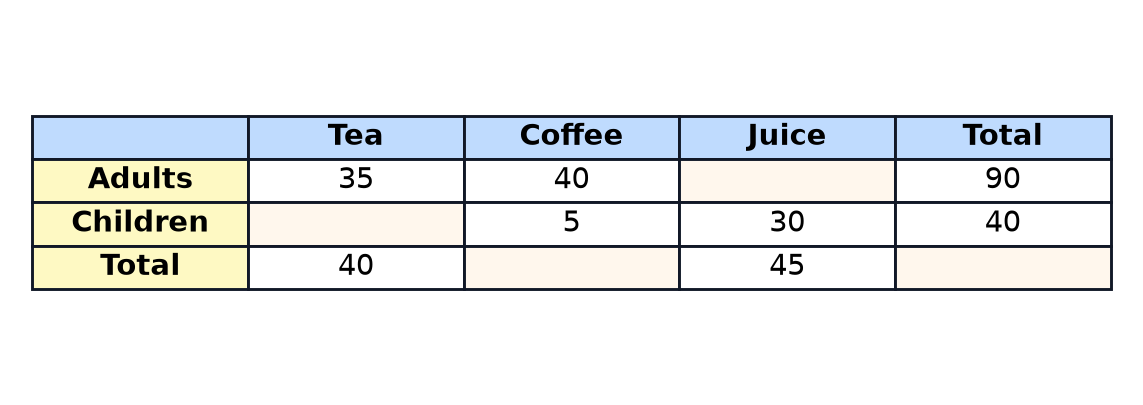
The two-way table shows the drinks ordered by 130 customers in a cafe. Some of the numbers are missing. (a) Complete the two-way table. [3 marks] (b) A customer is chosen at random. Calculate the probability that the customer is a child who ordered tea. [1 mark]
Show answerHide answer
Model answer
(a) Adults who ordered juice: \(90 - 35 - 40 = 15\). Children who ordered tea: \(40 - 5 - 30 = 5\). Coffee total: \(40 + 5 = 45\). Overall total: \(90 + 40 = 130\). (b) \(\dfrac{5}{130} = \dfrac{1}{26}\).
Mark scheme
- (a) At least two correct values — B1
- (a) At least three correct values — B1
- (a) 15, 5, 45 and 130 all correct — B1
- (b) \(\dfrac{1}{26}\) or \(\dfrac{5}{130}\) — B1
-
3 Calculate [3 marks]
There are 80 cars in a car park. 55% of the cars are petrol and the rest are diesel. \(\dfrac{1}{4}\) of the petrol cars and \(\dfrac{3}{4}\) of the diesel cars are red. Calculate the number of red cars. [3 marks]
Show answerHide answer
Model answer
Petrol: \(0.55 \times 80 = 44\) and diesel: 36. Red cars: \(\dfrac{1}{4} \times 44 = 11\) and \(\dfrac{3}{4} \times 36 = 27\). The total is \(11 + 27 = 38\).
Mark scheme
- 44 petrol and 36 diesel — M1
- 11 and 27 seen — M1
- 38 — A1
-
4 Calculate [3 marks]
There are 28 pupils in a class. 16 of them are girls. 9 of the girls and 5 of the boys have a pet. A pupil is chosen at random. (a) Calculate the number of pupils who do not have a pet. [1 mark] (b) Calculate the probability that the pupil has a pet. [2 marks]
Show answerHide answer
Model answer
(a) \(9 + 5 = 14\) have a pet, so \(28 - 14 = 14\) do not. (b) \(\dfrac{14}{28} = \dfrac{1}{2}\).
Mark scheme
- (a) 14 — B1
- (b) \(\dfrac{14}{28}\) — M1
- (b) \(\dfrac{1}{2}\) — A1
-
5 Calculate [3 marks]
In a school, 40% of the pupils are in the lower school. 15% of the lower school and 35% of the upper school walk home. A pupil is chosen at random. Calculate the probability that the pupil walks home. [3 marks]
Show answerHide answer
Model answer
Lower school: \(0.4 \times 0.15 = 0.06\). Upper school: \(0.6 \times 0.35 = 0.21\). The total is \(0.06 + 0.21 = 0.27\).
Mark scheme
- \(0.4 \times 0.15 = 0.06\) — M1
- \(0.6 \times 0.35 = 0.21\) — M1
- \(0.27\) — A1
-
6 Calculate [4 marks]
There are 120 people at a party. The ratio of men to women is \(2 : 3\). \(\dfrac{3}{4}\) of the men and \(\dfrac{1}{2}\) of the women wear a hat. A person is chosen at random. Calculate the probability that the person wears a hat. [4 marks]
Show answerHide answer
Model answer
Men: \(120 \div 5 \times 2 = 48\) and women: 72. Hats: \(\dfrac{3}{4} \times 48 = 36\) and \(\dfrac{1}{2} \times 72 = 36\), a total of 72. The probability is \(\dfrac{72}{120} = \dfrac{3}{5}\).
Mark scheme
- 48 men and 72 women — M1
- 36 and 36 seen — M1
- \(\dfrac{72}{120}\) — A1
- \(\dfrac{3}{5}\) — A1
Quick check
-
1
A frequency tree starts with 100 pupils, and 60 are girls. How many are boys?
Show answerHide answer
A: \(40\)
\(100 - 60 = 40\).
-
2
40% of 60 girls walk to school. How many girls walk?
Show answerHide answer
D: \(24\)
\(0.4 \times 60 = 24\).
-
3
In a two-way table the Year 10 row total is 50. 24 take the bus and 18 walk. How many cycle?
Show answerHide answer
C: \(8\)
\(50 - 24 - 18 = 8\).
-
4
In a survey of 100 students, 24 are in Year 10 and take the bus. What is the probability that a student is in Year 10 and takes the bus?
Show answerHide answer
B: \(\dfrac{6}{25}\)
\(\dfrac{24}{100} = \dfrac{6}{25}\).
-
5
13 out of 100 students cycle to school. How many of 500 students would you expect to cycle?
Show answerHide answer
A: \(65\)
\(\dfrac{13}{100} \times 500 = 65\).
-
6
What is 25% of 120?
Show answerHide answer
D: \(30\)
\(0.25 \times 120 = 30\).
-
7
200 people go to a gym. 60% are women. 25% of the women and 40% of the men go in the morning. How many people go in the morning?
Show answerHide answer
C: \(62\)
120 women and 80 men. \(30 + 32 = 62\).
-
8
50 people were asked about pets. 28 have a cat, 20 have a dog and 6 have both. How many have neither?
Show answerHide answer
B: \(8\)
At least one: \(22 + 6 + 14 = 42\). \(50 - 42 = 8\).
-
9
In a frequency tree, the branches after “60 girls” show 24 who walk and some who take the bus. How many take the bus?
Show answerHide answer
A: \(36\)
The branches add up to the number they came from: \(60 - 24 = 36\).