Exam questions · Maths · Ratio and Proportion
Speed, Distance, Time and Density
- 6 exam questions
- 19 marks
- 9 quick checks
-
1 Calculate [3 marks]
A van travels 180 km in 2 hours 24 minutes. Calculate the average speed of the van in kilometres per hour.
Show answerHide answer
Model answer
2 hours 24 minutes is \(2 + \dfrac{24}{60} = 2.4\) hours. Speed \(= 180 \div 2.4 = 75\) km/h.
Mark scheme
- 24 minutes written as 0.4 hours, or 2.4 hours seen — M1
- \(180 \div 2.4\) — M1
- 75 km/h — A1
-
2 Calculate [2 marks]
A plane flies at an average speed of 600 km/h for 1 hour 30 minutes. Calculate the distance the plane flies.
Show answerHide answer
Model answer
1 hour 30 minutes is 1.5 hours, so the distance is \(600 \times 1.5 = 900\) km.
Mark scheme
- \(600 \times 1.5\) — M1
- 900 km — A1
-
3 Calculate [5 marks]
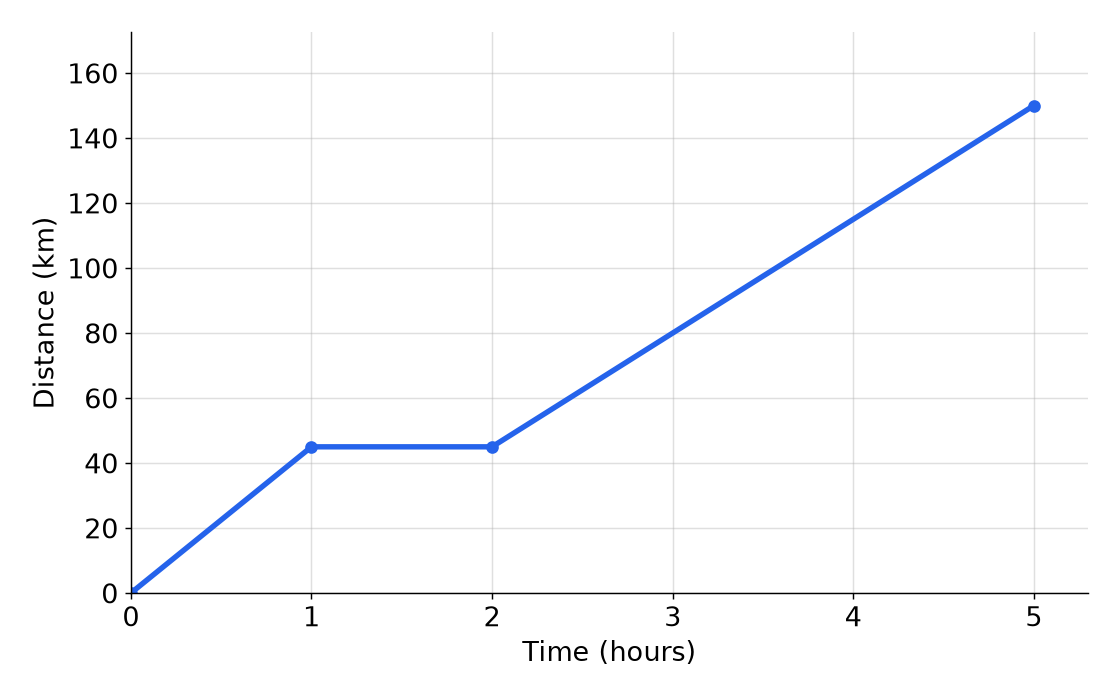
The graph shows Mia's journey from home to her cousin's house. (a) How far did Mia travel in the last 3 hours of her journey? [1 mark] (b) Calculate Mia's speed in the last 3 hours. [2 marks] (c) Mia says, “I travelled faster in the first hour than I did in the last 3 hours.” Is Mia correct? You must show your working. [2 marks]
Show answerHide answer
Model answer
(a) At 2 hours she was 45 km from home and at 5 hours 150 km, so she travelled \(150 - 45 = 105\) km. (b) \(105 \div 3 = 35\) km/h. (c) Her speed in the first hour was \(45 \div 1 = 45\) km/h. Since \(45 > 35\), Mia is correct.
Mark scheme
- (a) 105 km — B1
- (b) \(105 \div 3\) — M1
- (b) 35 km/h — A1
- (c) 45 km/h for the first hour — M1
- (c) Yes, with 45 compared with 35 — A1
-
4 Calculate [2 marks]
A coach travels 150 km at an average speed of 60 km/h. Calculate the time taken. Give your answer in hours and minutes.
Show answerHide answer
Model answer
Time \(= 150 \div 60 = 2.5\) hours, which is 2 hours 30 minutes.
Mark scheme
- \(150 \div 60\) — M1
- 2 hours 30 minutes — A1
-
5 Calculate [3 marks]
A solid metal cube has sides of length 5 cm and a mass of 1 kg. Calculate the density of the metal in g/cm\(^3\).
Show answerHide answer
Model answer
The volume is \(5 \times 5 \times 5 = 125\) cm\(^3\) and the mass is 1000 g. Density \(= 1000 \div 125 = 8\) g/cm\(^3\).
Mark scheme
- \(5^3 = 125\) — M1
- \(1000 \div 125\) — M1
- 8 g/cm\(^3\) — A1
-
6 Calculate [4 marks]
(a) A box exerts a force of 900 N on a surface of area 1.5 m\(^2\). Calculate the pressure in N/m\(^2\). [2 marks] (b) Convert a speed of 108 km/h to metres per second. [2 marks]
Show answerHide answer
Model answer
(a) Pressure \(= 900 \div 1.5 = 600\) N/m\(^2\). (b) \(108 \times 1000 \div 3600 = 30\) m/s.
Mark scheme
- (a) \(900 \div 1.5\) — M1
- (a) 600 — A1
- (b) \(108 \times 1000 \div 3600\) or \(108 \div 3.6\) — M1
- (b) 30 — A1
Quick check
-
1
A car travels 150 km in 2 hours 30 minutes. What is its average speed?
Show answerHide answer
D: 60 km/h
Write 2 hours 30 minutes as 2.5 hours. Then \(150 \div 2.5 = 60\) km/h.
-
2
What is 45 minutes as a decimal of an hour?
Show answerHide answer
C: 0.75 hours
\(45 \div 60 = 0.75\).
-
3
A train travels at 80 km/h for 3 hours 15 minutes. How far does it go?
Show answerHide answer
B: 260 km
3 hours 15 minutes is 3.25 hours, so the distance is \(80 \times 3.25 = 260\) km. Writing the time as 3.15 hours is a common error.
-
4
A cyclist rides 60 km at 30 km/h and then 60 km at 60 km/h. What is the average speed for the whole journey?
Show answerHide answer
A: 40 km/h
The times are 2 hours and 1 hour. The total distance is 120 km and the total time is 3 hours, so \(120 \div 3 = 40\) km/h.
-
5
What does a horizontal line on a distance-time graph show?
Show answerHide answer
D: The object is stationary
A flat line means the distance is not changing with time, so the speed is zero.
-
6
A metal block has mass 240 g and volume 30 cm\(^3\). What is its density?
Show answerHide answer
C: 8 g/cm\(^3\)
Density \(=\) mass \(\div\) volume \(= 240 \div 30 = 8\) g/cm\(^3\).
-
7
The density of a metal is 8 g/cm\(^3\). What is the mass of 25 cm\(^3\) of it?
Show answerHide answer
B: 200 g
Mass \(=\) density \(\times\) volume \(= 8 \times 25 = 200\) g.
-
8
Change 72 km/h into metres per second.
Show answerHide answer
A: 20 m/s
\(72 \times 1000 = 72\,000\) m per hour, and \(72\,000 \div 3600 = 20\) m/s.
-
9
A force of 600 N acts on an area of 0.5 m\(^2\). What is the pressure?
Show answerHide answer
D: 1200 N/m\(^2\)
Pressure \(=\) force \(\div\) area \(= 600 \div 0.5 = 1200\) N/m\(^2\).