Exam questions · Maths · Vectors, Constructions and Loci
Vector Geometry and Proof
- 6 exam questions
- 18 marks
- 9 quick checks
-
1 Write down [2 marks]
In the triangle \(OAB\), \(\overrightarrow{OA} = \mathbf{a}\) and \(\overrightarrow{OB} = \mathbf{b}\). Write down (a) \(\overrightarrow{BO}\), (b) \(\overrightarrow{BA}\). [2 marks]
Show answerHide answer
Model answer
(a) \(\overrightarrow{BO} = -\mathbf{b}\). (b) \(\overrightarrow{BA} = \overrightarrow{BO} + \overrightarrow{OA} = -\mathbf{b} + \mathbf{a} = \mathbf{a} - \mathbf{b}\).
Mark scheme
- (a) \(-\mathbf{b}\) — B1
- (b) \(\mathbf{a} - \mathbf{b}\) — B1
-
2 Calculate [4 marks]
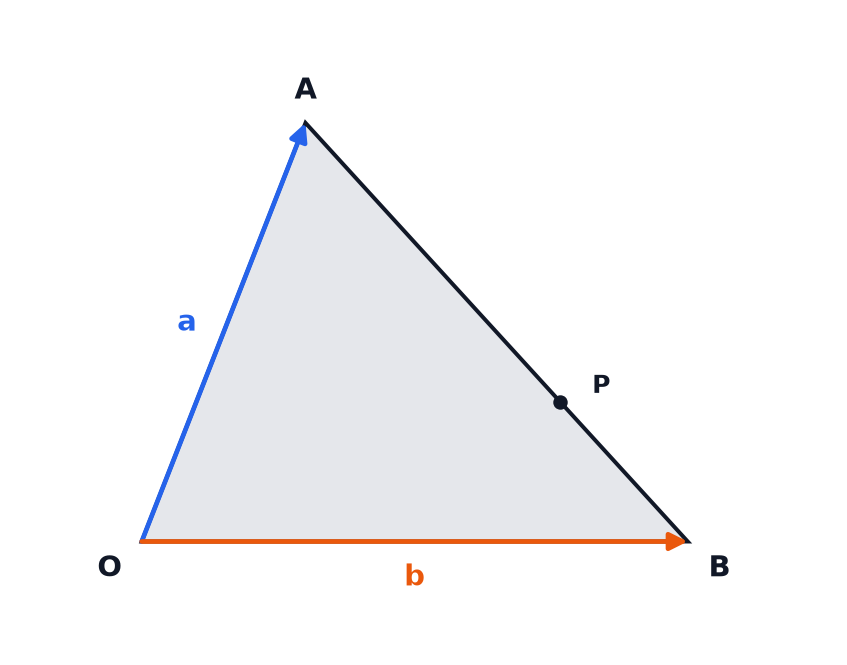
\(OAB\) is a triangle with \(\overrightarrow{OA} = \mathbf{a}\) and \(\overrightarrow{OB} = \mathbf{b}\). \(P\) is the point on \(AB\) such that \(AP : PB = 2 : 1\). (a) Write down \(\overrightarrow{AB}\) in terms of \(\mathbf{a}\) and \(\mathbf{b}\). [1 mark] (b) Find \(\overrightarrow{OP}\) in terms of \(\mathbf{a}\) and \(\mathbf{b}\). Give your answer in its simplest form. [3 marks]
Show answerHide answer
Model answer
(a) \(\overrightarrow{AB} = \mathbf{b} - \mathbf{a}\). (b) \(AP = \dfrac{2}{3}AB\), so \(\overrightarrow{AP} = \dfrac{2}{3}(\mathbf{b} - \mathbf{a})\). Then \(\overrightarrow{OP} = \mathbf{a} + \dfrac{2}{3}(\mathbf{b} - \mathbf{a}) = \dfrac{1}{3}\mathbf{a} + \dfrac{2}{3}\mathbf{b}\).
Mark scheme
- (a) \(\mathbf{b} - \mathbf{a}\) — B1
- (b) \(\overrightarrow{AP} = \dfrac{2}{3}\overrightarrow{AB}\) — M1
- (b) \(\mathbf{a} + \dfrac{2}{3}(\mathbf{b} - \mathbf{a})\) — M1
- (b) \(\dfrac{1}{3}\mathbf{a} + \dfrac{2}{3}\mathbf{b}\) — A1
-
3 Prove [3 marks]
\(\overrightarrow{OA} = \mathbf{a}\), \(\overrightarrow{OB} = \mathbf{b}\) and \(\overrightarrow{OC} = 4\mathbf{b} - 3\mathbf{a}\). Prove that \(A\), \(B\) and \(C\) lie on a straight line. [3 marks]
Show answerHide answer
Model answer
\(\overrightarrow{AB} = \mathbf{b} - \mathbf{a}\) and \(\overrightarrow{BC} = -\mathbf{b} + 4\mathbf{b} - 3\mathbf{a} = 3\mathbf{b} - 3\mathbf{a} = 3\overrightarrow{AB}\). The vectors are parallel and share the point \(B\), so \(A\), \(B\) and \(C\) are on a straight line.
Mark scheme
- \(\overrightarrow{AB} = \mathbf{b} - \mathbf{a}\) — M1
- \(\overrightarrow{BC} = 3\mathbf{b} - 3\mathbf{a}\) or \(3\overrightarrow{AB}\) — M1
- Parallel with a common point, so collinear — A1
-
4 Find [3 marks]
\(\overrightarrow{OA} = \mathbf{a}\) and \(\overrightarrow{OB} = \mathbf{b}\). \(Q\) is the point on \(OA\) such that \(OQ : QA = 1 : 3\). Find \(\overrightarrow{BQ}\) in terms of \(\mathbf{a}\) and \(\mathbf{b}\). [3 marks]
Show answerHide answer
Model answer
\(OQ = \dfrac{1}{4}OA\), so \(\overrightarrow{OQ} = \dfrac{1}{4}\mathbf{a}\). Then \(\overrightarrow{BQ} = \overrightarrow{BO} + \overrightarrow{OQ} = -\mathbf{b} + \dfrac{1}{4}\mathbf{a} = \dfrac{1}{4}\mathbf{a} - \mathbf{b}\).
Mark scheme
- \(\overrightarrow{OQ} = \dfrac{1}{4}\mathbf{a}\) — M1
- \(\overrightarrow{BQ} = \overrightarrow{BO} + \overrightarrow{OQ}\) or \(-\mathbf{b} + \dfrac{1}{4}\mathbf{a}\) — M1
- \(\dfrac{1}{4}\mathbf{a} - \mathbf{b}\) — A1
-
5 Show that [3 marks]
\(\overrightarrow{OA} = \mathbf{a}\) and \(\overrightarrow{OB} = \mathbf{b}\). \(X\) is the point such that \(\overrightarrow{OX} = 2\mathbf{a}\), and \(Y\) is the point such that \(\overrightarrow{OY} = 2\mathbf{b}\). Show that \(XY\) is parallel to \(AB\). [3 marks]
Show answerHide answer
Model answer
\(\overrightarrow{XY} = -2\mathbf{a} + 2\mathbf{b} = 2(\mathbf{b} - \mathbf{a}) = 2\overrightarrow{AB}\). It is a multiple of \(\overrightarrow{AB}\), so the lines are parallel.
Mark scheme
- \(\overrightarrow{XY} = 2\mathbf{b} - 2\mathbf{a}\) — M1
- \(2\overrightarrow{AB}\) or \(2(\mathbf{b} - \mathbf{a})\) — M1
- A multiple, so parallel — A1
-
6 Calculate [3 marks]
\(\overrightarrow{PQ} = \begin{pmatrix} 6 \\ 8 \end{pmatrix}\) and \(\overrightarrow{QR} = \begin{pmatrix} 3 \\ 4 \end{pmatrix}\). (a) Show that \(P\), \(Q\) and \(R\) lie on a straight line. [2 marks] (b) Calculate the length of \(PR\). [1 mark]
Show answerHide answer
Model answer
(a) \(\begin{pmatrix} 6 \\ 8 \end{pmatrix} = 2 \times \begin{pmatrix} 3 \\ 4 \end{pmatrix}\), so \(\overrightarrow{PQ} = 2\overrightarrow{QR}\). The vectors are parallel and share \(Q\), so the points are collinear. (b) \(\overrightarrow{PR} = \begin{pmatrix} 9 \\ 12 \end{pmatrix}\), and the length is \(\sqrt{81 + 144} = \sqrt{225} = 15\).
Mark scheme
- (a) \(\overrightarrow{PQ} = 2\overrightarrow{QR}\) — M1
- (a) Parallel with a common point, so collinear — A1
- (b) 15 — B1
Quick check
-
1
\(\overrightarrow{OA} = \mathbf{a}\) and \(\overrightarrow{OB} = \mathbf{b}\). What is \(\overrightarrow{AB}\)?
Show answerHide answer
C: \(\mathbf{b} - \mathbf{a}\)
Go from \(A\) to \(O\) (\(-\mathbf{a}\)) and then to \(B\) (\(\mathbf{b}\)).
-
2
\(\overrightarrow{OA} = \mathbf{a}\). What is \(\overrightarrow{AO}\)?
Show answerHide answer
B: \(-\mathbf{a}\)
Going backwards reverses the vector.
-
3
\(\overrightarrow{OA} = \mathbf{a}\) and \(\overrightarrow{OB} = \mathbf{b}\). \(M\) is the midpoint of \(AB\). What is \(\overrightarrow{OM}\)?
Show answerHide answer
A: \(\dfrac{1}{2}(\mathbf{a} + \mathbf{b})\)
\(\overrightarrow{OM} = \mathbf{a} + \dfrac{1}{2}(\mathbf{b} - \mathbf{a}) = \dfrac{1}{2}(\mathbf{a} + \mathbf{b})\).
-
4
\(P\) is on \(AB\) with \(AP : PB = 1 : 2\). What fraction of \(AB\) is \(AP\)?
Show answerHide answer
D: \(\dfrac{1}{3}\)
There are \(1 + 2 = 3\) parts, and \(AP\) is 1 of them.
-
5
\(\overrightarrow{OA} = \mathbf{a}\), \(\overrightarrow{OB} = \mathbf{b}\), and \(P\) is on \(AB\) with \(AP : PB = 1 : 2\). What is \(\overrightarrow{OP}\)?
Show answerHide answer
C: \(\dfrac{2}{3}\mathbf{a} + \dfrac{1}{3}\mathbf{b}\)
\(\overrightarrow{OP} = \mathbf{a} + \dfrac{1}{3}(\mathbf{b} - \mathbf{a}) = \dfrac{2}{3}\mathbf{a} + \dfrac{1}{3}\mathbf{b}\).
-
6
How do you show that two lines are parallel using vectors?
Show answerHide answer
B: Show that one vector is a multiple of the other
Parallel vectors are scalar multiples of each other.
-
7
\(\overrightarrow{AB} = 2\overrightarrow{BC}\). What does this show?
Show answerHide answer
A: \(A\), \(B\) and \(C\) are on a straight line
The vectors are parallel and share the point \(B\), so the three points are collinear.
-
8
\(\overrightarrow{OA} = \mathbf{a}\), \(\overrightarrow{OB} = \mathbf{b}\) and \(\overrightarrow{OC} = 3\mathbf{b} - 2\mathbf{a}\). What is \(\overrightarrow{BC}\)?
Show answerHide answer
D: \(2\mathbf{b} - 2\mathbf{a}\)
\(\overrightarrow{BC} = -\mathbf{b} + 3\mathbf{b} - 2\mathbf{a} = 2\mathbf{b} - 2\mathbf{a}\).
-
9
What is the length of the vector \(\begin{pmatrix} 5 \\ 12 \end{pmatrix}\)?
Show answerHide answer
C: \(13\)
\(\sqrt{5^2 + 12^2} = \sqrt{169} = 13\).