Slides · PPTX · 320 KB · 29 slides
Forces and elasticity - Teacher Slides.pptx
The lesson slides with the teacher's notes on each slide, and every question and mark scheme built in. Built from the lesson script on 30 September 2026.
AQA GCSE PHYSICS · PAPER 2 · FOUNDATION & HIGHER
Forces and elasticity
Forces
Lesson 5 of 20
openrevise.com
AQA GCSE PHYSICS · PAPER 2 · FOUNDATION & HIGHER
Warm-up
Forces
Lesson 5 of 20
Answer each one, then check.
1
What is a spring?
2
What does proportional mean?
3
Convert 6 cm to m.
4
What is elastic potential energy?
5
What is the unit of force?
openrevise.com
AQA GCSE PHYSICS · PAPER 2 · FOUNDATION & HIGHER
Warm-up - Answers
Forces
Lesson 5 of 20
1
What is a spring?
A coiled wire that can be stretched or compressed
2
What does proportional mean?
Doubling one doubles the other
3
Convert 6 cm to m.
0.06 m
4
What is elastic potential energy?
Energy stored in a stretched spring
5
What is the unit of force?
Newton
openrevise.com
AQA GCSE PHYSICS · PAPER 2 · FOUNDATION & HIGHER
Learning Objectives
Forces
Lesson 5 of 20
1
Explain why more than one force is needed to stretch, bend or compress an object.
2
Describe elastic and inelastic deformation.
3
Recall and apply F = ke and E_e = ½ke².
4
Interpret force-extension graphs and describe Required Practical 6.
openrevise.com
AQA GCSE PHYSICS · PAPER 2 · FOUNDATION & HIGHER
Forces
Lesson 5 of 20
HOOKE'S LAW
force = spring constant × extension F = ke
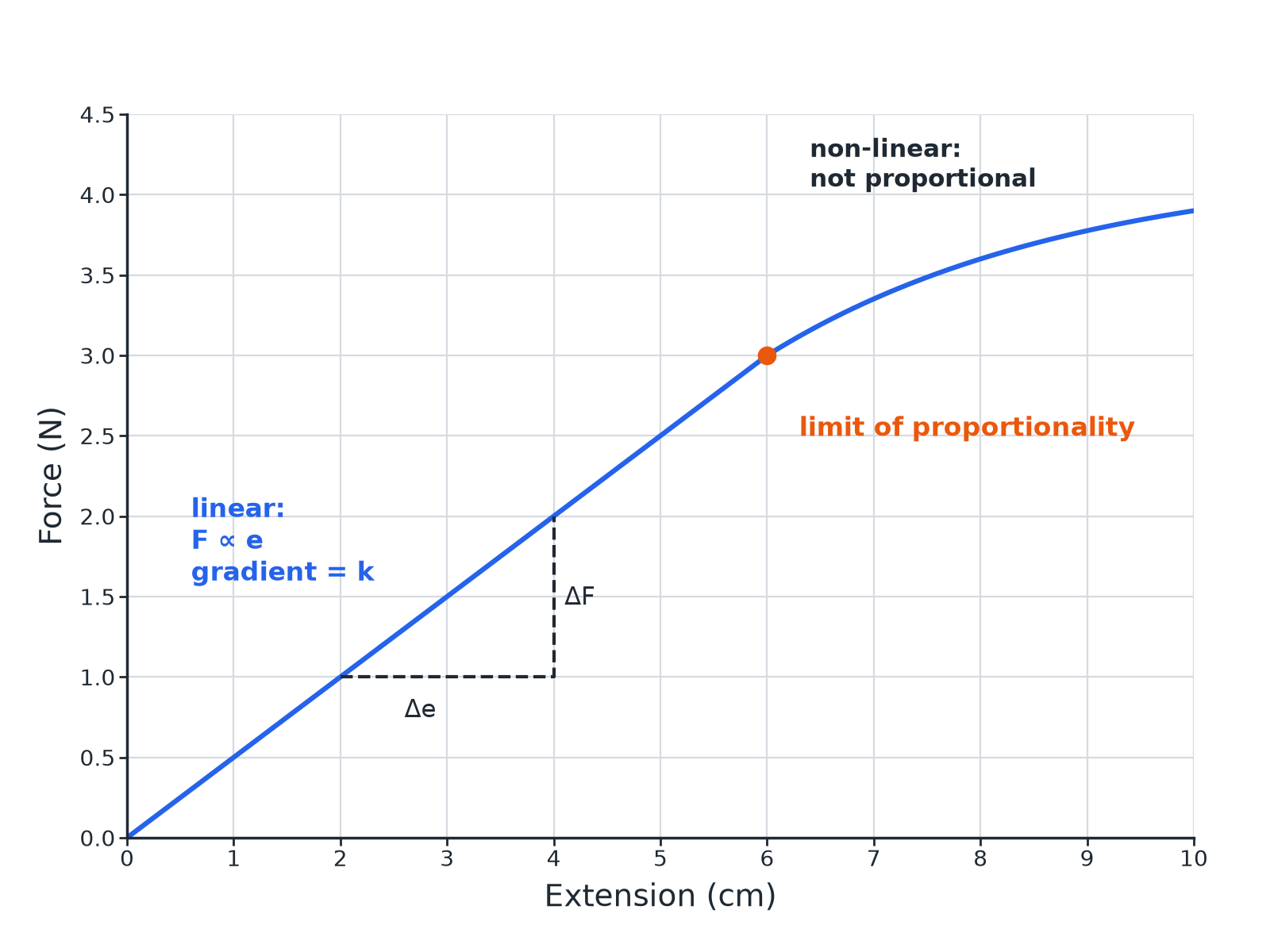
The extension of an elastic object is directly proportional to the force applied, provided the limit of proportionality is not exceeded. The same applies to compression.
openrevise.com
AQA GCSE PHYSICS · PAPER 2 · FOUNDATION & HIGHER
Force and Extension
Forces
Lesson 5 of 20

Beyond the limit, the spring does not return to its original length.
openrevise.com
AQA GCSE PHYSICS · PAPER 2 · FOUNDATION & HIGHER
Required Practical 6: Stretching a Spring
Forces
Lesson 5 of 20

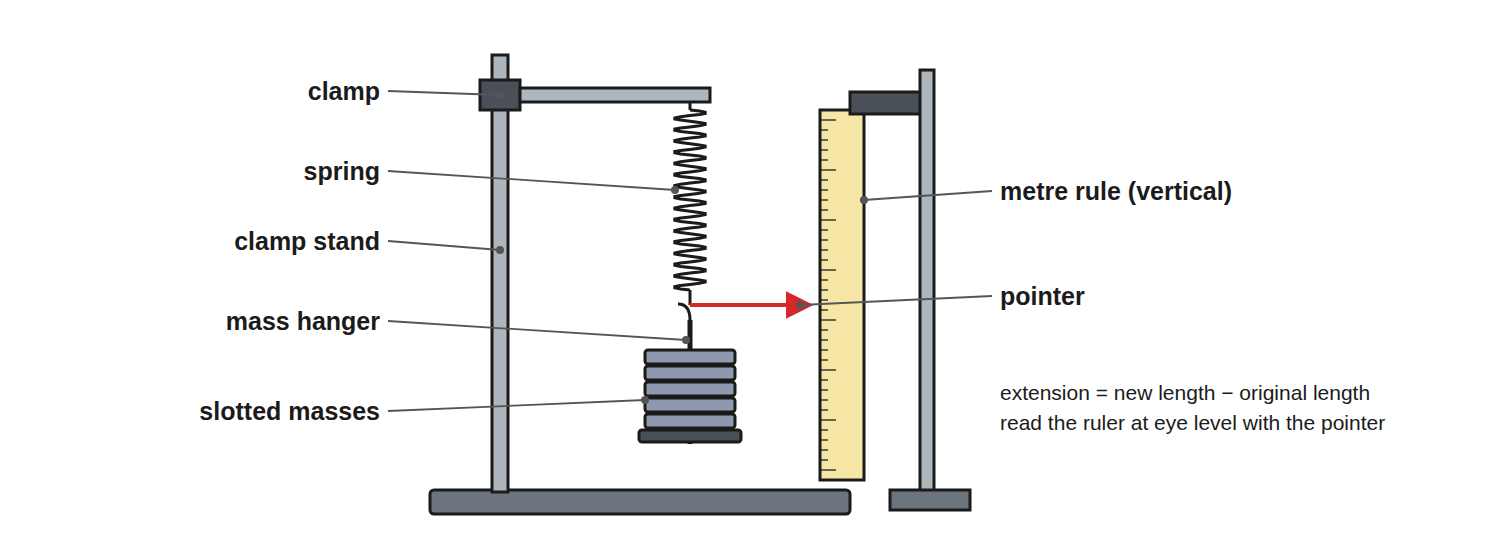
Measure the length with each extra mass added.
openrevise.com
AQA GCSE PHYSICS · PAPER 2 · FOUNDATION & HIGHER
Required Practical 6: Method
Forces
Lesson 5 of 20
Investigate force and extension.
1
Measure the original length
With no masses on the spring.
2
Add a mass
Record the force (weight = mg) and the new length.
3
Calculate the extension
New length minus original length.
4
Repeat
Add masses one at a time, keeping below the limit of proportionality at first.
5
Plot
Force (y-axis) against extension (x-axis).
6
Gradient
Gradient of the straight part = spring constant k.
openrevise.com
AQA GCSE PHYSICS · PAPER 2 · FOUNDATION & HIGHER
Spring Constant
Forces
Lesson 5 of 20
A force of 3.0 N stretches a spring by 6.0 cm (within the limit of proportionality). Calculate the spring constant.
1
Convert
6.0 cm = 0.060 m
2
Rearrange
k = F ÷ e
3
Substitute
k = 3.0 ÷ 0.060
4
Answer
k = 50 N/m
ANSWER
50 N/m
openrevise.com
AQA GCSE PHYSICS · PAPER 2 · FOUNDATION & HIGHER
Elastic Potential Energy
Forces
Lesson 5 of 20
Calculate the energy stored in the spring when the extension is 0.040 m and k = 50 N/m.
1
Write the equation
E_e = ½ke²
2
Substitute
E_e = 0.5 × 50 × 0.040²
3
Answer
E_e = 0.040 J
ANSWER
0.040 J
openrevise.com
AQA GCSE PHYSICS · PAPER 2 · FOUNDATION & HIGHER
Elastic or Inelastic?
Forces
Lesson 5 of 20
ELASTIC DEFORMATION
• The object returns to its original shape when the force is removed.
• Happens within the limit of proportionality.
INELASTIC DEFORMATION
• The object does not return to its original shape.
• Happens beyond the limit of proportionality.
openrevise.com
AQA GCSE PHYSICS · PAPER 2 · FOUNDATION & HIGHER
Key Ideas
Forces
Lesson 5 of 20
Learn these.
Two forces
To stretch, bend or compress a stationary object, more than one force is needed (for example pull at both ends).
Work done
The work done on an elastic object equals the elastic potential energy stored, provided it is not inelastically deformed.
Linear
A straight line through the origin: proportional.
Non-linear
A curve: not proportional.
openrevise.com
AQA GCSE PHYSICS · PAPER 2 · FOUNDATION & HIGHER
Key Terms
Forces
Lesson 5 of 20
Extension
The increase in length of a spring.
Spring constant
The force needed per metre of extension (N/m).
Limit of proportionality
The point beyond which force and extension are no longer proportional.
Elastic deformation
A change of shape that is reversed when the force is removed.
Inelastic deformation
A permanent change of shape.
Linear
Following a straight line.
openrevise.com
AQA GCSE PHYSICS · PAPER 2 · FOUNDATION & HIGHER
Forces
Lesson 5 of 20
YOUR TASK
Spring Test
12 minutes
A spring stretches 4.0 cm when a 2.0 N force is applied. (a) Calculate k in N/m. (b) What force gives an extension of 10 cm if the limit is not exceeded? (c) What energy is stored at 10 cm?
1
Convert cm to m.
2
Use F = ke and Ee = ½ke².
WHAT A GOOD ANSWER SHOWS
(a) 50 N/m. (b) F = 50 × 0.10 = 5.0 N. (c) E = 0.5 × 50 × 0.10² = 0.25 J.
openrevise.com
AQA GCSE PHYSICS · PAPER 2 · FOUNDATION & HIGHER
Can I...?
Forces
Lesson 5 of 20
State F = ke.
Convert cm to m.
Calculate a spring constant.
Calculate stored energy.
Describe elastic and inelastic deformation.
Read a force-extension graph.
Describe Required Practical 6.
Find the gradient.
openrevise.com
AQA GCSE PHYSICS · PAPER 2 · FOUNDATION & HIGHER
Summary & Exam Focus
F = ke.
E_e = ½ke².
Beyond the limit of proportionality: non-linear, may not return.
Spring constant = gradient of the linear part.
EXAM FOCUS
A spring has a spring constant of 50 N/m. Calculate the force needed to stretch it by 0.10 m. (2 marks)
Use F = ke.
openrevise.com
AQA GCSE PHYSICS · PAPER 2 · FOUNDATION & HIGHER
Exam Practice: Forces and elasticity
Forces
Lesson 5 of 20
Answer all questions. Use the mark allocation as a guide to how much to write. · 18 minutes
Question 1 · 2 marks · Calculate
A spring has a spring constant of 50 N/m. Calculate the force needed to stretch the spring by 0.10 m. Use the equation: force = spring…
Question 2 · 5 marks · Use the graph
A student investigates a spring. The graph shows how the force changes with extension. (a) State the extension at the limit of…
Question 3 · 2 marks · Describe
Describe the difference between elastic deformation and inelastic deformation of a spring.
openrevise.com
AQA GCSE PHYSICS · PAPER 2 · FOUNDATION & HIGHER
Exam Practice: Forces and elasticity (cont.)
Forces
Lesson 5 of 20
Question 4 · 6 marks · Describe
Describe how to investigate the relationship between the force applied to a spring and the extension of the spring. Your answer should…
Question 5 · 2 marks · Explain
Explain why two forces are needed to stretch a spring that is fixed to a wall.
openrevise.com
AQA GCSE PHYSICS · PAPER 2 · FOUNDATION & HIGHER
Question 1 · 2 marks · Calculate
Forces
Lesson 5 of 20
“
A spring has a spring constant of 50 N/m. Calculate the force needed to stretch the spring by 0.10 m. Use the equation: force = spring constant × extension
HOW TO ANSWER IT
Command word: Calculate. Worth 2 marks, so plan before writing.
openrevise.com
AQA GCSE PHYSICS · PAPER 2 · FOUNDATION & HIGHER
Question 1 · mark scheme
Forces
Lesson 5 of 20
2 marks available. Award a mark for each point made.
Correct substitution
1 mark
5.0 N
1 mark
openrevise.com
AQA GCSE PHYSICS · PAPER 2 · FOUNDATION & HIGHER
Question 2 · 5 marks · Use the graph
Forces
Lesson 5 of 20

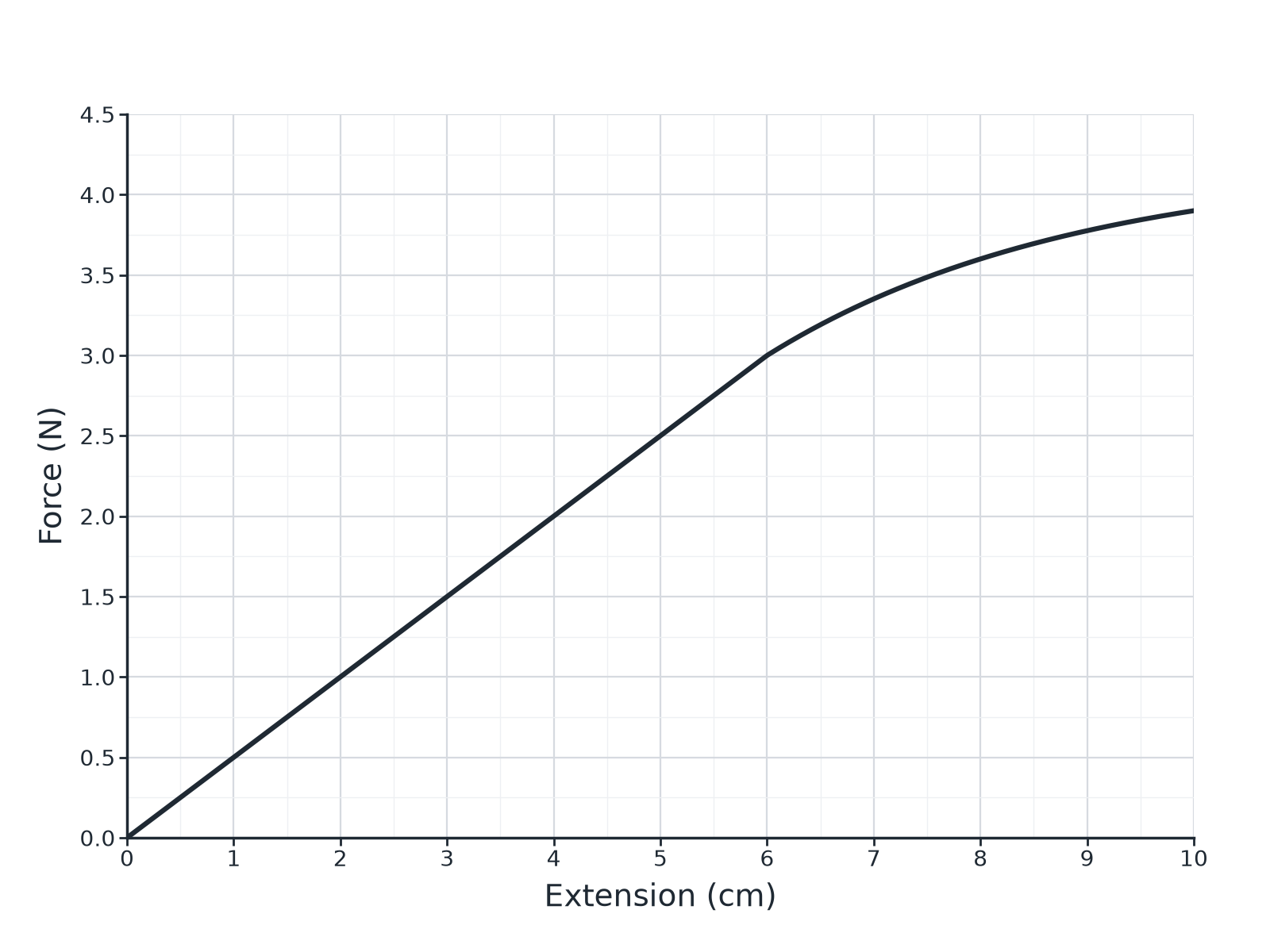
A student investigates a spring. The graph shows how the force changes with extension. (a) State the extension at the limit of proportionality. (b) Calculate the spring constant of the spring. (c) Calculate the elastic potential energy stored when the extension is 0.040 m. (5 marks)
openrevise.com
AQA GCSE PHYSICS · PAPER 2 · FOUNDATION & HIGHER
Question 2 · mark scheme
Forces
Lesson 5 of 20
5 marks available. Award a mark for each point made.
6 cm (accept 5.5 to 6.5)
1 mark
Uses 3.0 N at 0.060 m
1 mark
50 N/m
1 mark
openrevise.com
AQA GCSE PHYSICS · PAPER 2 · FOUNDATION & HIGHER
Question 2 · mark scheme (cont.)
Forces
Lesson 5 of 20
Correct substitution
1 mark
0.040 J
1 mark
openrevise.com
AQA GCSE PHYSICS · PAPER 2 · FOUNDATION & HIGHER
Question 3 · 2 marks · Describe
Forces
Lesson 5 of 20
“
Describe the difference between elastic deformation and inelastic deformation of a spring.
HOW TO ANSWER IT
Command word: Describe. Worth 2 marks, so plan before writing.
openrevise.com
AQA GCSE PHYSICS · PAPER 2 · FOUNDATION & HIGHER
Question 3 · mark scheme
Forces
Lesson 5 of 20
2 marks available. Award a mark for each point made.
Elastic: returns to original shape
1 mark
Inelastic: does not return
1 mark
openrevise.com
AQA GCSE PHYSICS · PAPER 2 · FOUNDATION & HIGHER
Question 4 · 6 marks · Describe
Forces
Lesson 5 of 20
“
Describe how to investigate the relationship between the force applied to a spring and the extension of the spring. Your answer should include the apparatus, the measurements, and how you would use them.
HOW TO ANSWER IT
Command word: Describe. Worth 6 marks, so plan before writing.
openrevise.com
AQA GCSE PHYSICS · PAPER 2 · FOUNDATION & HIGHER
Question 4 · mark scheme
Forces
Lesson 5 of 20
6 marks available. Award a mark for each point made.
Level 3 (5 to 6 marks): a complete method with stand, ruler and masses, original length measured, several forces (weights) applied with the new length each time, extension calculated, graph plotted and spring constant from the gradient, with a precaution (eye level, avoid overstretching)
5 to 6 marks
Level 2 (3 to 4 marks): a method covering force and extension with some detail missing
3 to 4 marks
Level 1 (1 to 2 marks): simple statements about adding masses and measuring length
1 to 2 marks
openrevise.com
AQA GCSE PHYSICS · PAPER 2 · FOUNDATION & HIGHER
Question 5 · 2 marks · Explain
Forces
Lesson 5 of 20
“
Explain why two forces are needed to stretch a spring that is fixed to a wall.
HOW TO ANSWER IT
Command word: Explain. Worth 2 marks, so plan before writing.
openrevise.com
AQA GCSE PHYSICS · PAPER 2 · FOUNDATION & HIGHER
Question 5 · mark scheme
Forces
Lesson 5 of 20
2 marks available. Award a mark for each point made.
Forces act at both ends
1 mark
Equal and opposite forces
1 mark
openrevise.com
← → to move, F to present full screen, G for every slide at once.