Slides · PPTX · 265 KB · 24 slides
Managing quality - Teacher Slides.pptx
The lesson slides with the teacher's notes on each slide, and every question and mark scheme built in. Built from the lesson script on 28 September 2026.
EDEXCEL GCSE BUSINESS · PAPER 2

Managing quality
Making operational decisions
Lesson 3 of 4
openrevise.com
EDEXCEL GCSE BUSINESS · PAPER 2

Last Lesson
Making operational decisions
Lesson 3 of 4
Answer from memory before the answers appear.
1
What is buffer stock?
2
What is just-in-time?
3
Name three factors in choosing a supplier.
4
What is lead time?
openrevise.com
EDEXCEL GCSE BUSINESS · PAPER 2

Last Lesson - Answers
Making operational decisions
Lesson 3 of 4
1
What is buffer stock?
The minimum stock kept for emergencies.
2
What is just-in-time?
Ordering stock to arrive exactly when needed, holding little or none.
3
Name three factors in choosing a supplier.
Any three of: quality, delivery, availability, cost, trust.
4
What is lead time?
The time between ordering stock and it arriving.
openrevise.com
EDEXCEL GCSE BUSINESS · PAPER 2

Learning Objectives
Making operational decisions
Lesson 3 of 4
1
Explain what quality means.
2
Explain quality control.
3
Explain quality assurance.
4
Explain the importance of quality in controlling costs and gaining competitive advantage.
openrevise.com
EDEXCEL GCSE BUSINESS · PAPER 2

What Is Quality?
Making operational decisions
Lesson 3 of 4
A quality product meets or exceeds customers' expectations - and does so every time.
Fit for purpose
It does what customers need it to do.
Consistent
Every product is made to the same standard.
Not the same as luxury
A cheap product can be high quality if it meets the expectations of customers who buy it.
Services too
Quality applies to service - speed, friendliness and reliability.
openrevise.com
EDEXCEL GCSE BUSINESS · PAPER 2

Quality Control or Quality Assurance?
Making operational decisions
Lesson 3 of 4
QUALITY CONTROL
• Checking finished products for faults, usually at the end of production.
• Done by specialist inspectors.
• Faulty products are thrown away or reworked.
• Finds problems after they have happened.
• Can be wasteful: materials and time are lost on every faulty product.
QUALITY ASSURANCE
• Checking quality at every stage of production.
• Every worker is responsible for their own work.
• Aims to prevent faults happening in the first place.
• Less waste, as faults are caught early.
• Needs training, and staff who care about quality.
openrevise.com
EDEXCEL GCSE BUSINESS · PAPER 2

Checking Every Detail
Making operational decisions
Lesson 3 of 4
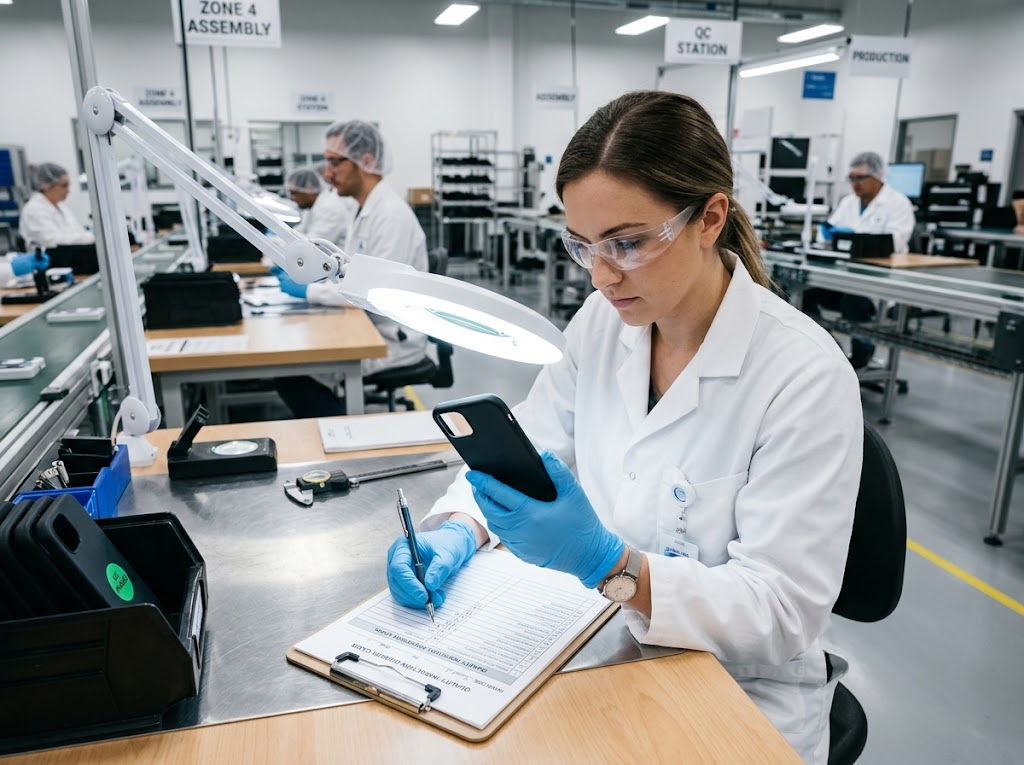
Quality control: inspecting finished products for faults.
Quality control inspectors check finished products, or a sample of them, before they are sent to customers. It stops faulty products reaching customers - but by the time a fault is found, the materials and time have already been used.
openrevise.com
EDEXCEL GCSE BUSINESS · PAPER 2

PART ONE
Why Quality Matters
Quality is about costs as well as customers.
openrevise.com
EDEXCEL GCSE BUSINESS · PAPER 2

The Importance of Quality
Making operational decisions
Lesson 3 of 4
Controlling costs
Fewer faulty products means less waste, fewer returns and less money spent fixing mistakes.
Competitive advantage
A reputation for quality helps a business stand out from rivals and win customers.
Premium prices
Customers will often pay more for a product they trust to be well made.
Customer loyalty
Customers who get good quality every time come back and recommend the business.
openrevise.com
EDEXCEL GCSE BUSINESS · PAPER 2

The Cost of Poor Quality
Making operational decisions
Lesson 3 of 4
When quality fails, the costs mount up quickly.
Waste
Faulty products must be scrapped or reworked.
Returns and refunds
Customers return faulty goods and demand their money back.
Product recalls
Dangerous faults can force a business to recall every product sold - extremely expensive.
Reputation
Bad reviews and news stories drive customers away for years.
openrevise.com
EDEXCEL GCSE BUSINESS · PAPER 2
Making operational decisions
Lesson 3 of 4
CASE STUDY

The Galaxy Note 7 Recall
In August 2016 Samsung launched the Galaxy Note 7 smartphone. Within weeks, reports emerged of phones overheating and catching fire because of faulty batteries. Airlines banned the phone from flights. Samsung recalled millions of phones, and when replacement phones also caught fire, it stopped making the Note 7 altogether in October 2016. The failure cost Samsung billions of dollars and damaged its reputation - a clear example of how poor quality can cost far more than getting it right would have done.
2016
Galaxy Note 7 launched and recalled
Billions
The cost of the failure, in US dollars
openrevise.com
EDEXCEL GCSE BUSINESS · PAPER 2

Key Terms
Making operational decisions
Lesson 3 of 4
Quality
Meeting or exceeding customers' expectations, consistently.
Quality control
Checking finished products for faults.
Quality assurance
Checking quality at every stage of production to prevent faults.
Product recall
When a business asks customers to return a product because it is faulty or dangerous.
Competitive advantage
Anything that makes a business more attractive to customers than its rivals.
openrevise.com
EDEXCEL GCSE BUSINESS · PAPER 2
Making operational decisions
Lesson 3 of 4

YOUR TASK
Build Quality In
12 minutes
A sandwich factory has had complaints about missing ingredients and wrong labels. Design a quality assurance system for it: list three checks at different stages of production, and explain how each would prevent the problem rather than just finding it.
1
One check when ingredients arrive.
2
One check during assembly.
3
One check at labelling.
4
How each prevents problems.
WHAT A GOOD ANSWER SHOWS
Three checks at different stages (ingredients arriving, assembly, labelling) with each explained as preventing faults.
openrevise.com
EDEXCEL GCSE BUSINESS · PAPER 2

Can I...?
Making operational decisions
Lesson 3 of 4
Explain what quality means.
Explain quality control.
Explain quality assurance.
Compare quality control and quality assurance.
Explain how quality controls costs.
Explain how quality gives a competitive advantage.
Explain the costs of poor quality.
openrevise.com
EDEXCEL GCSE BUSINESS · PAPER 2
Summary & Exam Focus
Quality means meeting customers' expectations, every time.
Quality control checks finished products; quality assurance builds quality into every stage.
High quality controls costs and gives a competitive advantage.
Poor quality brings waste, returns, recalls and damaged reputation.
EXAM FOCUS
Explain one benefit to a business of using quality assurance rather than quality control. (3 marks)
The difference is when quality is checked: control finds faults at the end, assurance prevents them throughout. Link your answer to costs or reputation.
openrevise.com
EDEXCEL GCSE BUSINESS · PAPER 2

Exam Practice: Managing Quality
Making operational decisions
Lesson 3 of 4
Answer all questions. Use the context of the business in the question where one is given. · 20 minutes
Question 1 · 1 mark · Define
Define the term 'quality control'.
Question 2 · 2 marks · Outline
Outline one cost to a business of poor quality.
Question 3 · 3 marks · Explain
Explain one benefit to a business of using quality assurance rather than quality control.
Question 4 · 6 marks · Analyse
Analyse the impact of poor quality on SmartHome Ltd.
openrevise.com
EDEXCEL GCSE BUSINESS · PAPER 2

Question 1 · 1 mark · Define
Making operational decisions
Lesson 3 of 4
“
Define the term 'quality control'.
HOW TO ANSWER IT
Command word: Define. Worth 1 mark, so plan before writing.
openrevise.com
EDEXCEL GCSE BUSINESS · PAPER 2

Question 1 · mark scheme
Making operational decisions
Lesson 3 of 4
1 mark available. Award a mark for each point made.
Inspecting finished products / checking for faults at the end
1 mark
openrevise.com
EDEXCEL GCSE BUSINESS · PAPER 2

Question 2 · 2 marks · Outline
Making operational decisions
Lesson 3 of 4
“
Outline one cost to a business of poor quality.
HOW TO ANSWER IT
Command word: Outline. Worth 2 marks, so plan before writing.
openrevise.com
EDEXCEL GCSE BUSINESS · PAPER 2

Question 2 · mark scheme
Making operational decisions
Lesson 3 of 4
2 marks available. Award a mark for each point made.
A cost identified, e.g. waste / returns / recalls / reputation
1 mark
Developed
1 mark
openrevise.com
EDEXCEL GCSE BUSINESS · PAPER 2

Question 3 · 3 marks · Explain
Making operational decisions
Lesson 3 of 4
“
Explain one benefit to a business of using quality assurance rather than quality control.
HOW TO ANSWER IT
Command word: Explain. Worth 3 marks, so plan before writing.
openrevise.com
EDEXCEL GCSE BUSINESS · PAPER 2

Question 3 · mark scheme
Making operational decisions
Lesson 3 of 4
3 marks available. Award a mark for each point made.
A benefit identified, e.g. less waste / lower costs / staff responsibility / fewer faults reach customers
1 mark
First linked point of explanation
1 mark
Second linked point of explanation
1 mark
openrevise.com
EDEXCEL GCSE BUSINESS · PAPER 2

Question 4 · 6 marks · Analyse
Making operational decisions
Lesson 3 of 4
“
Analyse the impact of poor quality on SmartHome Ltd.
— SmartHome Ltd makes wireless doorbells. It uses quality control, with inspectors checking one in every 50 doorbells at the end of the production line. Last year 4% of doorbells…
HOW TO ANSWER IT
Command word: Analyse. Worth 6 marks, so plan before writing.
openrevise.com
EDEXCEL GCSE BUSINESS · PAPER 2

Question 4 · mark scheme
Making operational decisions
Lesson 3 of 4
6 marks available. Award a mark for each point made.
AO2 (Application, 3 marks): uses the context - 1 in 50 checks, 4% returns, 4.5 to 3.2 stars
Level 1-3
AO3a (Analysis, 3 marks): chains of reasoning about costs, reputation and sales
Level 1-3
openrevise.com
← → to move, F to present full screen, G for every slide at once.