Slides · PPTX · 331 KB · 23 slides
Organisational structures.pptx
Built from the lesson script on 28 September 2026.
EDEXCEL GCSE BUSINESS · PAPER 2

Organisational structures
Making human resource decisions
Lesson 1 of 4
openrevise.com
EDEXCEL GCSE BUSINESS · PAPER 2

From Making Financial Decisions
Making human resource decisions
Lesson 1 of 4
Answer from memory before the answers appear.
1
How do you calculate gross profit?
2
How do you calculate net profit margin?
3
What does ARR show?
4
Give one limitation of financial data.
openrevise.com
EDEXCEL GCSE BUSINESS · PAPER 2

From Making Financial Decisions - Answers
Making human resource decisions
Lesson 1 of 4
1
How do you calculate gross profit?
Sales revenue - cost of sales.
2
How do you calculate net profit margin?
(Net profit ÷ sales revenue) × 100.
3
What does ARR show?
Average annual profit from an investment as a percentage of its cost.
4
Give one limitation of financial data.
It looks backwards, ignores non-financial factors, or relies on forecasts.
openrevise.com
EDEXCEL GCSE BUSINESS · PAPER 2

Learning Objectives
Making human resource decisions
Lesson 1 of 4
1
Explain hierarchical and flat structures, span of control and chain of command.
2
Explain centralised and decentralised structures.
3
Explain the importance of effective communication and the barriers to it.
4
Explain different ways of working, and the effect of technology on them.
openrevise.com
EDEXCEL GCSE BUSINESS · PAPER 2

What Is an Organisational Structure?
Making human resource decisions
Lesson 1 of 4
An organisational structure shows how a business is organised: the roles, who is responsible for what, and who reports to whom.
Organisation chart
A diagram showing the structure, with each role and the lines of authority between them.
Levels of hierarchy
The number of layers of management from the top to the bottom.
Chain of command
The line of authority through which instructions pass down and information passes up.
Span of control
The number of employees who report directly to one manager.
openrevise.com
EDEXCEL GCSE BUSINESS · PAPER 2

PART ONE
Tall or Flat?
Two very different shapes.
openrevise.com
EDEXCEL GCSE BUSINESS · PAPER 2

Hierarchical and Flat Structures
Making human resource decisions
Lesson 1 of 4
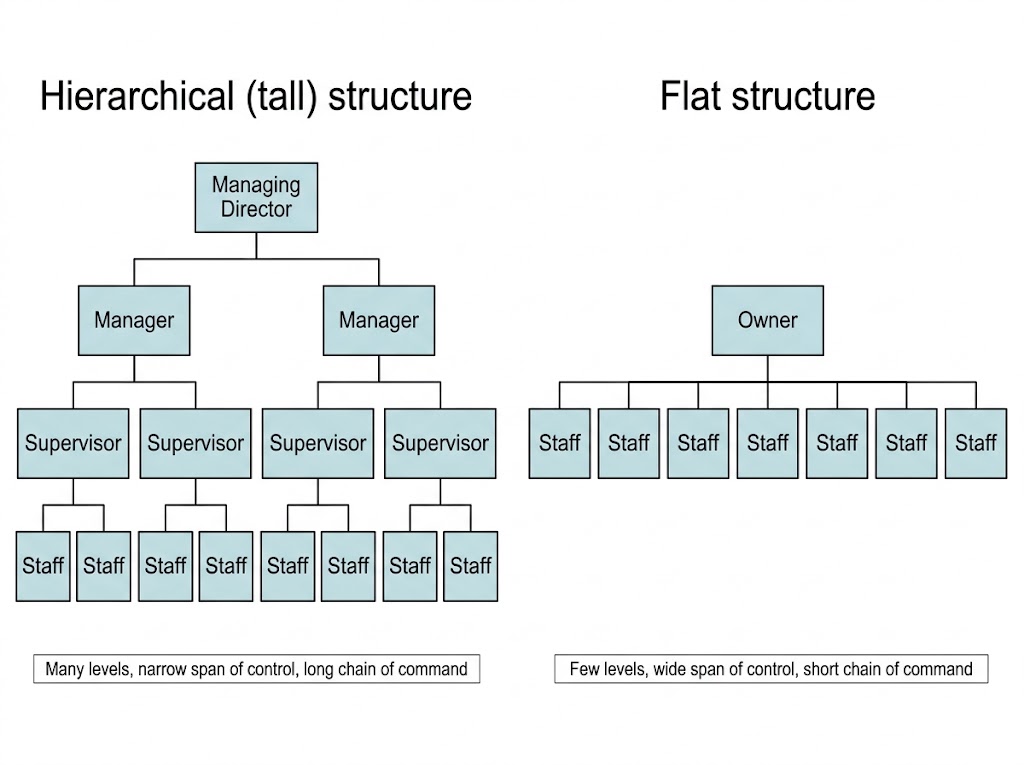
A tall structure has many levels and narrow spans of control; a flat structure has few levels and wide spans.
The same number of staff can be organised in very different ways. A tall structure has many managers each looking after a few people; a flat structure has few managers each looking after many.
openrevise.com
EDEXCEL GCSE BUSINESS · PAPER 2

Hierarchical or Flat?
Making human resource decisions
Lesson 1 of 4
HIERARCHICAL (TALL) STRUCTURE
• Many levels of hierarchy.
• Narrow span of control: managers supervise few staff closely.
• Clear roles and promotion opportunities.
• But: long chain of command, so communication and decisions are slow.
• Many managers, so high wage costs.
FLAT STRUCTURE
• Few levels of hierarchy.
• Wide span of control: managers supervise many staff.
• Fast communication and decisions.
• Staff have more responsibility, which can motivate them.
• But: managers may be overloaded, and there are fewer promotion opportunities.
openrevise.com
EDEXCEL GCSE BUSINESS · PAPER 2

PART TWO
Who Makes the Decisions?
Centralised or decentralised.
openrevise.com
EDEXCEL GCSE BUSINESS · PAPER 2

Centralised or Decentralised?
Making human resource decisions
Lesson 1 of 4
CENTRALISED
• Decisions are made by a few senior managers at the top, often at head office.
• Consistent decisions across the whole business.
• Senior managers have experience and see the big picture.
• But: slow, and head office may not understand local needs.
• Staff lower down may feel undervalued.
DECENTRALISED
• Decision-making is passed down to managers in branches or departments.
• Faster decisions that suit local customers.
• Staff feel trusted, which motivates them.
• But: decisions may be inconsistent between branches.
• Local managers may lack experience.
openrevise.com
EDEXCEL GCSE BUSINESS · PAPER 2

PART THREE
Communication
Getting the message through.
openrevise.com
EDEXCEL GCSE BUSINESS · PAPER 2

The Importance of Effective Communication
Making human resource decisions
Lesson 1 of 4
Effective communication means the right message reaches the right people at the right time and is understood.
Why it matters
Staff know what to do, mistakes are avoided, and customers are served well.
Motivation
Staff who are kept informed and listened to feel valued.
Too little communication
Staff do not know what is expected, leading to mistakes and poor morale.
Too much communication
Information overload: important messages are lost among hundreds of emails.
openrevise.com
EDEXCEL GCSE BUSINESS · PAPER 2

Barriers to Communication
Making human resource decisions
Lesson 1 of 4
Too many levels
In a tall structure, messages pass through many people and can be delayed or changed.
Language and jargon
Technical terms or a different language can confuse the receiver.
Distance and technology
Staff in different places, or technology that fails, make communication harder.
Attitudes
Staff who distrust managers, or managers who do not listen, block communication.
openrevise.com
EDEXCEL GCSE BUSINESS · PAPER 2

PART FOUR
Different Ways of Working
Not everyone works nine to five.
openrevise.com
EDEXCEL GCSE BUSINESS · PAPER 2

Ways of Working
Making human resource decisions
Lesson 1 of 4
Type
Meaning
Benefit to the business
Full-time
Working a full working week, often around 35-40 hours
Staff are always available and committed
Part-time
Working fewer hours than full-time
Covers busy periods cheaply; attracts people who cannot work full-time
Flexible hours
Staff choose when they work, within limits
Motivates staff and helps retain them
Permanent
A contract with no end date
Loyal, experienced staff
Temporary
A contract for a fixed period
Covers busy seasons or absences without a long-term cost
Freelance
Self-employed people hired for specific jobs
Specialist skills only when needed
openrevise.com
EDEXCEL GCSE BUSINESS · PAPER 2

Technology and Ways of Working
Making human resource decisions
Lesson 1 of 4
Technology has changed how, when and where people work.
Remote working
Laptops, video calls and cloud software let staff work from home, cutting office costs.
Efficiency
Software and automation speed up tasks and reduce mistakes.
Flexible working
Staff can work at different times and still stay connected.
Drawbacks
Isolation, harder teamwork, and staff who never switch off from work.
openrevise.com
EDEXCEL GCSE BUSINESS · PAPER 2

Working from Anywhere
Making human resource decisions
Lesson 1 of 4

Technology lets staff work from home and stay connected.
Video calls and cloud software mean many office jobs can now be done from anywhere. Businesses save on office space and can hire people who live far away - but have to work harder to keep teams communicating well.
openrevise.com
EDEXCEL GCSE BUSINESS · PAPER 2
Making human resource decisions
Lesson 1 of 4
CASE STUDY

Timpson: Upside-down Management
Timpson, the shoe repair and key-cutting chain, runs what it calls "upside-down management" - a highly decentralised approach. Staff in each shop are trusted to run it their own way: they set their own prices for some jobs, decide how to serve customers and can spend up to £500 to settle a customer complaint without asking head office. Head office exists to support the shops rather than to control them. Timpson believes staff who are trusted give better service, and the business is well known for its customer service and staff loyalty.
£500
What shop staff can spend to settle a complaint
Decentralised
Decisions made in each shop, not at head office
openrevise.com
EDEXCEL GCSE BUSINESS · PAPER 2

Key Terms
Making human resource decisions
Lesson 1 of 4
Organisational structure
How a business is organised: its roles, responsibilities and lines of authority.
Hierarchy
The levels of management in a business.
Chain of command
The line of authority from the top to the bottom of a business.
Span of control
The number of employees who report directly to one manager.
Centralised
Decisions are made by senior managers at the top.
Decentralised
Decision-making is passed down to managers and staff lower down.
openrevise.com
EDEXCEL GCSE BUSINESS · PAPER 2

Key Terms (cont.)
Making human resource decisions
Lesson 1 of 4
Freelance
Self-employed and hired for specific jobs.
Remote working
Working away from the business's premises, often from home.
openrevise.com
EDEXCEL GCSE BUSINESS · PAPER 2
Making human resource decisions
Lesson 1 of 4

YOUR TASK
Restructure the Business
15 minutes
A chain of 20 cafés has a tall, centralised structure: every decision - from menu changes to staff rotas - is made at head office. Customers complain that cafés are slow to respond to problems. Recommend changes to the structure, and explain one benefit and one risk of your changes.
1
Recommend changes.
2
Explain one benefit.
3
Explain one risk.
WHAT A GOOD ANSWER SHOWS
A move towards a flatter, more decentralised structure, with a benefit (faster, local decisions; motivated managers) and a risk (inconsistency, inexperienced managers).
openrevise.com
EDEXCEL GCSE BUSINESS · PAPER 2

Can I...?
Making human resource decisions
Lesson 1 of 4
Explain span of control and chain of command.
Compare hierarchical and flat structures.
Compare centralised and decentralised structures.
Explain why effective communication matters.
Explain barriers to communication.
Explain full-time, part-time and flexible working.
Explain permanent, temporary and freelance contracts.
Explain the effect of technology on ways of working.
openrevise.com
EDEXCEL GCSE BUSINESS · PAPER 2
Summary & Exam Focus
Tall structures: many levels, narrow spans, slow communication. Flat structures: few levels, wide spans, fast communication.
Centralised: decisions at the top. Decentralised: decisions passed down.
Effective communication avoids mistakes and motivates staff; barriers include levels, jargon, distance and attitudes.
Ways of working: full-time, part-time, flexible, permanent, temporary, freelance - changed by technology.
EXAM FOCUS
Explain one disadvantage to a business of having a hierarchical structure. (3 marks)
Use the key terms - span of control, chain of command, levels of hierarchy - and link them to speed of decisions, communication or costs.
openrevise.com
← → to move, F to present full screen, G for every slide at once.