Slides · PPTX · 236 KB · 34 slides
HCF and LCM - Teacher Slides.pptx
The lesson slides with the teacher's notes on each slide, and every question and mark scheme built in. Built from the lesson script on 28 September 2026.
EDEXCEL GCSE MATHS · FOUNDATION & HIGHER

HCF and LCM
Number
Lesson 3 of 7
openrevise.com
EDEXCEL GCSE MATHS · FOUNDATION & HIGHER

Last Lesson and Before
Number
Lesson 3 of 7
Answer each one, then check.
1
List all the factors of 12.
2
Write down the first five multiples of 6.
3
Is 51 a prime number?
4
What is 2³?
5
Last lesson: round 0.004 76 to 2 significant figures.
openrevise.com
EDEXCEL GCSE MATHS · FOUNDATION & HIGHER

Last Lesson and Before - Answers
Number
Lesson 3 of 7
1
List all the factors of 12.
1, 2, 3, 4, 6, 12
2
Write down the first five multiples of 6.
6, 12, 18, 24, 30
3
Is 51 a prime number?
No: 51 = 3 × 17.
4
What is 2³?
2 × 2 × 2 = 8
5
Last lesson: round 0.004 76 to 2 significant figures.
0.0048
openrevise.com
EDEXCEL GCSE MATHS · FOUNDATION & HIGHER

Learning Objectives
Number
Lesson 3 of 7
1
Know the difference between factors, multiples and prime numbers.
2
Write a number as a product of its prime factors, in index form.
3
Find the HCF and LCM of two numbers using prime factors.
4
Use a Venn diagram of prime factors to find the HCF and LCM.
5
Decide whether a problem needs the HCF or the LCM, and solve it.
openrevise.com
EDEXCEL GCSE MATHS · FOUNDATION & HIGHER

Factors, Multiples and Primes
Number
Lesson 3 of 7
Factor
A number that divides exactly into another. The factors of 10 are 1, 2, 5 and 10.
Multiple
A number in another number's times table. The multiples of 10 are 10, 20, 30, ...
Prime number
A number with exactly two factors: 1 and itself. 2, 3, 5, 7, 11, 13, ...
1 is not prime
It has only one factor.
2 is the only even prime
Every other even number has 2 as a factor.
Prime factor
A factor that is also a prime number. The prime factors of 10 are 2 and 5.
openrevise.com
EDEXCEL GCSE MATHS · FOUNDATION & HIGHER

Products of Prime Factors
Number
Lesson 3 of 7
Every whole number greater than 1 can be written as a product of prime numbers in exactly one way.
Factor tree
Split the number into any two factors, then keep splitting until every branch ends in a prime.
Circle the primes
Circle each prime as you reach it, so none is missed.
Index form
Write repeated primes as powers, smallest prime first: 2 × 2 × 2 × 3 × 3 × 5 = 2³ × 3² × 5.
Check
Multiply your answer out: it should give the number you started with.
openrevise.com
EDEXCEL GCSE MATHS · FOUNDATION & HIGHER

A Factor Tree for 360
Number
Lesson 3 of 7
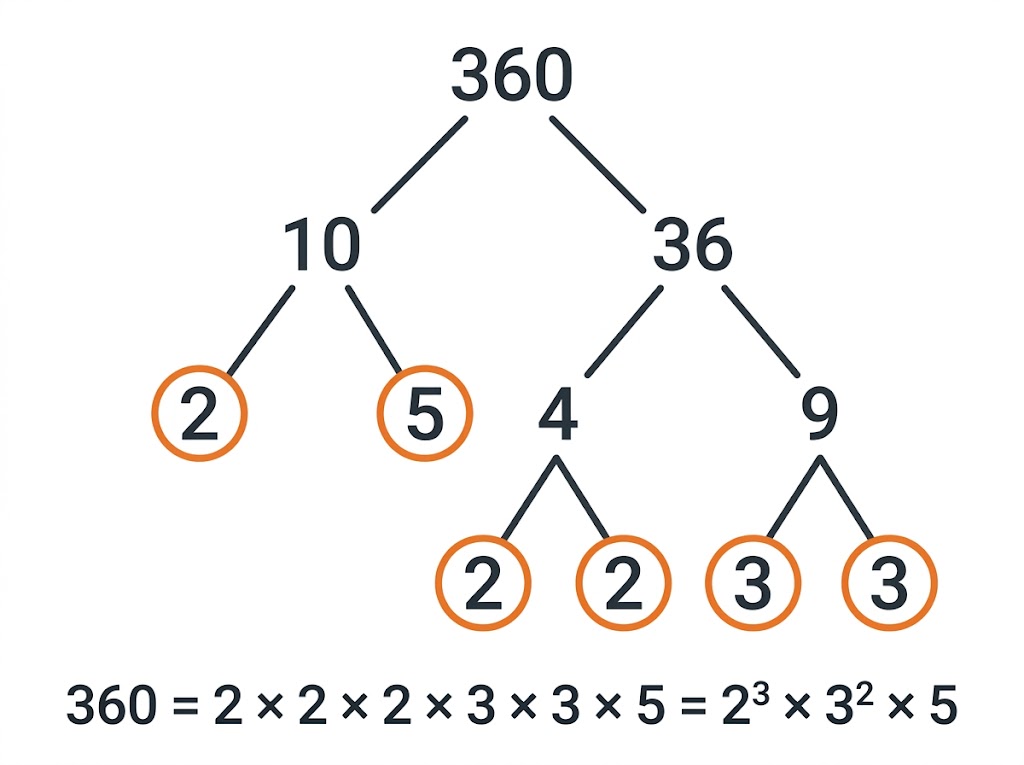
360 = 2³ × 3² × 5
It does not matter how you start: 360 = 10 × 36, 360 = 2 × 180 and 360 = 12 × 30 all end in the same set of primes. That is why the prime factors of a number are like its fingerprint.
openrevise.com
EDEXCEL GCSE MATHS · FOUNDATION & HIGHER

Writing a Number as a Product of Primes
Number
Lesson 3 of 7
Write 360 as a product of its prime factors. Give your answer in index form.
1
Split into two factors
360 = 10 × 36
2
Keep splitting until every branch is prime
10 = 2 × 5, 36 = 4 × 9 = 2 × 2 × 3 × 3
3
Collect the primes, smallest first
2 × 2 × 2 × 3 × 3 × 5
4
Write repeats as powers
2³ × 3² × 5
5
Check
8 × 9 × 5 = 360
ANSWER
360 = 2³ × 3² × 5
openrevise.com
EDEXCEL GCSE MATHS · FOUNDATION & HIGHER

PART ONE
HCF and LCM
Using prime factors.
openrevise.com
EDEXCEL GCSE MATHS · FOUNDATION & HIGHER

HCF or LCM?
Number
Lesson 3 of 7
HIGHEST COMMON FACTOR (HCF)
• The biggest number that divides into both numbers.
• It is never bigger than the smaller number.
• Prime factors: multiply the primes the numbers SHARE.
• Use the LOWER power of each shared prime.
• Used for splitting things into equal groups.
LOWEST COMMON MULTIPLE (LCM)
• The smallest number both numbers divide into.
• It is never smaller than the larger number.
• Prime factors: multiply EVERY prime that appears.
• Use the HIGHER power of each prime.
• Used for when things happen together again.
openrevise.com
EDEXCEL GCSE MATHS · FOUNDATION & HIGHER

HCF and LCM from Prime Factors
Number
Lesson 3 of 7
Find the HCF and the LCM of 84 and 120.
1
Write each number as a product of primes
84 = 2² × 3 × 7 and 120 = 2³ × 3 × 5
2
HCF: take each shared prime at its lower power
2² × 3
3
Work it out
HCF = 12
4
LCM: take every prime at its higher power
2³ × 3 × 5 × 7
5
Work it out
LCM = 840
ANSWER
HCF = 12, LCM = 840
openrevise.com
EDEXCEL GCSE MATHS · FOUNDATION & HIGHER

A Venn Diagram of Prime Factors
Number
Lesson 3 of 7
84 = 2 × 2 × 3 × 7
7
120 = 2 × 2 × 2 × 3 × 5
2
5
Shared primes
2
2
3
openrevise.com
EDEXCEL GCSE MATHS · FOUNDATION & HIGHER

Reading the Venn Diagram
Number
Lesson 3 of 7
Put the shared primes in the overlap and the rest in their own circles.
HCF
Multiply the numbers in the overlap: 2 × 2 × 3 = 12.
LCM
Multiply every number in the diagram: 7 × 2 × 2 × 3 × 2 × 5 = 840.
Check
HCF × LCM = the two numbers multiplied: 12 × 840 = 10 080 = 84 × 120.
Careful
Each prime goes in the diagram once for each time it is shared - two 2s are shared here, so two 2s go in the middle.
openrevise.com
EDEXCEL GCSE MATHS · FOUNDATION & HIGHER

PART TWO
Word Problems
Is it the HCF or the LCM?
openrevise.com
EDEXCEL GCSE MATHS · FOUNDATION & HIGHER

Spot the Clue
Number
Lesson 3 of 7
LCM: "at the same time again"
Buses, lights or events that repeat, meeting again.
LCM: "the same number of each"
Buying packs of different sizes to get equal numbers.
HCF: "the largest possible"
The biggest group size, tile or length that fits exactly.
HCF: "share equally with none left over"
Splitting two amounts into identical groups.
openrevise.com
EDEXCEL GCSE MATHS · FOUNDATION & HIGHER

A Lowest Common Multiple Problem
Number
Lesson 3 of 7
Bus A leaves the station every 12 minutes. Bus B leaves every 18 minutes. Both buses leave at 9:00 am. When do they next leave at the same time?
1
"Leave at the same time again" means the LCM
LCM of 12 and 18
2
Prime factors
12 = 2² × 3 and 18 = 2 × 3²
3
Highest power of each prime
2² × 3² = 36
4
Add 36 minutes to 9:00 am
9:36 am
ANSWER
9:36 am
openrevise.com
EDEXCEL GCSE MATHS · FOUNDATION & HIGHER

A Highest Common Factor Problem
Number
Lesson 3 of 7
A teacher has 48 pencils and 60 rubbers. She makes identical packs using all of them. What is the largest number of packs she can make, and what is in each pack?
1
"Largest number of identical packs" means the HCF
HCF of 48 and 60
2
Prime factors
48 = 2⁴ × 3 and 60 = 2² × 3 × 5
3
Lower power of each shared prime
2² × 3 = 12
4
Share each item between 12 packs
48 ÷ 12 = 4, 60 ÷ 12 = 5
ANSWER
12 packs, each with 4 pencils and 5 rubbers
openrevise.com
EDEXCEL GCSE MATHS · FOUNDATION & HIGHER
Number
Lesson 3 of 7
CASE STUDY

Prime-Numbered Cicadas
Periodical cicadas in North America spend most of their lives underground and come out in their millions only once every 13 or 17 years - both prime numbers. One idea is that a prime cycle makes it hard for predators with shorter cycles to keep meeting them: a predator on a 2, 3, 4 or 6 year cycle rarely lines up with a 13 or 17 year one. Because 13 and 17 share no factors, their LCM is 13 × 17 = 221, so a 13-year brood and a 17-year brood living side by side come out together only once every 221 years. In 2024 two neighbouring broods did exactly that in Illinois - the first time since 1803.
13 and 17
Years between emergences - both prime
221
Years between joint emergences: LCM(13, 17) = 13 × 17
openrevise.com
EDEXCEL GCSE MATHS · FOUNDATION & HIGHER

Key Terms
Number
Lesson 3 of 7
Factor
A number that divides exactly into another number.
Multiple
A number in another number's times table.
Prime number
A number with exactly two factors, 1 and itself.
Prime factor decomposition
Writing a number as a product of its prime factors.
Index form
Writing repeated factors as powers, e.g. 2³ × 3².
Highest common factor (HCF)
The largest number that is a factor of two or more numbers.
Lowest common multiple (LCM)
The smallest number that is a multiple of two or more numbers.
openrevise.com
EDEXCEL GCSE MATHS · FOUNDATION & HIGHER
Number
Lesson 3 of 7

YOUR TASK
HCF or LCM?
12 minutes
For each problem, decide whether it needs the HCF or the LCM, then solve it. (a) Two lighthouses flash every 20 seconds and every 45 seconds. They flash together now. How long until they next flash together? (b) A rectangular floor 240 cm by 180 cm is covered with identical square tiles with no cutting. What is the largest tile that can be used? (c) Hot dogs come in packs of 8 and rolls in packs of 10. What is the least number of each pack needed to have the same number of hot dogs and rolls?
1
Decide: HCF or LCM?
2
Write both numbers as products of primes, or list multiples.
3
Answer the question that was asked.
WHAT A GOOD ANSWER SHOWS
(a) LCM = 180 seconds (3 minutes). (b) HCF = 60 cm tiles. (c) LCM = 40: 5 packs of hot dogs and 4 packs of rolls.
openrevise.com
EDEXCEL GCSE MATHS · FOUNDATION & HIGHER

Can I...?
Number
Lesson 3 of 7
Explain what factors, multiples and primes are.
Draw a factor tree.
Write a number as a product of primes in index form.
Find the HCF using prime factors.
Find the LCM using prime factors.
Use a Venn diagram of prime factors.
Recognise HCF and LCM word problems.
Answer the question that was actually asked.
openrevise.com
EDEXCEL GCSE MATHS · FOUNDATION & HIGHER
Summary & Exam Focus
Every number has one set of prime factors: use a factor tree and write it in index form.
HCF: shared primes at the lower power - the overlap of the Venn diagram.
LCM: every prime at the higher power - everything in the Venn diagram.
HCF problems split things into equal groups; LCM problems ask when things happen together again.
EXAM FOCUS
Paper cups are sold in packs of 24. Paper plates are sold in packs of 36. Amir wants exactly the same number of cups and plates. What is the smallest number of packs of each he can buy? (3 marks)
After finding the HCF or LCM, reread the question. It often asks for something you work out from it - a time, a number of packs, a group size.
openrevise.com
EDEXCEL GCSE MATHS · FOUNDATION & HIGHER

Exam Practice: HCF and LCM
Number
Lesson 3 of 7
Answer all questions. Show your working. All questions are non-calculator. · 25 minutes
Question 1 · 2 marks · Non-calculator
Write 180 as a product of its prime factors. Give your answer in index form.
Question 2 · 2 marks · Non-calculator
A = 2³ × 3 × 5² and B = 2² × 3³ × 7. (a) Find the highest common factor of A and B. (b) Find the lowest common multiple of A and B. You may…
Question 3 · 3 marks · Non-calculator
Light A flashes every 20 seconds. Light B flashes every 45 seconds. Both lights flash at 10 pm. At what time will they next flash together?
openrevise.com
EDEXCEL GCSE MATHS · FOUNDATION & HIGHER

Exam Practice: HCF and LCM (cont.)
Number
Lesson 3 of 7
Question 4 · 3 marks · Non-calculator
Paper cups are sold in packs of 24. Paper plates are sold in packs of 36. Amir wants to buy exactly the same number of cups and plates…
Question 5 · 2 marks · Non-calculator
The HCF of two numbers is 6. The LCM of the same two numbers is 36. Both numbers are greater than 6. Find the two numbers.
openrevise.com
EDEXCEL GCSE MATHS · FOUNDATION & HIGHER

Question 1 · 2 marks · Non-calculator
Number
Lesson 3 of 7
“
Write 180 as a product of its prime factors. Give your answer in index form.
HOW TO ANSWER IT
Command word: Non-calculator. Worth 2 marks, so plan before writing.
openrevise.com
EDEXCEL GCSE MATHS · FOUNDATION & HIGHER

Question 1 · mark scheme
Number
Lesson 3 of 7
2 marks available. Award a mark for each point made.
A correct method, e.g. a factor tree with at least two correct steps, or 2, 2, 3, 3, 5 seen
M1
2² × 3² × 5
A1
openrevise.com
EDEXCEL GCSE MATHS · FOUNDATION & HIGHER

Question 2 · 2 marks · Non-calculator
Number
Lesson 3 of 7
“
A = 2³ × 3 × 5² and B = 2² × 3³ × 7. (a) Find the highest common factor of A and B. (b) Find the lowest common multiple of A and B. You may leave your answers in index form.
HOW TO ANSWER IT
Command word: Non-calculator. Worth 2 marks, so plan before writing.
openrevise.com
EDEXCEL GCSE MATHS · FOUNDATION & HIGHER

Question 2 · mark scheme
Number
Lesson 3 of 7
2 marks available. Award a mark for each point made.
(a) 2² × 3 or 12
B1
(b) 2³ × 3³ × 5² × 7 or 37 800
B1
openrevise.com
EDEXCEL GCSE MATHS · FOUNDATION & HIGHER

Question 3 · 3 marks · Non-calculator
Number
Lesson 3 of 7
“
Light A flashes every 20 seconds. Light B flashes every 45 seconds. Both lights flash at 10 pm. At what time will they next flash together?
HOW TO ANSWER IT
Command word: Non-calculator. Worth 3 marks, so plan before writing.
openrevise.com
EDEXCEL GCSE MATHS · FOUNDATION & HIGHER

Question 3 · mark scheme
Number
Lesson 3 of 7
3 marks available. Award a mark for each point made.
Lists multiples of 20 and 45, or writes both as products of primes
P1
180 (seconds) or 3 minutes
P1
10:03 pm
A1
openrevise.com
EDEXCEL GCSE MATHS · FOUNDATION & HIGHER

Question 4 · 3 marks · Non-calculator
Number
Lesson 3 of 7
“
Paper cups are sold in packs of 24. Paper plates are sold in packs of 36. Amir wants to buy exactly the same number of cups and plates. What is the smallest number of packs of cups and the smallest number of packs of plates he can buy?
HOW TO ANSWER IT
Command word: Non-calculator. Worth 3 marks, so plan before writing.
openrevise.com
EDEXCEL GCSE MATHS · FOUNDATION & HIGHER

Question 4 · mark scheme
Number
Lesson 3 of 7
3 marks available. Award a mark for each point made.
Lists multiples of 24 and 36, or writes both as products of primes
P1
72
P1
3 packs of cups and 2 packs of plates
A1
openrevise.com
EDEXCEL GCSE MATHS · FOUNDATION & HIGHER

Question 5 · 2 marks · Non-calculator
Number
Lesson 3 of 7
“
The HCF of two numbers is 6. The LCM of the same two numbers is 36. Both numbers are greater than 6. Find the two numbers.
HOW TO ANSWER IT
Command word: Non-calculator. Worth 2 marks, so plan before writing.
openrevise.com
EDEXCEL GCSE MATHS · FOUNDATION & HIGHER

Question 5 · mark scheme
Number
Lesson 3 of 7
2 marks available. Award a mark for each point made.
Considers multiples of 6 that are factors of 36, e.g. 12, 18 seen
P1
12 and 18
A1
openrevise.com
← → to move, F to present full screen, G for every slide at once.