Slides · PPTX · 206 KB · 21 slides
Surds.pptx
Built from the lesson script on 28 September 2026.
EDEXCEL GCSE MATHS · HIGHER TIER
Surds
Number
Lesson 7 of 7
openrevise.com
EDEXCEL GCSE MATHS · HIGHER TIER
Last Lesson and Before
Number
Lesson 7 of 7
Answer each one, then check.
1
What is √36?
2
What is √4 × √9?
3
Expand 3(x + 2).
4
Last lesson: write 4 × 10³ as an ordinary number.
5
Which of these is a whole number: √16 or √17?
openrevise.com
EDEXCEL GCSE MATHS · HIGHER TIER
Last Lesson and Before - Answers
Number
Lesson 7 of 7
1
What is √36?
6
2
What is √4 × √9?
2 × 3 = 6 - the same as √36.
3
Expand 3(x + 2).
3x + 6
4
Last lesson: write 4 × 10³ as an ordinary number.
4000
5
Which of these is a whole number: √16 or √17?
√16 = 4. √17 is not a whole number.
openrevise.com
EDEXCEL GCSE MATHS · HIGHER TIER
Learning Objectives
Number
Lesson 7 of 7
1
Know what rational and irrational numbers are, and what a surd is.
2
Simplify surds such as √72.
3
Multiply, divide, add and subtract surds.
4
Expand brackets containing surds.
5
Rationalise the denominator of a fraction such as 6/(√3).
openrevise.com
EDEXCEL GCSE MATHS · HIGHER TIER
What Is a Surd?
Number
Lesson 7 of 7
A surd is a root that cannot be written exactly as a fraction or a terminating or recurring decimal.
Rational numbers
Can be written as a fraction of two integers: ¾, −7, 0.6, √25 = 5.
Irrational numbers
Cannot: √2 = 1.414 213 56…, π= 3.141 592 65… The decimals never end and never repeat.
Surds
Roots that are irrational: √2, √10, ∛5. √9 is not a surd, because √9 = 3.
Why use them
√2 is exact; 1.414 is not. When a question says "give your answer in surd form", it wants the exact answer.
openrevise.com
EDEXCEL GCSE MATHS · HIGHER TIER
Rational or Irrational?
Number
Lesson 7 of 7
RATIONAL
• ¾
• 0.666…= ⅔
• √25 = 5
• −7
• √(4/9) = ⅔
IRRATIONAL
• √2
• √10
• π
• ∛5
• 1 + √3
openrevise.com
EDEXCEL GCSE MATHS · HIGHER TIER
The Rules for Surds
Number
Lesson 7 of 7
Roots can be split up and combined when multiplying and dividing - but not when adding.
Multiplying
√a × √b = √ab. √2 × √8 = √16 = 4.
Dividing
√a/(√b) = √(a/b). √50/(√2) = √25 = 5.
A surd times itself
√a × √a = a. √7 × √7 = 7.
Not for adding
√(a + b) is NOT √a + √b: √(9 + 16) = √25 = 5, but √9 + √16 = 7.
openrevise.com
EDEXCEL GCSE MATHS · HIGHER TIER
Surds in Right-Angled Triangles
Number
Lesson 7 of 7

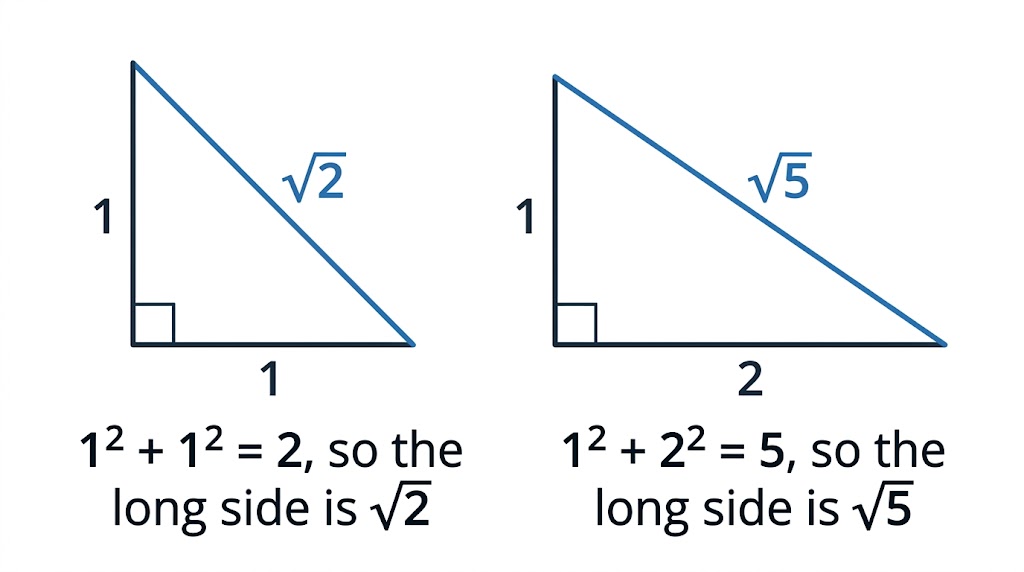
The long side of a right-angled triangle is often a surd.
Surds turn up all the time in geometry. A right-angled triangle with shorter sides 1 and 1 has a hypotenuse of exactly √2 - a length you can draw perfectly but never write exactly as a decimal.
openrevise.com
EDEXCEL GCSE MATHS · HIGHER TIER
PART ONE
Simplifying Surds
Take out the biggest square factor.
openrevise.com
EDEXCEL GCSE MATHS · HIGHER TIER
Simplifying a Surd
Number
Lesson 7 of 7
Simplify √72
1
Find the largest square number that is a factor of 72
Square numbers: 4, 9, 16, 25, 36 ... and 36 × 2 = 72
2
Split the root
√72 = √36 × √2
3
Work out the square root
√36 = 6
ANSWER
√72 = 6√2
openrevise.com
EDEXCEL GCSE MATHS · HIGHER TIER
Adding Surds
Number
Lesson 7 of 7
Simplify √50 + √18
1
Simplify each surd
√50 = √25 × √2 = 5√2 and √18 = √9 × √2 = 3√2
2
They are now "like surds" - both multiples of √2
5√2 + 3√2
3
Add them like algebra: 5x + 3x = 8x
8√2
ANSWER
8√2
openrevise.com
EDEXCEL GCSE MATHS · HIGHER TIER
Expanding Brackets with Surds
Number
Lesson 7 of 7
Expand and simplify (3 + √2)(5 − √2)
1
First times first
3 × 5 = 15
2
Outer and inner
3 × (−√2) = −3√2 and √2 × 5 = 5√2
3
Last times last
√2 × (−√2) = −2
4
Collect like terms
15 − 2 = 13 and −3√2 + 5√2 = 2√2
ANSWER
13 + 2√2
openrevise.com
EDEXCEL GCSE MATHS · HIGHER TIER
PART TWO
Rationalising the Denominator
Getting the surd out of the bottom of a fraction.
openrevise.com
EDEXCEL GCSE MATHS · HIGHER TIER
Rationalising the Denominator
Number
Lesson 7 of 7
To rationalise a fraction like a/(√b), multiply the top AND the bottom by √b.
Why it works
Multiplying top and bottom by the same number does not change a fraction's value, and √b × √b = b removes the surd from the bottom.
Example
6/(√3) = (6 × √3)/(√3 × √3) = 6√3/3 = 2√3.
Always simplify
Cancel any common factors, and simplify any surd left on top.
Exam wording
"Rationalise the denominator" and "give your answer in the form a√b" both mean do this.
openrevise.com
EDEXCEL GCSE MATHS · HIGHER TIER
Rationalising
Number
Lesson 7 of 7
Rationalise the denominator of 10/(√5). Give your answer in its simplest form.
1
Multiply the top and the bottom by √5
(10 × √5)/(√5 × √5)
2
The bottom becomes a whole number
√5 × √5 = 5
3
So
10√5/5
4
Simplify
10 ÷ 5 = 2
ANSWER
2√5
openrevise.com
EDEXCEL GCSE MATHS · HIGHER TIER
Number
Lesson 7 of 7
CASE STUDY
A4 Paper and the Square Root of 2
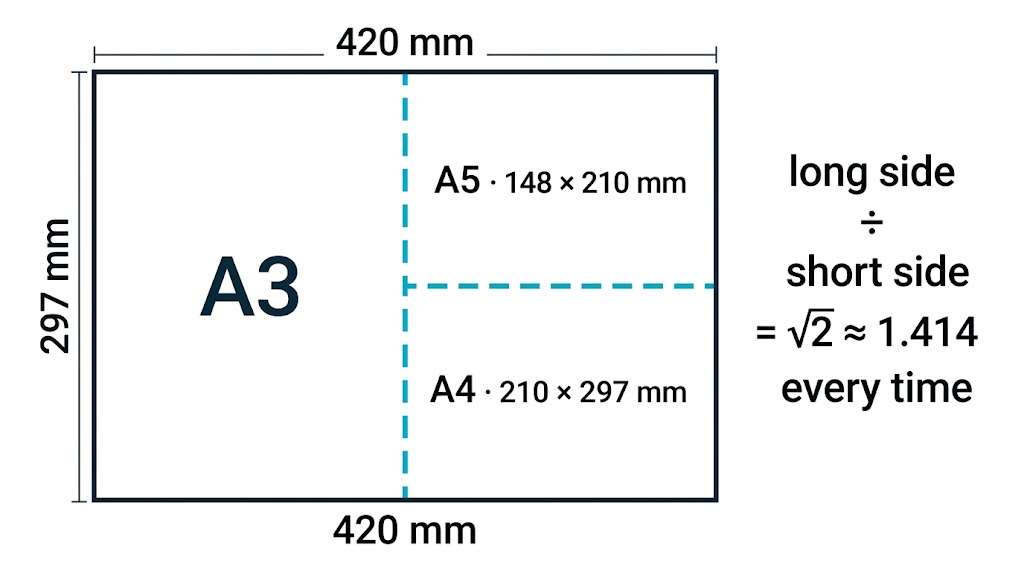
Every A-size sheet of paper - A3, A4, A5 - has its long side √2 times its short side. That is the one shape that stays exactly the same when you fold it in half: halve the long side of a sheet with sides 1 and √2 and you get sides √2/2 and 1, which is the same shape again. It is why an A4 page shrinks perfectly onto A5 on a photocopier. An A4 sheet is 210 mm by 297 mm, and 297 ÷ 210 = 1.414…, which is √2 to the nearest millimetre.
210 × 297 mm
The size of an A4 sheet
1 : √2
The ratio of the sides of every A-size sheet
openrevise.com
EDEXCEL GCSE MATHS · HIGHER TIER
Folding A-Size Paper
Number
Lesson 7 of 7

Fold A3 in half and you get A4; fold A4 in half and you get A5.
Halving an A-size sheet always makes the next size down, with exactly the same shape. The ratio of the sides is 1 : √2 at every size - a surd you use every day.
openrevise.com
EDEXCEL GCSE MATHS · HIGHER TIER
Key Terms
Number
Lesson 7 of 7
Rational number
A number that can be written as a fraction of two integers.
Irrational number
A number that cannot be written as a fraction; its decimal never ends or repeats.
Surd
A root that is irrational, such as √2 or √10.
Like surds
Multiples of the same surd, such as 5√2 and 3√2, which can be added and subtracted.
Simplest form
A surd with the largest possible square number taken out, e.g. 6√2.
Rationalise the denominator
Rewrite a fraction so there is no surd on the bottom.
openrevise.com
EDEXCEL GCSE MATHS · HIGHER TIER
Number
Lesson 7 of 7
YOUR TASK
Surd Simplifying Race
12 minutes
Simplify each. (a) √12 (b) √45 (c) √200 (d) √8 + √32 (e) √75 − √27 (f) √3 × √15 (g) (1 + √3)² (h) 12/(√6)
1
Look for the largest square factor.
2
Simplify before adding or subtracting.
3
Rationalise any surd in the denominator.
WHAT A GOOD ANSWER SHOWS
(a) 2√3 (b) 3√5 (c) 10√2 (d) 2√2 + 4√2 = 6√2 (e) 5√3 − 3√3 = 2√3 (f) √45 = 3√5 (g) 1 + 2√3 + 3 = 4 + 2√3 (h) 12√6/6 = 2√6
openrevise.com
EDEXCEL GCSE MATHS · HIGHER TIER
Can I...?
Number
Lesson 7 of 7
Explain what a surd is.
Say whether a number is rational or irrational.
Simplify a surd such as √72.
Multiply and divide surds.
Add and subtract like surds.
Expand brackets containing surds.
Rationalise a denominator like a/(√b).
Give an exact answer in surd form.
openrevise.com
EDEXCEL GCSE MATHS · HIGHER TIER
Summary & Exam Focus
A surd is an irrational root, and gives an exact value.
√ab = √a × √b: take out the largest square factor to simplify.
Only like surds can be added or subtracted.
Rationalise a/(√b) by multiplying the top and the bottom by √b.
EXAM FOCUS
Rationalise the denominator of 12/(√3). Give your answer in its simplest form. (2 marks)
"Exact" or "surd form" means do not use a decimal. Leave the root in the answer and simplify it as far as it goes.
openrevise.com
← → to move, F to present full screen, G for every slide at once.