Slides · PPTX · 113 KB · 16 slides
Linear sequences.pptx
Built from the lesson script on 28 September 2026.
EDEXCEL GCSE MATHS · FOUNDATION & HIGHER
Linear sequences
Algebra
Lesson 5 of 7
openrevise.com
EDEXCEL GCSE MATHS · FOUNDATION & HIGHER
Last Lesson and Before
Algebra
Lesson 5 of 7
Answer each one, then check.
1
Write down the next term: 3, 7, 11, 15, ...
2
What is the difference between the terms of 20, 17, 14, ...?
3
Solve 3n + 2 = 50.
4
Last lesson: work out 2n + 1 when n = 10.
5
Last lesson: make n the subject of T = 4n − 1.
openrevise.com
EDEXCEL GCSE MATHS · FOUNDATION & HIGHER
Last Lesson and Before - Answers
Algebra
Lesson 5 of 7
1
Write down the next term: 3, 7, 11, 15, ...
19
2
What is the difference between the terms of 20, 17, 14, ...?
−3
3
Solve 3n + 2 = 50.
n = 16
4
Last lesson: work out 2n + 1 when n = 10.
21
5
Last lesson: make n the subject of T = 4n − 1.
n = (T + 1)/4
openrevise.com
EDEXCEL GCSE MATHS · FOUNDATION & HIGHER
Learning Objectives
Algebra
Lesson 5 of 7
1
Continue a sequence using a term-to-term rule.
2
Generate terms of a sequence from its nth term.
3
Find the nth term of a linear (arithmetic) sequence.
4
Decide whether a number is a term of a sequence.
5
Solve problems with linear sequences and patterns.
openrevise.com
EDEXCEL GCSE MATHS · FOUNDATION & HIGHER
Sequences
Algebra
Lesson 5 of 7
A sequence is a list of numbers that follows a rule.
Term
Each number in a sequence. The 1st term, 2nd term and so on.
Term-to-term rule
How to get from one term to the next: "add 3".
Position-to-term rule (nth term)
A formula for any term from its position n: the nth term 3n + 2 gives 5, 8, 11, ...
Linear (arithmetic) sequence
One that goes up or down by the same amount - the common difference - every time.
openrevise.com
EDEXCEL GCSE MATHS · FOUNDATION & HIGHER
Where the nth Term Comes From
Algebra
Lesson 5 of 7
The sequence 5, 8, 11, 14, ... goes up by 3, so compare it with the 3 times table.
Position n
3n
Term
Term − 3n
1
3
5
+2
2
6
8
+2
3
9
11
+2
4
12
14
+2
n
3n
3n + 2
+2
openrevise.com
EDEXCEL GCSE MATHS · FOUNDATION & HIGHER
Finding the nth Term
Algebra
Lesson 5 of 7
Works for every linear sequence.
1
Difference
Find the common difference, d.
2
Times table
Write down dn: the d times table.
3
Compare
How do you get from dn to the sequence?
4
Adjust
Add or subtract that number.
5
Check
Put n = 1 and n = 2 into your answer.
openrevise.com
EDEXCEL GCSE MATHS · FOUNDATION & HIGHER
Finding the nth Term
Algebra
Lesson 5 of 7
Find the nth term of 7, 11, 15, 19, ...
1
The common difference is +4
so it starts 4n
2
The 4 times table
4, 8, 12, 16
3
Compare with the sequence
7 − 4 = 3: each term is 3 more
4
Write the nth term
4n + 3
5
Check n = 3
4 × 3 + 3 = 15
ANSWER
4n + 3
openrevise.com
EDEXCEL GCSE MATHS · FOUNDATION & HIGHER
A Decreasing Sequence
Algebra
Lesson 5 of 7
Find the nth term of 20, 17, 14, 11, ...
1
The common difference is −3
so it starts −3n
2
The −3 times table
−3, −6, −9, −12
3
Compare with the sequence
20 − (−3) = 23: each term is 23 more
4
Write the nth term
−3n + 23, usually written 23 − 3n
5
Check n = 1
23 − 3 = 20
ANSWER
23 − 3n
openrevise.com
EDEXCEL GCSE MATHS · FOUNDATION & HIGHER
Is It in the Sequence?
Algebra
Lesson 5 of 7
Is 100 a term of the sequence with nth term 4n + 3?
1
Set the nth term equal to 100
4n + 3 = 100
2
Solve
4n = 97, so n = 24.25
3
n must be a whole number (a position)
24.25 is not a whole number
ANSWER
No - 100 is not in the sequence (the 24th term is 99 and the 25th is 103).
openrevise.com
EDEXCEL GCSE MATHS · FOUNDATION & HIGHER
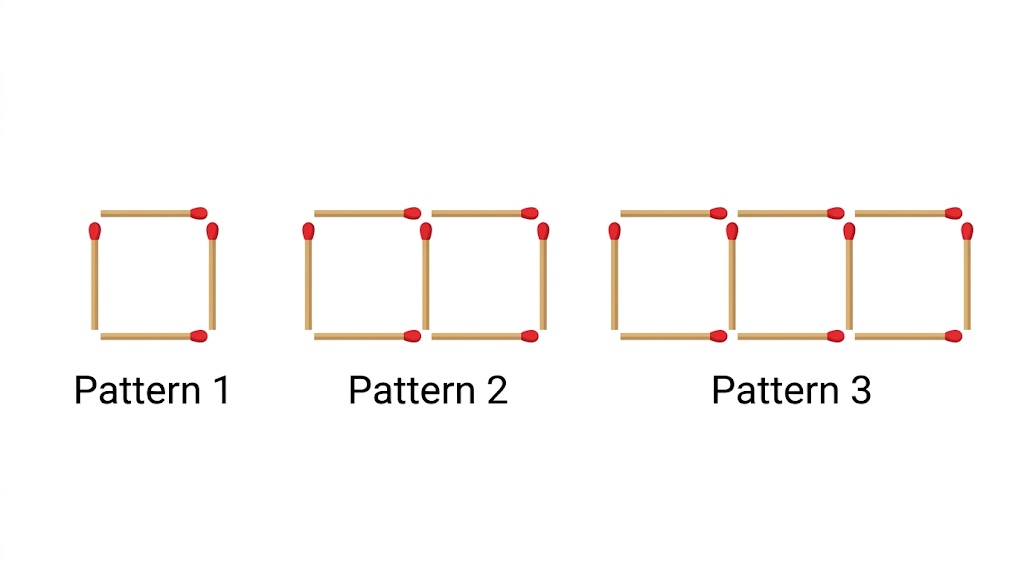
A Matchstick Pattern
Algebra
Lesson 5 of 7

4, 7, 10, ...: each new square needs 3 more matchsticks.
Each new square needs 3 more matchsticks, so the sequence 4, 7, 10, ... has a common difference of 3. Comparing with 3n (3, 6, 9) shows each pattern uses one more: the nth pattern needs 3n + 1 matchsticks - the extra 1 is the first stick on the left.
openrevise.com
EDEXCEL GCSE MATHS · FOUNDATION & HIGHER
Using the Pattern
Algebra
Lesson 5 of 7
Pattern n uses 3n + 1 matchsticks. (a) How many matchsticks does pattern 20 use? (b) What is the largest pattern that can be made with 100 matchsticks?
1
(a) Substitute n = 20
3 × 20 + 1 = 61
2
(b) The number of matchsticks must be 100 or fewer
3n + 1 ≤ 100
3
Solve
3n ≤ 99, so n ≤ 33
4
Pattern 33 uses exactly 3 × 33 + 1 = 100
it fits
ANSWER
(a) 61 matchsticks (b) Pattern 33
openrevise.com
EDEXCEL GCSE MATHS · FOUNDATION & HIGHER
Key Terms
Algebra
Lesson 5 of 7
Sequence
A list of numbers or patterns that follows a rule.
Term
One number in a sequence.
Term-to-term rule
The rule that gets you from one term to the next.
nth term
A formula that gives any term from its position, n.
Common difference
The amount a linear sequence goes up or down by each time.
Linear (arithmetic) sequence
A sequence with a common difference.
openrevise.com
EDEXCEL GCSE MATHS · FOUNDATION & HIGHER
Algebra
Lesson 5 of 7
YOUR TASK
Sequence Detectives
12 minutes
For each sequence, find the nth term and the 50th term. Then decide whether 150 is in it. (a) 6, 11, 16, 21, ... (b) 1, 4, 7, 10, ... (c) 40, 36, 32, 28, ... (d) −5, −3, −1, 1, ...
1
Find the difference.
2
Write the nth term and check it.
3
Solve nth term = 150.
WHAT A GOOD ANSWER SHOWS
(a) 5n + 1; 251; 150 is not in it (n = 29.8). (b) 3n − 2; 148; 150 is not in it (n = 50.67). (c) 44 − 4n; −156; 150 is not in it (it is decreasing from 40). (d) 2n − 7; 93; 150 is not in it (n = 78.5).
openrevise.com
EDEXCEL GCSE MATHS · FOUNDATION & HIGHER
Can I...?
Algebra
Lesson 5 of 7
Continue a sequence.
Describe a term-to-term rule.
Work out terms from an nth term.
Find the nth term of an increasing sequence.
Find the nth term of a decreasing sequence.
Decide whether a number is in a sequence.
Find the nth term of a pattern.
Use an nth term to solve a problem.
openrevise.com
EDEXCEL GCSE MATHS · FOUNDATION & HIGHER
Summary & Exam Focus
A linear sequence has a common difference.
nth term = (difference) × n, then adjust with a number.
To test a number, set the nth term equal to it: a whole-number n means it is in the sequence.
For patterns, the difference is how many more items each new pattern needs.
EXAM FOCUS
Here are the first five terms of a sequence: 5, 9, 13, 17, 21. Find an expression for the nth term. (2 marks)
"n + 4" is the term-to-term rule written wrongly, not an nth term. The nth term of a sequence going up by 4 always starts 4n.
openrevise.com
← → to move, F to present full screen, G for every slide at once.