Slides · PPTX · 143 KB · 19 slides
More expanding and factorising.pptx
Built from the lesson script on 28 September 2026.
EDEXCEL GCSE MATHS · HIGHER TIER
More expanding and factorising
Algebra
Lesson 7 of 7
openrevise.com
EDEXCEL GCSE MATHS · HIGHER TIER
From Earlier Lessons
Algebra
Lesson 7 of 7
Answer each one, then check.
1
Expand and simplify (x + 3)(x + 5).
2
Factorise x² + 5x + 6.
3
Factorise x² − 25.
4
Simplify 6x² ÷ 2x.
5
Work out 7² − 3².
openrevise.com
EDEXCEL GCSE MATHS · HIGHER TIER
From Earlier Lessons - Answers
Algebra
Lesson 7 of 7
1
Expand and simplify (x + 3)(x + 5).
x² + 8x + 15
2
Factorise x² + 5x + 6.
(x + 2)(x + 3)
3
Factorise x² − 25.
(x + 5)(x − 5)
4
Simplify 6x² ÷ 2x.
3x
5
Work out 7² − 3².
49 − 9 = 40
openrevise.com
EDEXCEL GCSE MATHS · HIGHER TIER
Learning Objectives
Algebra
Lesson 7 of 7
1
Expand the product of three binomials.
2
Factorise quadratics of the form ax² + bx + c.
3
Factorise the difference of two squares with coefficients, such as 9x² − 16y².
4
Simplify algebraic fractions by factorising.
5
Use expanding and factorising in algebraic proof.
openrevise.com
EDEXCEL GCSE MATHS · HIGHER TIER
Expanding Three Brackets
Algebra
Lesson 7 of 7
Expand and simplify (x + 1)(x + 2)(x + 3)
1
Expand the first two brackets
(x + 1)(x + 2) = x² + 3x + 2
2
Multiply every term by x
x(x² + 3x + 2) = x³ + 3x² + 2x
3
Multiply every term by +3
3(x² + 3x + 2) = 3x² + 9x + 6
4
Collect like terms
x³ + 6x² + 11x + 6
ANSWER
x³ + 6x² + 11x + 6
openrevise.com
EDEXCEL GCSE MATHS · HIGHER TIER
Three Brackets with Negatives
Algebra
Lesson 7 of 7
Expand and simplify (x − 2)(x + 3)(2x − 1)
1
Expand the first two
(x − 2)(x + 3) = x² + x − 6
2
Multiply by 2x
2x³ + 2x² − 12x
3
Multiply by −1
−x² − x + 6
4
Collect like terms
2x³ + x² − 13x + 6
ANSWER
2x³ + x² − 13x + 6 (check x = 1: (−1)(4)(1) = −4 and 2 + 1 − 13 + 6 = −4)
openrevise.com
EDEXCEL GCSE MATHS · HIGHER TIER
The Difference of Two Squares, Again
Algebra
Lesson 7 of 7
a² − b² = (a + b)(a − b) works for any two squares, not just x² and a number.
With coefficients
9x² − 16y² = (3x)² − (4y)² = (3x + 4y)(3x − 4y).
Take out a factor first
2x² − 18 = 2(x² − 9) = 2(x + 3)(x − 3).
With numbers
101² − 99² = (101 + 99)(101 − 99) = 200 × 2 = 400 - no squaring needed.
Watch for it
50 − 2x² = 2(25 − x²) = 2(5 + x)(5 − x).
openrevise.com
EDEXCEL GCSE MATHS · HIGHER TIER
Why the Difference of Two Squares Works
Algebra
Lesson 7 of 7

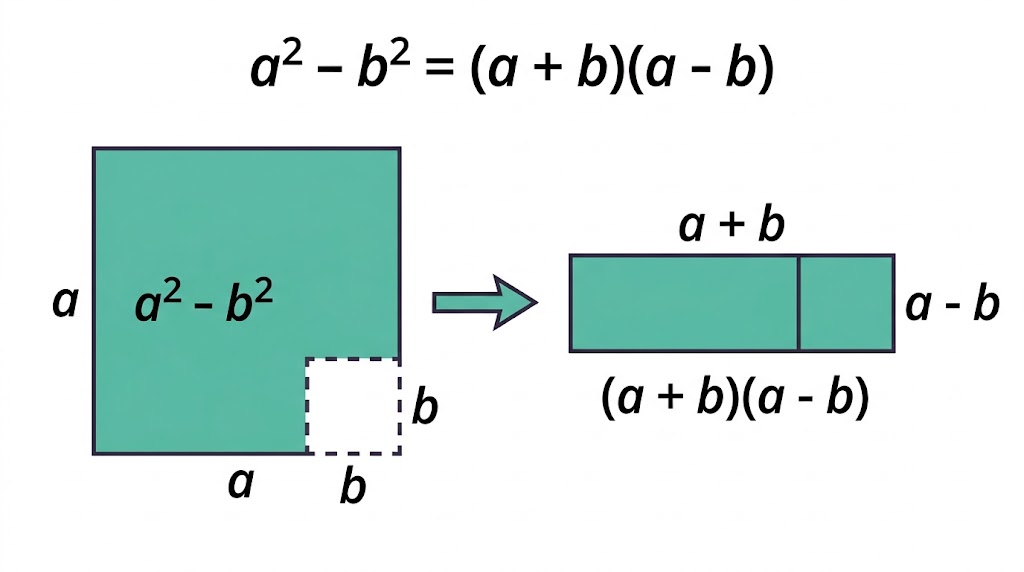
Cut the L-shape and rearrange it: a² − b² = (a + b)(a − b).
Take a square of side a and cut a square of side b from its corner. What is left has area a² − b². Slice it in two and rearrange the pieces, and they make a rectangle a + b long and a − b wide. Same area, two ways of writing it.
openrevise.com
EDEXCEL GCSE MATHS · HIGHER TIER
PART ONE
Factorising ax² + bx + c
When the squared term has a number in front.
openrevise.com
EDEXCEL GCSE MATHS · HIGHER TIER
Splitting the Middle Term
Algebra
Lesson 7 of 7
A reliable method for any quadratic ax² + bx + c.
1
Multiply
Work out a × c.
2
Find the pair
Two numbers that multiply to ac and add to b.
3
Split
Write bx as the sum of those two x terms.
4
Pairs
Factorise the first two terms and the last two terms.
5
Common bracket
Take out the bracket they share.
openrevise.com
EDEXCEL GCSE MATHS · HIGHER TIER
Factorising a Quadratic with a Coefficient
Algebra
Lesson 7 of 7
Factorise 6x² + 11x − 10
1
a × c
6 × (−10) = −60
2
Two numbers that multiply to −60 and add to 11
15 and −4
3
Split the middle term
6x² + 15x − 4x − 10
4
Factorise in pairs
3x(2x + 5) − 2(2x + 5)
5
Take out the common bracket
(2x + 5)(3x − 2)
ANSWER
(2x + 5)(3x − 2) (check: 6x² − 4x + 15x − 10)
openrevise.com
EDEXCEL GCSE MATHS · HIGHER TIER
Simplifying Algebraic Fractions
Algebra
Lesson 7 of 7
Factorise the top and the bottom, then cancel any bracket they share.
Cancel brackets, not terms
In (x + 3)/(x + 5), nothing cancels: the 3 and the 5 are not factors.
Factorise everything
Take out common factors, use the difference of two squares, factorise quadratics.
Then cancel
A bracket on the top and the bottom divides to 1.
openrevise.com
EDEXCEL GCSE MATHS · HIGHER TIER
Simplifying an Algebraic Fraction
Algebra
Lesson 7 of 7
Simplify fully (x² − 9)/(2x² + 5x − 3)
1
Top: difference of two squares
x² − 9 = (x + 3)(x − 3)
2
Bottom: ac = −6; 6 and −1 multiply to −6 and add to 5
2x² + 6x − x − 3 = (x + 3)(2x − 1)
3
Write it factorised
(x + 3)(x − 3)/((x + 3)(2x − 1))
4
Cancel (x + 3)
(x − 3)/(2x − 1)
ANSWER
(x − 3)/(2x − 1)
openrevise.com
EDEXCEL GCSE MATHS · HIGHER TIER
Algebraic Proof
Algebra
Lesson 7 of 7
Algebra can prove something is true for every number at once.
Even and odd
An even number is 2n; an odd number is 2n + 1, where n is an integer.
Consecutive numbers
n, n + 1, n + 2, ...
The method
Write the expression, expand and simplify, then factorise to show the property.
Example
(n + 3)² − (n + 1)² = n² + 6n + 9 − n² − 2n − 1 = 4n + 8 = 4(n + 2), which is always a multiple of 4.
openrevise.com
EDEXCEL GCSE MATHS · HIGHER TIER
Match the Quadratic to Its Factors
Algebra
Lesson 7 of 7
Expression
Factorised
2x² + 7x + 3
A
(3x − 1)(2x + 1)
1
3x² − 5x − 2
B
x(x + 2)(x − 2)
2
4x² − 25
C
(2x + 1)(x + 3)
3
2x² − 8
D
(3x + 1)(x − 2)
4
6x² + x − 1
E
(2x + 5)(2x − 5)
5
x³ − 4x
F
2(x + 2)(x − 2)
6
openrevise.com
EDEXCEL GCSE MATHS · HIGHER TIER
Key Terms
Algebra
Lesson 7 of 7
Binomial
An expression with two terms, such as (x + 3).
Product of three binomials
Three brackets multiplied, such as (x + 1)(x + 2)(x + 3).
Splitting the middle term
Writing bx as two terms so that ax² + bx + c can be factorised in pairs.
Algebraic fraction
A fraction with algebra on the top, the bottom or both.
Proof
An argument showing something is true in every case, not just the ones tested.
openrevise.com
EDEXCEL GCSE MATHS · HIGHER TIER
Algebra
Lesson 7 of 7
YOUR TASK
Factorise and Cancel
15 minutes
(a) Factorise 2x² + 9x + 4. (b) Factorise 3x² − 10x + 8. (c) Factorise fully 3x² − 75. (d) Simplify (x² + 3x − 10)/(x² − 4). (e) Expand (x + 2)³. (f) Prove that the sum of three consecutive integers is always a multiple of 3.
1
Look for a common factor first.
2
Then the difference of two squares or splitting the middle term.
3
Check by expanding.
WHAT A GOOD ANSWER SHOWS
(a) (2x + 1)(x + 4) (b) (3x − 4)(x − 2) (c) 3(x + 5)(x − 5) (d) (x + 5)(x − 2)/((x + 2)(x − 2)) = (x + 5)/(x + 2) (e) x³ + 6x² + 12x + 8 (f) n + (n + 1) + (n + 2) = 3n + 3 = 3(n + 1)
openrevise.com
EDEXCEL GCSE MATHS · HIGHER TIER
Can I...?
Algebra
Lesson 7 of 7
Expand three brackets.
Factorise ax² + bx + c by splitting the middle term.
Factorise the difference of two squares with coefficients.
Take out a common factor before factorising.
Simplify algebraic fractions.
Use 2n and 2n + 1 for even and odd numbers.
Write an algebraic proof.
Check a factorisation by expanding.
openrevise.com
EDEXCEL GCSE MATHS · HIGHER TIER
Summary & Exam Focus
Three brackets: expand two, then multiply every term by the third.
ax² + bx + c: find two numbers that multiply to ac and add to b, split, factorise in pairs.
a² − b² = (a + b)(a − b), with any squares; take out common factors first.
Algebraic fractions: factorise top and bottom, then cancel brackets.
EXAM FOCUS
Factorise 3x² + 10x + 8 (2 marks)
In a proof, finish with a sentence: "4(n + 2) is a multiple of 4, so the expression is always a multiple of 4". The last mark is for saying what you have shown.
openrevise.com
← → to move, F to present full screen, G for every slide at once.