Slides · PPTX · 228 KB · 33 slides
More expanding and factorising - Teacher Slides.pptx
The lesson slides with the teacher's notes on each slide, and every question and mark scheme built in. Built from the lesson script on 28 September 2026.
EDEXCEL GCSE MATHS · HIGHER TIER
More expanding and factorising
Algebra
Lesson 7 of 7
openrevise.com
EDEXCEL GCSE MATHS · HIGHER TIER
From Earlier Lessons
Algebra
Lesson 7 of 7
Answer each one, then check.
1
Expand and simplify (x + 3)(x + 5).
2
Factorise x² + 5x + 6.
3
Factorise x² − 25.
4
Simplify 6x² ÷ 2x.
5
Work out 7² − 3².
openrevise.com
EDEXCEL GCSE MATHS · HIGHER TIER
From Earlier Lessons - Answers
Algebra
Lesson 7 of 7
1
Expand and simplify (x + 3)(x + 5).
x² + 8x + 15
2
Factorise x² + 5x + 6.
(x + 2)(x + 3)
3
Factorise x² − 25.
(x + 5)(x − 5)
4
Simplify 6x² ÷ 2x.
3x
5
Work out 7² − 3².
49 − 9 = 40
openrevise.com
EDEXCEL GCSE MATHS · HIGHER TIER
Learning Objectives
Algebra
Lesson 7 of 7
1
Expand the product of three binomials.
2
Factorise quadratics of the form ax² + bx + c.
3
Factorise the difference of two squares with coefficients, such as 9x² − 16y².
4
Simplify algebraic fractions by factorising.
5
Use expanding and factorising in algebraic proof.
openrevise.com
EDEXCEL GCSE MATHS · HIGHER TIER
Expanding Three Brackets
Algebra
Lesson 7 of 7
Expand and simplify (x + 1)(x + 2)(x + 3)
1
Expand the first two brackets
(x + 1)(x + 2) = x² + 3x + 2
2
Multiply every term by x
x(x² + 3x + 2) = x³ + 3x² + 2x
3
Multiply every term by +3
3(x² + 3x + 2) = 3x² + 9x + 6
4
Collect like terms
x³ + 6x² + 11x + 6
ANSWER
x³ + 6x² + 11x + 6
openrevise.com
EDEXCEL GCSE MATHS · HIGHER TIER
Three Brackets with Negatives
Algebra
Lesson 7 of 7
Expand and simplify (x − 2)(x + 3)(2x − 1)
1
Expand the first two
(x − 2)(x + 3) = x² + x − 6
2
Multiply by 2x
2x³ + 2x² − 12x
3
Multiply by −1
−x² − x + 6
4
Collect like terms
2x³ + x² − 13x + 6
ANSWER
2x³ + x² − 13x + 6 (check x = 1: (−1)(4)(1) = −4 and 2 + 1 − 13 + 6 = −4)
openrevise.com
EDEXCEL GCSE MATHS · HIGHER TIER
The Difference of Two Squares, Again
Algebra
Lesson 7 of 7
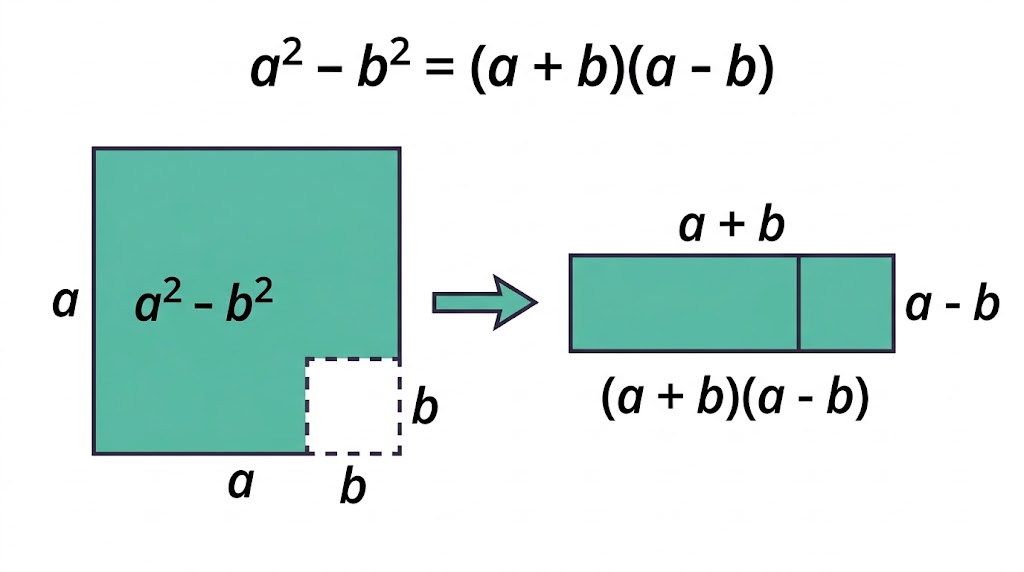
a² − b² = (a + b)(a − b) works for any two squares, not just x² and a number.
With coefficients
9x² − 16y² = (3x)² − (4y)² = (3x + 4y)(3x − 4y).
Take out a factor first
2x² − 18 = 2(x² − 9) = 2(x + 3)(x − 3).
With numbers
101² − 99² = (101 + 99)(101 − 99) = 200 × 2 = 400 - no squaring needed.
Watch for it
50 − 2x² = 2(25 − x²) = 2(5 + x)(5 − x).
openrevise.com
EDEXCEL GCSE MATHS · HIGHER TIER
Why the Difference of Two Squares Works
Algebra
Lesson 7 of 7

Cut the L-shape and rearrange it: a² − b² = (a + b)(a − b).
Take a square of side a and cut a square of side b from its corner. What is left has area a² − b². Slice it in two and rearrange the pieces, and they make a rectangle a + b long and a − b wide. Same area, two ways of writing it.
openrevise.com
EDEXCEL GCSE MATHS · HIGHER TIER
PART ONE
Factorising ax² + bx + c
When the squared term has a number in front.
openrevise.com
EDEXCEL GCSE MATHS · HIGHER TIER
Splitting the Middle Term
Algebra
Lesson 7 of 7
A reliable method for any quadratic ax² + bx + c.
1
Multiply
Work out a × c.
2
Find the pair
Two numbers that multiply to ac and add to b.
3
Split
Write bx as the sum of those two x terms.
4
Pairs
Factorise the first two terms and the last two terms.
5
Common bracket
Take out the bracket they share.
openrevise.com
EDEXCEL GCSE MATHS · HIGHER TIER
Factorising a Quadratic with a Coefficient
Algebra
Lesson 7 of 7
Factorise 6x² + 11x − 10
1
a × c
6 × (−10) = −60
2
Two numbers that multiply to −60 and add to 11
15 and −4
3
Split the middle term
6x² + 15x − 4x − 10
4
Factorise in pairs
3x(2x + 5) − 2(2x + 5)
5
Take out the common bracket
(2x + 5)(3x − 2)
ANSWER
(2x + 5)(3x − 2) (check: 6x² − 4x + 15x − 10)
openrevise.com
EDEXCEL GCSE MATHS · HIGHER TIER
Simplifying Algebraic Fractions
Algebra
Lesson 7 of 7
Factorise the top and the bottom, then cancel any bracket they share.
Cancel brackets, not terms
In (x + 3)/(x + 5), nothing cancels: the 3 and the 5 are not factors.
Factorise everything
Take out common factors, use the difference of two squares, factorise quadratics.
Then cancel
A bracket on the top and the bottom divides to 1.
openrevise.com
EDEXCEL GCSE MATHS · HIGHER TIER
Simplifying an Algebraic Fraction
Algebra
Lesson 7 of 7
Simplify fully (x² − 9)/(2x² + 5x − 3)
1
Top: difference of two squares
x² − 9 = (x + 3)(x − 3)
2
Bottom: ac = −6; 6 and −1 multiply to −6 and add to 5
2x² + 6x − x − 3 = (x + 3)(2x − 1)
3
Write it factorised
(x + 3)(x − 3)/((x + 3)(2x − 1))
4
Cancel (x + 3)
(x − 3)/(2x − 1)
ANSWER
(x − 3)/(2x − 1)
openrevise.com
EDEXCEL GCSE MATHS · HIGHER TIER
Algebraic Proof
Algebra
Lesson 7 of 7
Algebra can prove something is true for every number at once.
Even and odd
An even number is 2n; an odd number is 2n + 1, where n is an integer.
Consecutive numbers
n, n + 1, n + 2, ...
The method
Write the expression, expand and simplify, then factorise to show the property.
Example
(n + 3)² − (n + 1)² = n² + 6n + 9 − n² − 2n − 1 = 4n + 8 = 4(n + 2), which is always a multiple of 4.
openrevise.com
EDEXCEL GCSE MATHS · HIGHER TIER
Match the Quadratic to Its Factors
Algebra
Lesson 7 of 7
Expression
Factorised
2x² + 7x + 3
A
(3x − 1)(2x + 1)
1
3x² − 5x − 2
B
x(x + 2)(x − 2)
2
4x² − 25
C
(2x + 1)(x + 3)
3
2x² − 8
D
(3x + 1)(x − 2)
4
6x² + x − 1
E
(2x + 5)(2x − 5)
5
x³ − 4x
F
2(x + 2)(x − 2)
6
openrevise.com
EDEXCEL GCSE MATHS · HIGHER TIER
Key Terms
Algebra
Lesson 7 of 7
Binomial
An expression with two terms, such as (x + 3).
Product of three binomials
Three brackets multiplied, such as (x + 1)(x + 2)(x + 3).
Splitting the middle term
Writing bx as two terms so that ax² + bx + c can be factorised in pairs.
Algebraic fraction
A fraction with algebra on the top, the bottom or both.
Proof
An argument showing something is true in every case, not just the ones tested.
openrevise.com
EDEXCEL GCSE MATHS · HIGHER TIER
Algebra
Lesson 7 of 7
YOUR TASK
Factorise and Cancel
15 minutes
(a) Factorise 2x² + 9x + 4. (b) Factorise 3x² − 10x + 8. (c) Factorise fully 3x² − 75. (d) Simplify (x² + 3x − 10)/(x² − 4). (e) Expand (x + 2)³. (f) Prove that the sum of three consecutive integers is always a multiple of 3.
1
Look for a common factor first.
2
Then the difference of two squares or splitting the middle term.
3
Check by expanding.
WHAT A GOOD ANSWER SHOWS
(a) (2x + 1)(x + 4) (b) (3x − 4)(x − 2) (c) 3(x + 5)(x − 5) (d) (x + 5)(x − 2)/((x + 2)(x − 2)) = (x + 5)/(x + 2) (e) x³ + 6x² + 12x + 8 (f) n + (n + 1) + (n + 2) = 3n + 3 = 3(n + 1)
openrevise.com
EDEXCEL GCSE MATHS · HIGHER TIER
Can I...?
Algebra
Lesson 7 of 7
Expand three brackets.
Factorise ax² + bx + c by splitting the middle term.
Factorise the difference of two squares with coefficients.
Take out a common factor before factorising.
Simplify algebraic fractions.
Use 2n and 2n + 1 for even and odd numbers.
Write an algebraic proof.
Check a factorisation by expanding.
openrevise.com
EDEXCEL GCSE MATHS · HIGHER TIER
Summary & Exam Focus
Three brackets: expand two, then multiply every term by the third.
ax² + bx + c: find two numbers that multiply to ac and add to b, split, factorise in pairs.
a² − b² = (a + b)(a − b), with any squares; take out common factors first.
Algebraic fractions: factorise top and bottom, then cancel brackets.
EXAM FOCUS
Factorise 3x² + 10x + 8 (2 marks)
In a proof, finish with a sentence: "4(n + 2) is a multiple of 4, so the expression is always a multiple of 4". The last mark is for saying what you have shown.
openrevise.com
EDEXCEL GCSE MATHS · HIGHER TIER
Exam Practice: More Expanding and Factorising
Algebra
Lesson 7 of 7
Answer all questions. Show your working. All questions are non-calculator. · 30 minutes
Question 1 · 2 marks · Non-calculator
Factorise 3x² + 10x + 8
Question 2 · 3 marks · Non-calculator
Expand and simplify (x + 4)(x − 1)(x + 2)
Question 3 · 2 marks · Non-calculator
Factorise fully 50 − 2x²
openrevise.com
EDEXCEL GCSE MATHS · HIGHER TIER
Exam Practice: More Expanding and Factorising (cont.)
Algebra
Lesson 7 of 7
Question 4 · 3 marks · Non-calculator
Simplify fully (x² + 3x − 10)/(x² − 4)
Question 5 · 3 marks · Non-calculator · Prove
Prove that (2n + 1)² − (2n − 1)² is a multiple of 8 for all positive integer values of n.
Question 6 · 3 marks · Non-calculator · Show that
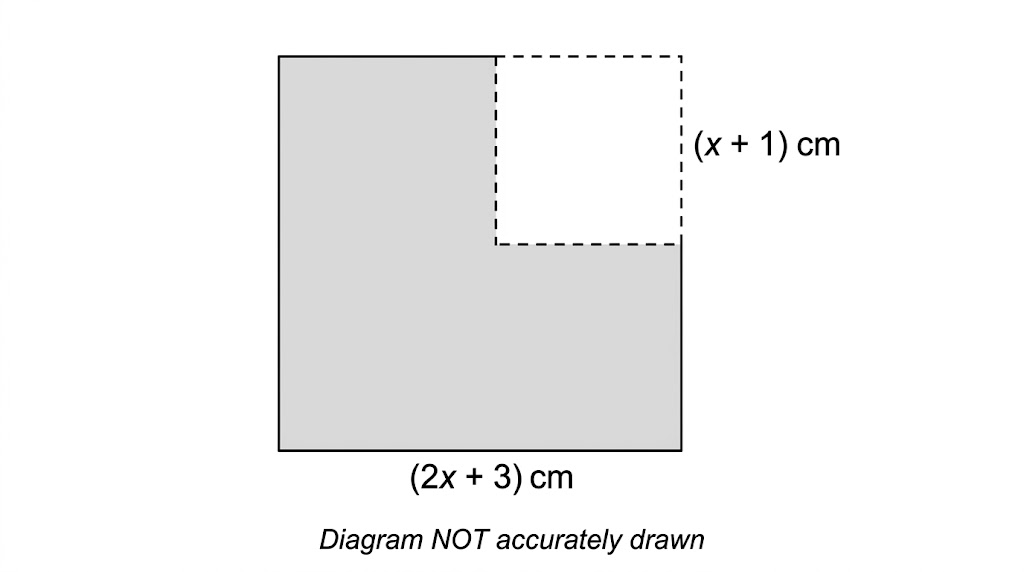
The diagram shows a square of side (2x + 3) cm with a square of side (x + 1) cm cut from one corner. Show that the shaded area, in cm², can…
openrevise.com
EDEXCEL GCSE MATHS · HIGHER TIER
Question 1 · 2 marks · Non-calculator
Algebra
Lesson 7 of 7
“
Factorise 3x² + 10x + 8
HOW TO ANSWER IT
Command word: Non-calculator. Worth 2 marks, so plan before writing.
openrevise.com
EDEXCEL GCSE MATHS · HIGHER TIER
Question 1 · mark scheme
Algebra
Lesson 7 of 7
2 marks available. Award a mark for each point made.
(3x ± 4)(x ± 2), or a correct split of the middle term
M1
(3x + 4)(x + 2)
A1
openrevise.com
EDEXCEL GCSE MATHS · HIGHER TIER
Question 2 · 3 marks · Non-calculator
Algebra
Lesson 7 of 7
“
Expand and simplify (x + 4)(x − 1)(x + 2)
HOW TO ANSWER IT
Command word: Non-calculator. Worth 3 marks, so plan before writing.
openrevise.com
EDEXCEL GCSE MATHS · HIGHER TIER
Question 2 · mark scheme
Algebra
Lesson 7 of 7
3 marks available. Award a mark for each point made.
Two brackets expanded correctly
M1
At least 6 correct terms from multiplying by the third bracket
M1
x³ + 5x² + 2x − 8
A1
openrevise.com
EDEXCEL GCSE MATHS · HIGHER TIER
Question 3 · 2 marks · Non-calculator
Algebra
Lesson 7 of 7
“
Factorise fully 50 − 2x²
HOW TO ANSWER IT
Command word: Non-calculator. Worth 2 marks, so plan before writing.
openrevise.com
EDEXCEL GCSE MATHS · HIGHER TIER
Question 3 · mark scheme
Algebra
Lesson 7 of 7
2 marks available. Award a mark for each point made.
2(25 − x²), or (10 + 2x)(5 − x)
M1
2(5 + x)(5 − x)
A1
openrevise.com
EDEXCEL GCSE MATHS · HIGHER TIER
Question 4 · 3 marks · Non-calculator
Algebra
Lesson 7 of 7
“
Simplify fully (x² + 3x − 10)/(x² − 4)
HOW TO ANSWER IT
Command word: Non-calculator. Worth 3 marks, so plan before writing.
openrevise.com
EDEXCEL GCSE MATHS · HIGHER TIER
Question 4 · mark scheme
Algebra
Lesson 7 of 7
3 marks available. Award a mark for each point made.
(x + 5)(x − 2)
M1
(x + 2)(x − 2)
M1
(x + 5)/(x + 2)
A1
openrevise.com
EDEXCEL GCSE MATHS · HIGHER TIER
Question 5 · 3 marks · Non-calculator · Prove
Algebra
Lesson 7 of 7
“
Prove that (2n + 1)² − (2n − 1)² is a multiple of 8 for all positive integer values of n.
HOW TO ANSWER IT
Command word: Non-calculator · Prove. Worth 3 marks, so plan before writing.
openrevise.com
EDEXCEL GCSE MATHS · HIGHER TIER
Question 5 · mark scheme
Algebra
Lesson 7 of 7
3 marks available. Award a mark for each point made.
One bracket expanded correctly
M1
8n
A1
A concluding statement: 8n is a multiple of 8
C1
openrevise.com
EDEXCEL GCSE MATHS · HIGHER TIER
Question 6 · 3 marks · Non-calculator · Show that
Algebra
Lesson 7 of 7

The diagram shows a square of side (2x + 3) cm with a square of side (x + 1) cm cut from one corner. Show that the shaded area, in cm², can be written as (3x + 4)(x + 2). (3 marks)
openrevise.com
EDEXCEL GCSE MATHS · HIGHER TIER
Question 6 · mark scheme
Algebra
Lesson 7 of 7
3 marks available. Award a mark for each point made.
(2x + 3)² − (x + 1)²
M1
Uses the difference of two squares, or expands both to reach 3x² + 10x + 8
M1
Correctly reaches (3x + 4)(x + 2)
A1
openrevise.com
← → to move, F to present full screen, G for every slide at once.