Flashcards · Biology · Enzymes and Digestion
Food Tests
-
What is a food test?
A test that uses a reagent which changes colour when a particular type of molecule is present.
-
What does qualitative mean?
The test shows whether something is present, not how much.
-
Which reagent tests for starch?
Iodine solution.
-
What is a positive result for starch?
Orange-brown changes to blue-black.
-
Which reagent tests for sugar?
Benedict's reagent.
-
What is the colour of Benedict's reagent at the start?
Blue.
-
What is a positive result for sugar?
The blue changes to green, yellow, orange or brick red.
-
What must you do for Benedict's test?
Heat it in a water bath at about 75 °C.
-
What does a brick-red result mean in Benedict's test?
A large amount of sugar is present.
-
Which reagent tests for protein?
Biuret reagent.
-
What is a positive result for protein?
Blue changes to purple.
-
Does the Biuret test need heating?
No.
-
Which test is used for lipids?
The emulsion test: shake with ethanol, then pour into water.
-
What is a positive result for lipids?
A cloudy white emulsion.
-
What is a negative result for the iodine test?
The solution stays orange-brown.
-
What is a negative result for Benedict's test?
The mixture stays blue.
-
How do you prepare a solid food for testing?
Grind it with distilled water, stir to dissolve some of it, and filter it.
-
Why is ethanol used for the lipid test?
Lipids dissolve in ethanol.
-
Why use a water bath instead of a flame?
So the liquid cannot boil over, and the temperature is steady.
-
Why should you wear eye protection?
Some reagents are corrosive or harmful, such as Biuret reagent and Benedict's reagent.
-
Why is ethanol kept away from flames?
It is flammable.
-
Why test distilled water as a control?
To show what a negative result looks like.
-
 Name the test, the reagent and the positive result for starch, sugar, protein and lipids.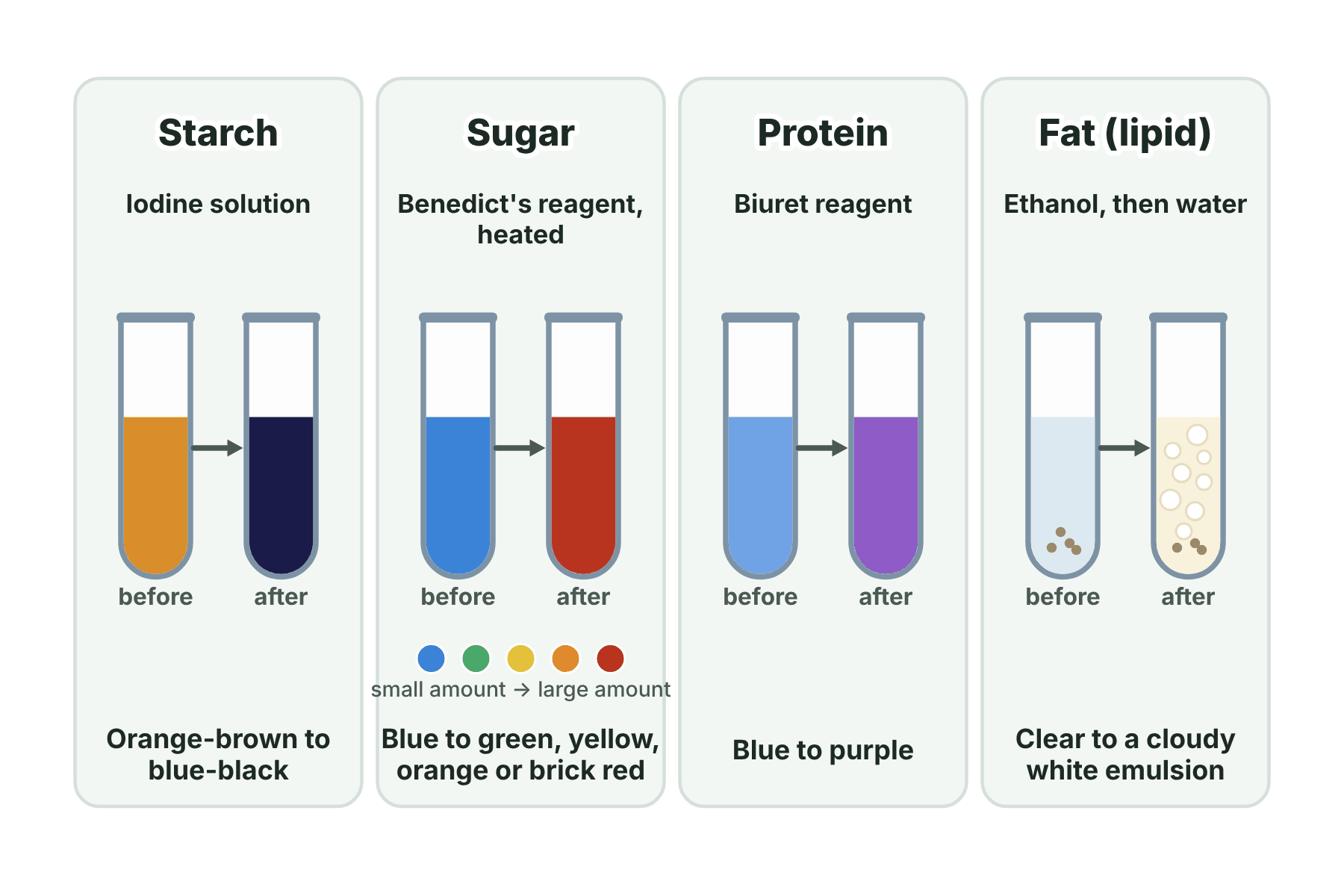
-
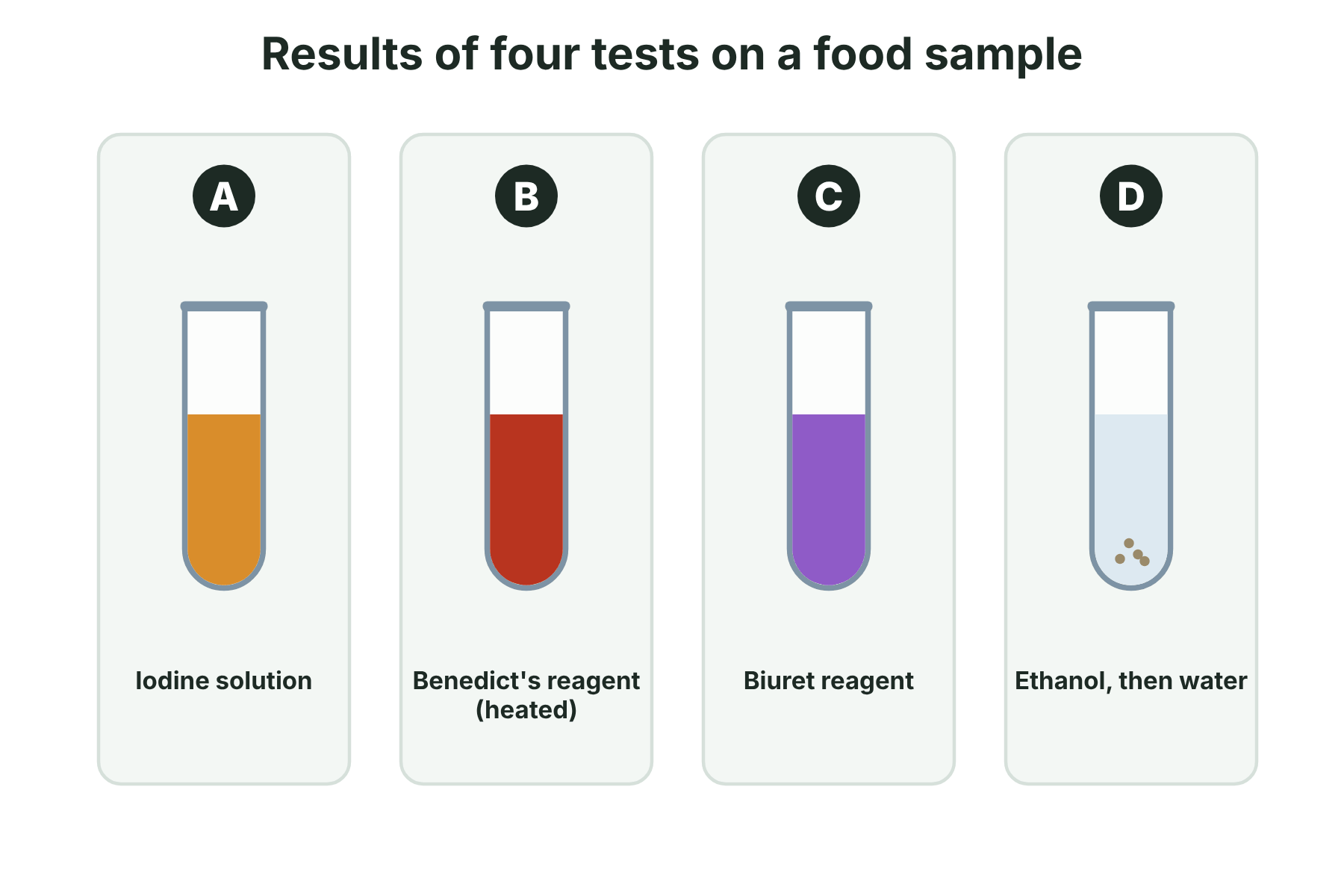 Four tests were done on a food sample, as shown. Say which food groups are present in the sample.
 Sugar is present (B, brick red) and protein is present (C, purple). Starch is not present (A stayed orange-brown) and lipid is not present (D stayed clear).
-
What does each colour in the Benedict's test tell you?
Blue means no sugar. Green means a very small amount, yellow a small amount, orange a moderate amount, and brick red a large amount.