Flashcards · Biology · Transport In and Out of Cells
Investigating Osmosis in Plant Tissue
-
What is the aim of the osmosis practical?
To investigate the effect of different concentrations of salt or sugar solution on the mass of plant tissue.
-
Why is potato used?
It is cheap, easy to cut into identical pieces, and made of cells with partially permeable membranes.
-
What tool cuts potato cylinders of equal width?
A cork borer.
-
What is the independent variable?
The concentration of the solution.
-
What is the dependent variable?
The percentage change in mass of the potato.
-
Name three control variables.
The size of the cylinders, the volume of solution, the time in solution (also the temperature and the type of potato).
-
Why do you blot the cylinders dry before weighing?
To remove liquid from the surface, which would add extra mass.
-
What is the formula for percentage change in mass?
(final mass − start mass) ÷ start mass × 100.
-
A cylinder goes from 2.00 g to 2.30 g. What is the percentage change?
+15%.
-
What does a negative percentage change mean?
The potato lost mass, because water left it by osmosis.
-
Why use percentage change and not just change in mass?
The cylinders start with slightly different masses, and percentages make the results fair to compare.
-
What does a gain in mass tell you about the solution?
It is more dilute than the potato cell sap.
-
What does a loss in mass tell you about the solution?
It is more concentrated than the potato cell sap.
-
What does it mean when the graph line crosses zero?
There is no change in mass, so the solution has the same concentration as the cell sap.
-
How do you find the concentration of the cell sap from the graph?
Read the concentration where the line crosses 0% change.
-
Why use pure water as one of the solutions?
It is the most dilute solution, and shows the most water entering the potato.
-
How can you make the results more reliable?
Repeat the test with several cylinders and calculate a mean.
-
What is an anomalous result?
A result that does not fit the pattern of the others.
-
How could you find the cell sap concentration more accurately?
Use extra solutions of concentrations close to where the line crosses zero.
-
Give one safety precaution.
Cut on a tile, with the blade pointing away from your hands.
-
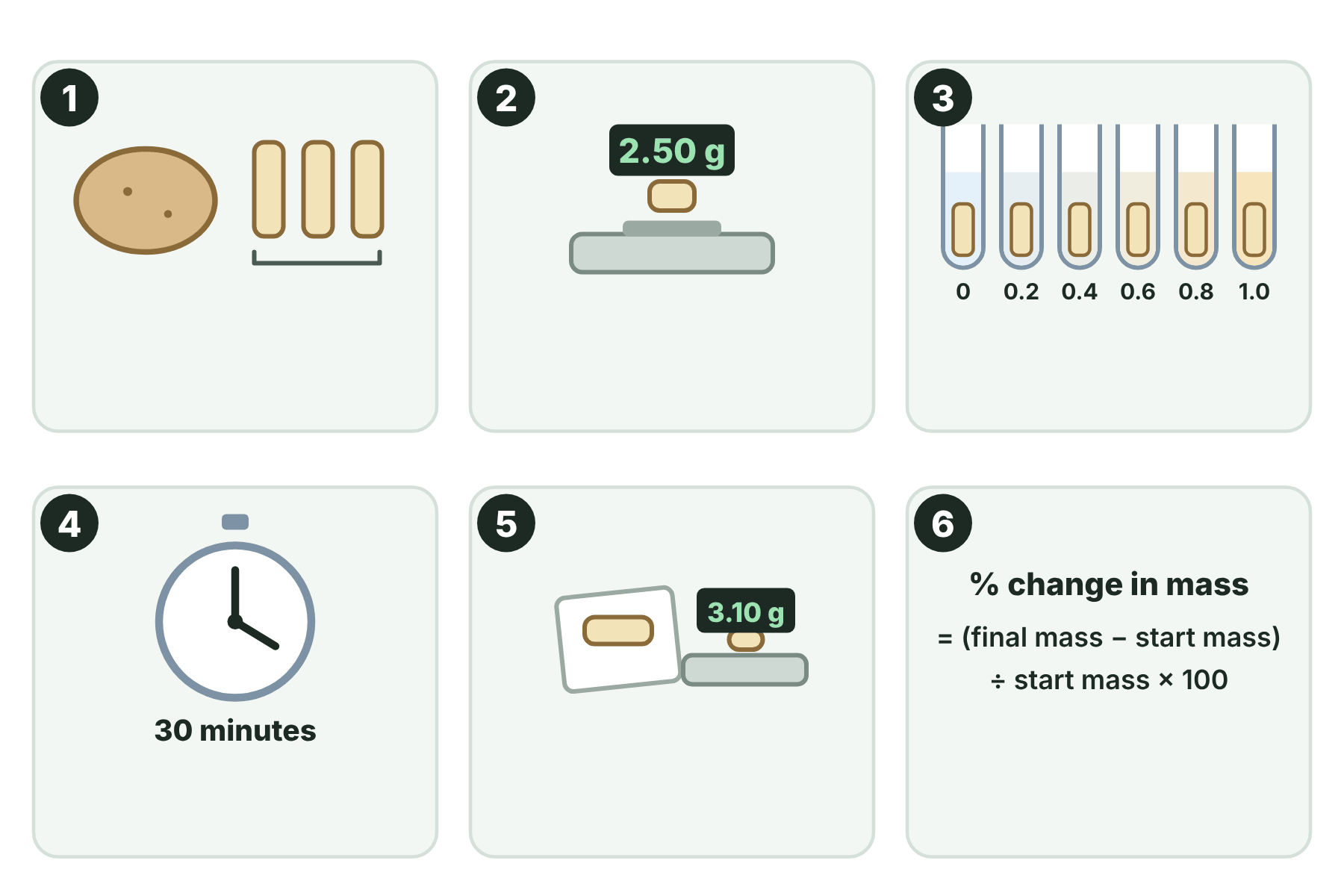 Describe the six steps of the potato osmosis investigation.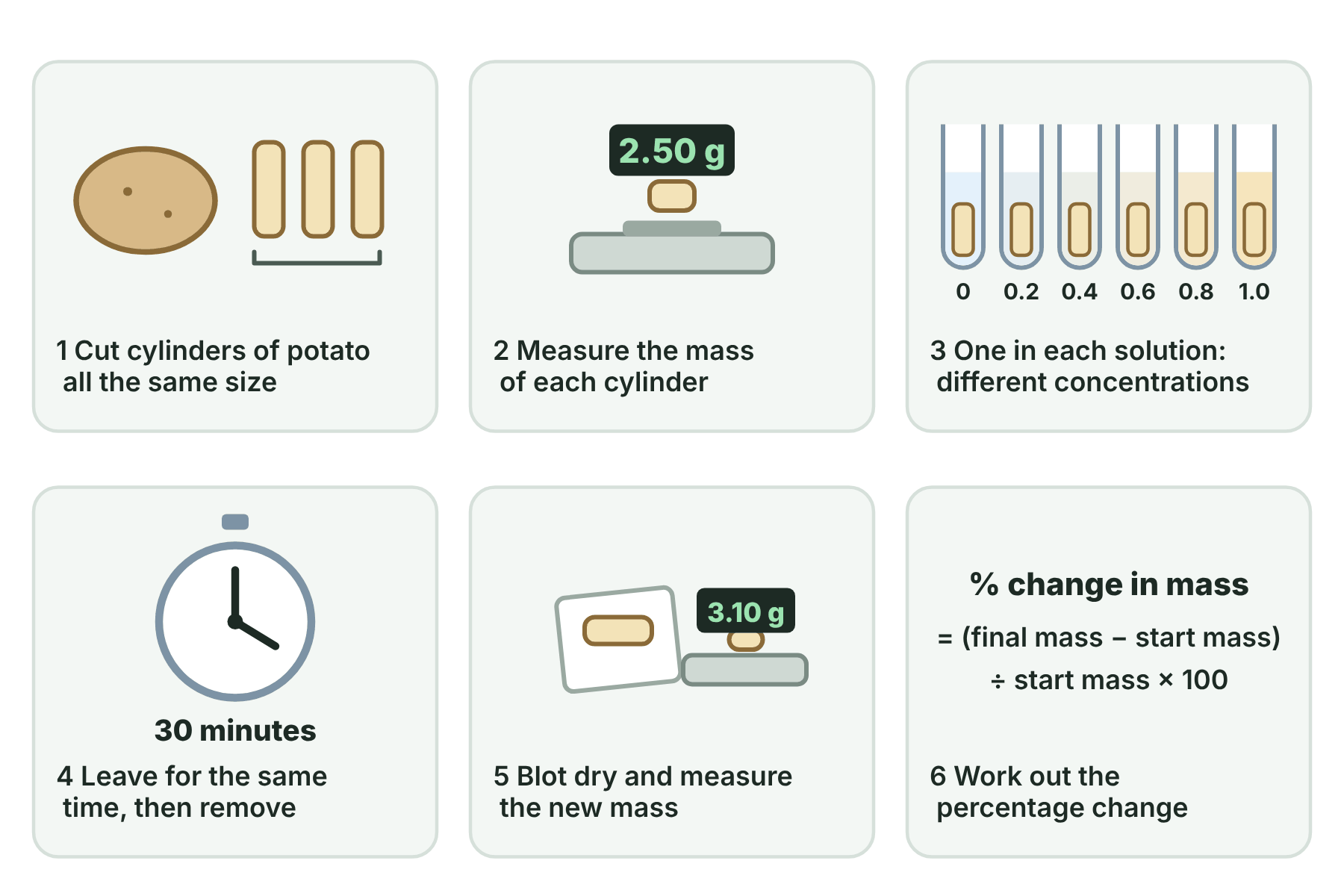
-
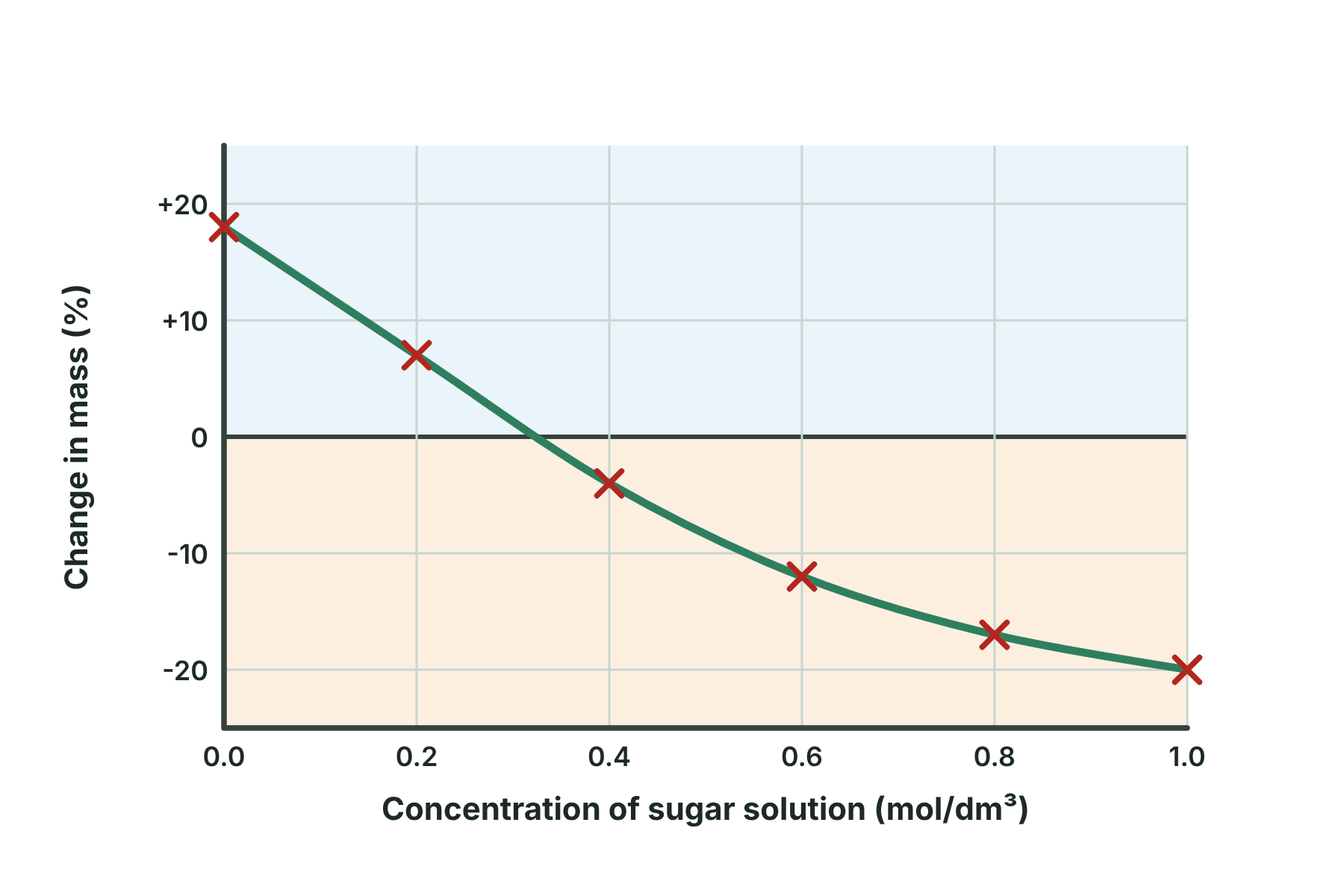 Read the concentration of the potato cell sap from this graph.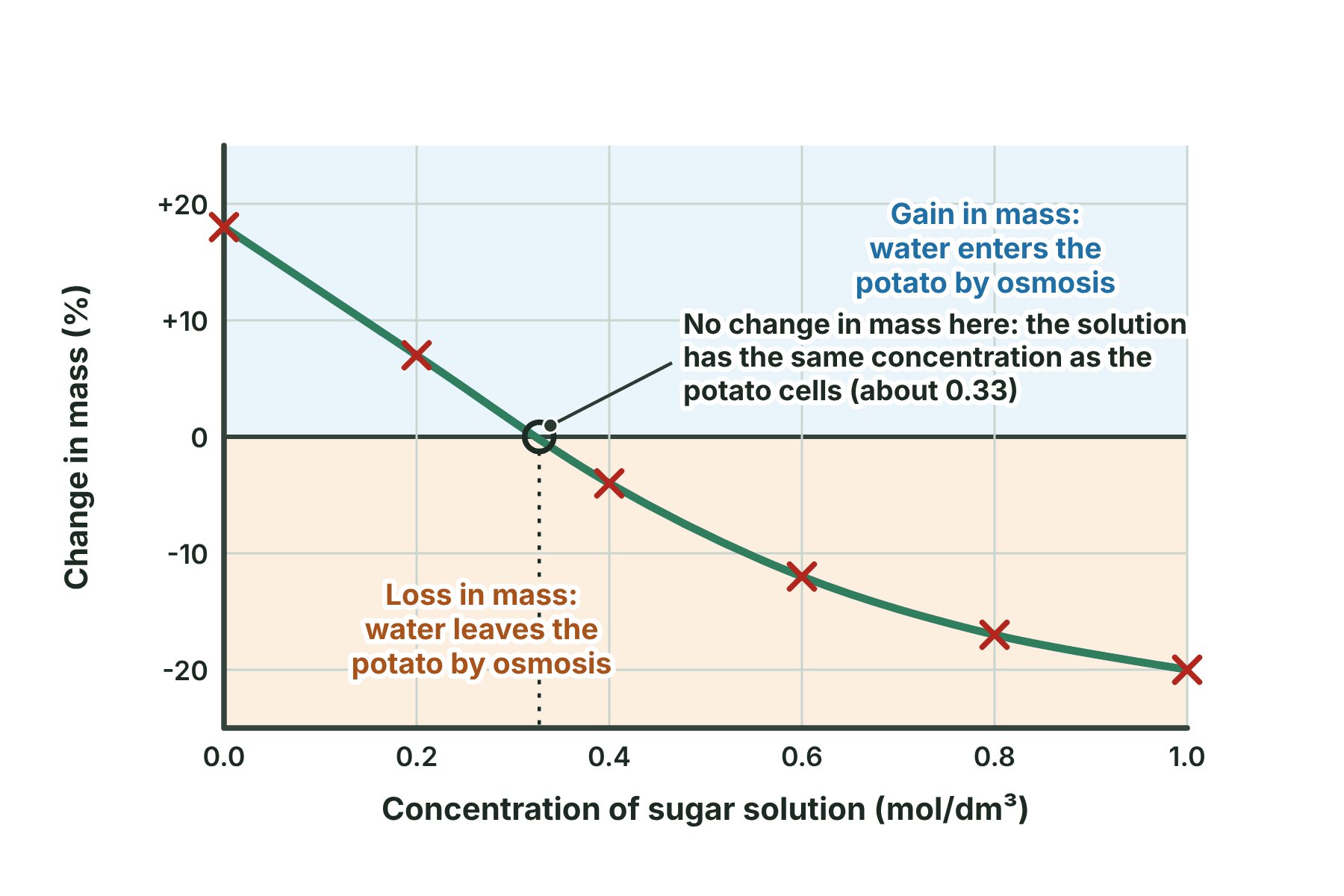
About 0.33 mol/dm³: where the line crosses 0% change, so there is no net movement of water.
-
A cylinder goes from 3.20 g to 2.72 g. What is the percentage change in mass?
−15%. The change is 2.72 − 3.20 = −0.48 g, then −0.48 ÷ 3.20 × 100 = −15%.