Flashcards · Biology
Transport in Cells
-
What is diffusion?
The spreading out of particles of a gas, or of a substance in solution, resulting in a net movement from a higher concentration to a lower concentration.
-
What does "net movement" mean?
The overall movement in one direction. Particles move both ways, but more move one way.
-
Does diffusion need energy from the cell?
No. The particles move on their own.
-
What is a concentration gradient?
The difference in concentration between two places.
-
Which way do particles move in diffusion?
From a higher concentration to a lower concentration, down the concentration gradient.
-
Name two gases that move by diffusion in gas exchange.
Oxygen and carbon dioxide.
-
Which waste product diffuses from cells into the blood plasma?
Urea.
-
What happens to urea once it is in the blood plasma?
The kidneys remove it so it can be excreted.
-
Which way does oxygen diffuse into a respiring cell, and why?
Into the cell, because oxygen is used up there, so its concentration is lower inside.
-
Why does carbon dioxide diffuse out of respiring cells?
Respiration makes it, so its concentration is higher inside the cell.
-
Name the three factors that affect the rate of diffusion.
The concentration gradient, the temperature, and the surface area of the membrane.
-
What happens to the rate of diffusion if the concentration gradient gets bigger?
It increases.
-
Why does diffusion speed up as temperature rises?
The particles have more energy and move faster.
-
Why does a larger surface area speed up diffusion?
More particles can cross the membrane at the same time.
-
When does diffusion stop?
Never for the particles themselves, but there is no net movement once they are evenly spread.
-
How do you calculate a rate?
Divide the amount that changed by the time it took.
-
A cell takes in 30 units in 6 minutes. What is the rate?
5 units per minute.
-
What keeps the concentration gradient steep in the alveoli?
Breathing brings fresh air in, and flowing blood carries oxygen away.
-
What is the usual mistake about diffusion?
Saying particles move only from high to low. They move both ways, but the net movement is from high to low.
-
Which process moves particles from low to high concentration?
Active transport, which needs energy.
-
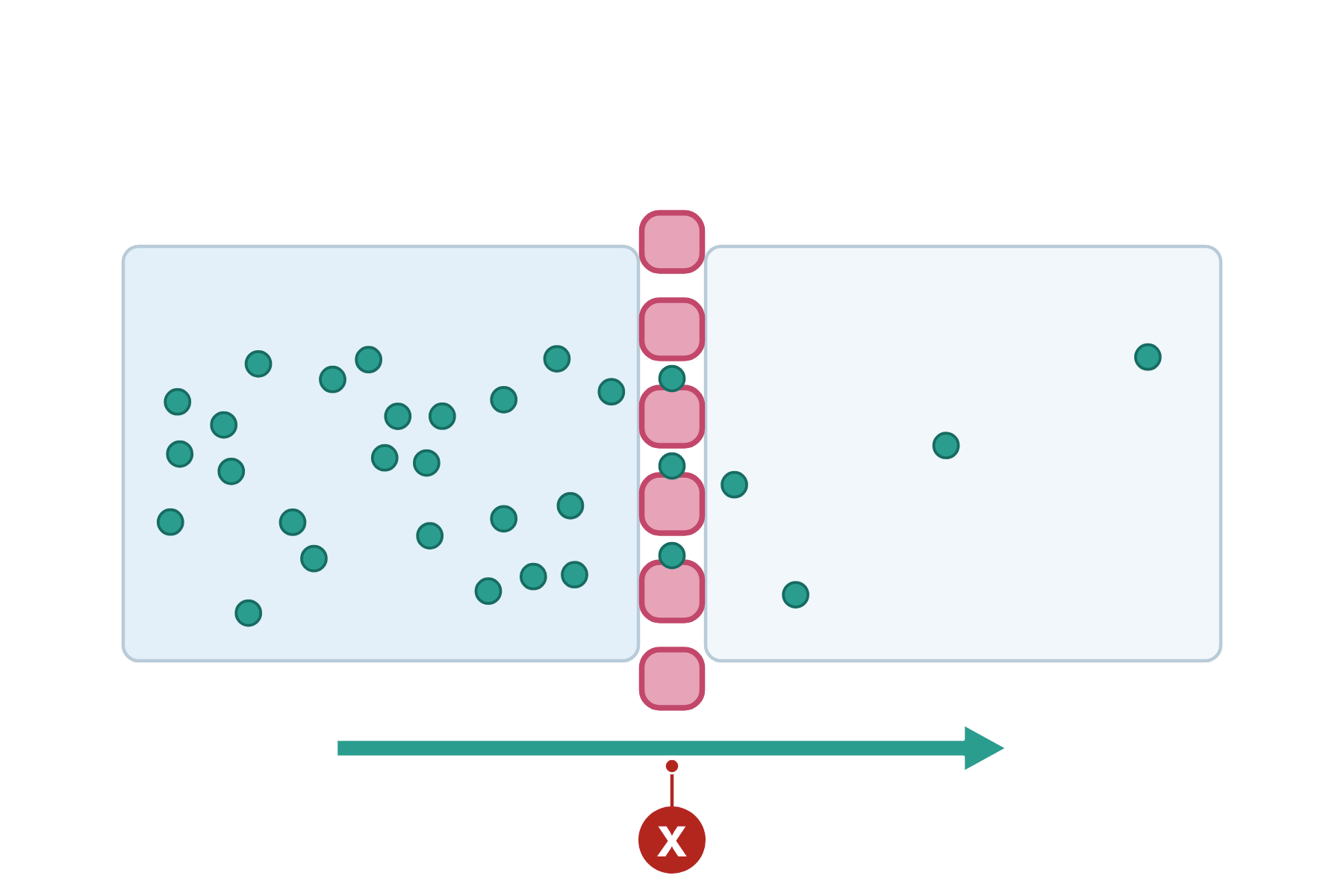 What does the arrow marked X show?
 The net movement of particles across the membrane, from the higher concentration to the lower concentration. This is diffusion.
-
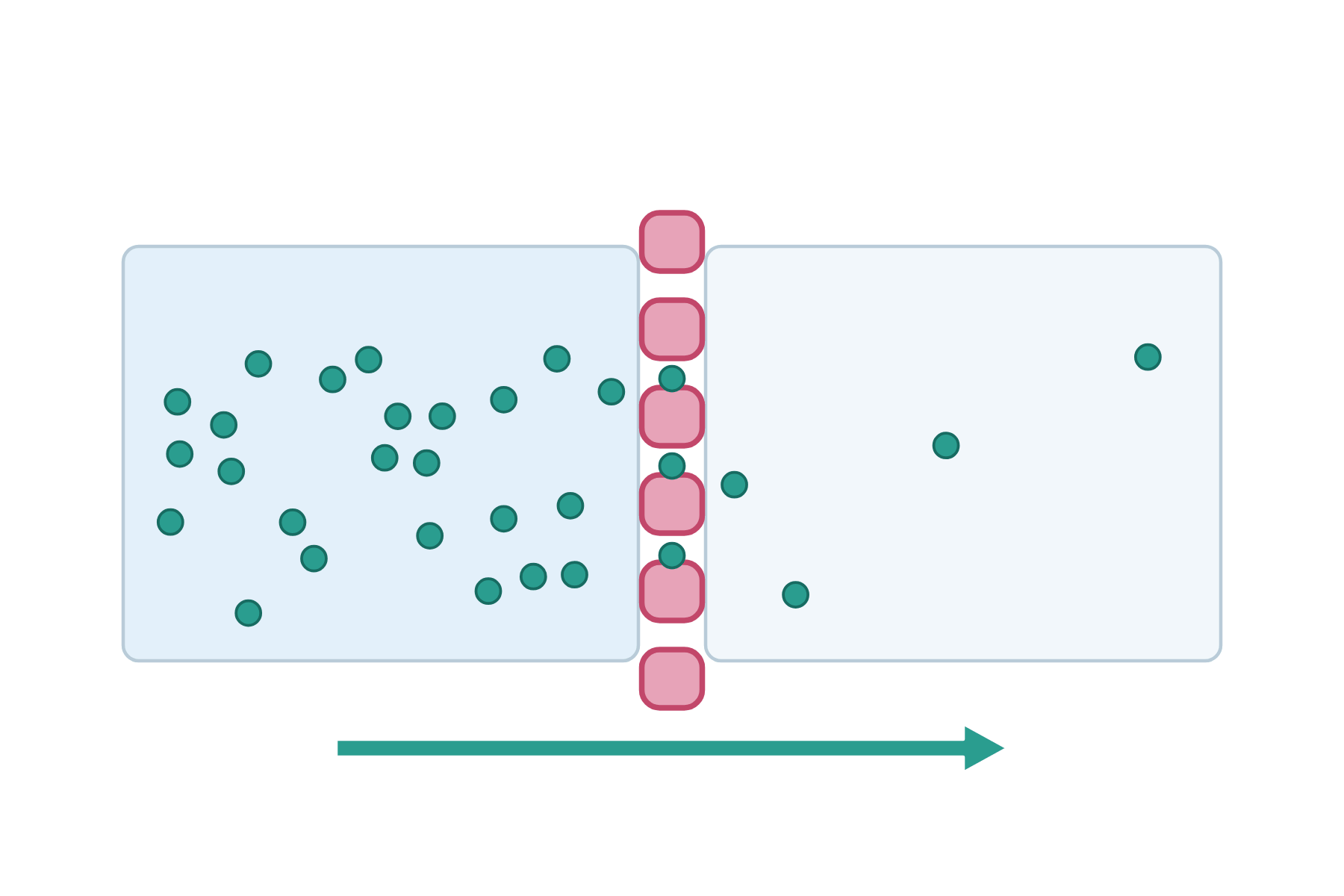 Label this diagram of diffusion across a cell membrane.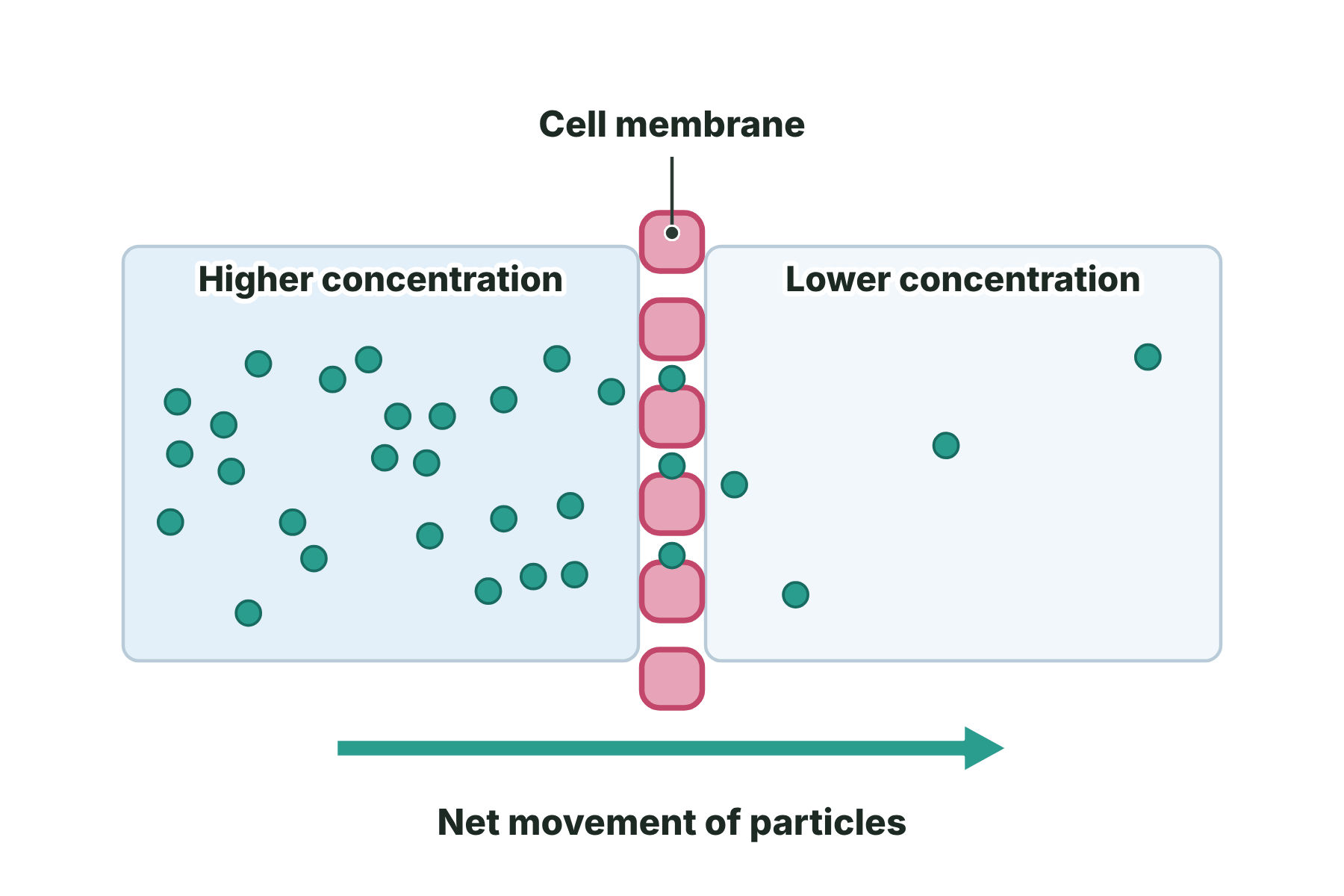
-
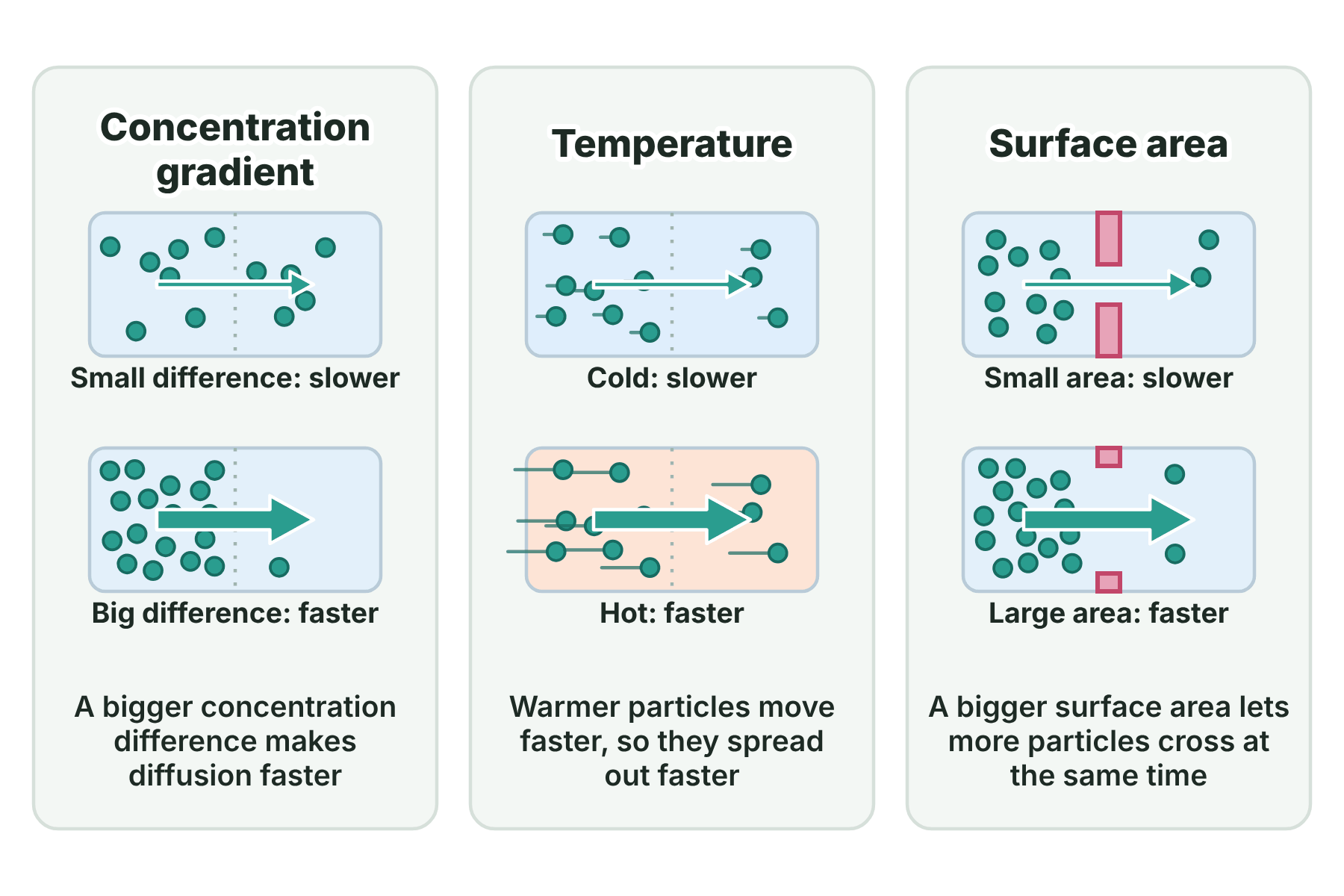 Which of these three changes make diffusion faster?
 All three: a bigger concentration gradient, a higher temperature and a larger surface area of membrane.
-
What is surface area to volume ratio?
The surface area of an object divided by its volume.
-
What happens to the ratio as an object gets bigger?
It gets smaller.
-
What is the surface area of a cube with 2 cm sides?
24 cm², because \(6 \times 2 \times 2\).
-
What is the volume of a cube with 3 cm sides?
27 cm³, because \(3 \times 3 \times 3\).
-
What is the surface area to volume ratio of a 3 cm cube?
2 : 1, from 54 ÷ 27.
-
Why can a single-celled organism exchange materials by diffusion across its surface?
It has a large surface area to volume ratio, so substances reach the whole cell fast enough.
-
Why can't a large organism rely on diffusion across its outer surface?
Its surface area to volume ratio is small, so substances would take too long to reach the cells in the middle.
-
What two things do large organisms have to solve this problem?
Exchange surfaces and a transport system.
-
Name the four features of an effective exchange surface.
A large surface area, a thin membrane, an efficient blood supply (animals) and ventilation (animals, for gas exchange).
-
Why does a thin membrane help?
It gives a short diffusion path.
-
Why does a good blood supply help?
It carries substances away, keeping the concentration gradient steep.
-
Why does ventilation help?
It keeps the concentration of the gas high on the outside, keeping the gradient steep.
-
What are villi?
Finger-like folds in the lining of the small intestine that give a large surface area.
-
What are alveoli?
The tiny air sacs in the lungs where oxygen and carbon dioxide are exchanged.
-
How are the lungs ventilated?
By breathing.
-
How are the gills of a fish ventilated?
Water flows over them all the time.
-
How are root hair cells adapted?
They have a long thin extension, which gives a large surface area.
-
How are leaves adapted for gas exchange?
They are flat and thin, with air spaces inside and stomata in the surface.
-
What are stomata?
Tiny pores in the leaf surface that let carbon dioxide in and oxygen out.
-
Which exchange surfaces are not supplied with blood?
Those of plants: the roots and the leaves.
-
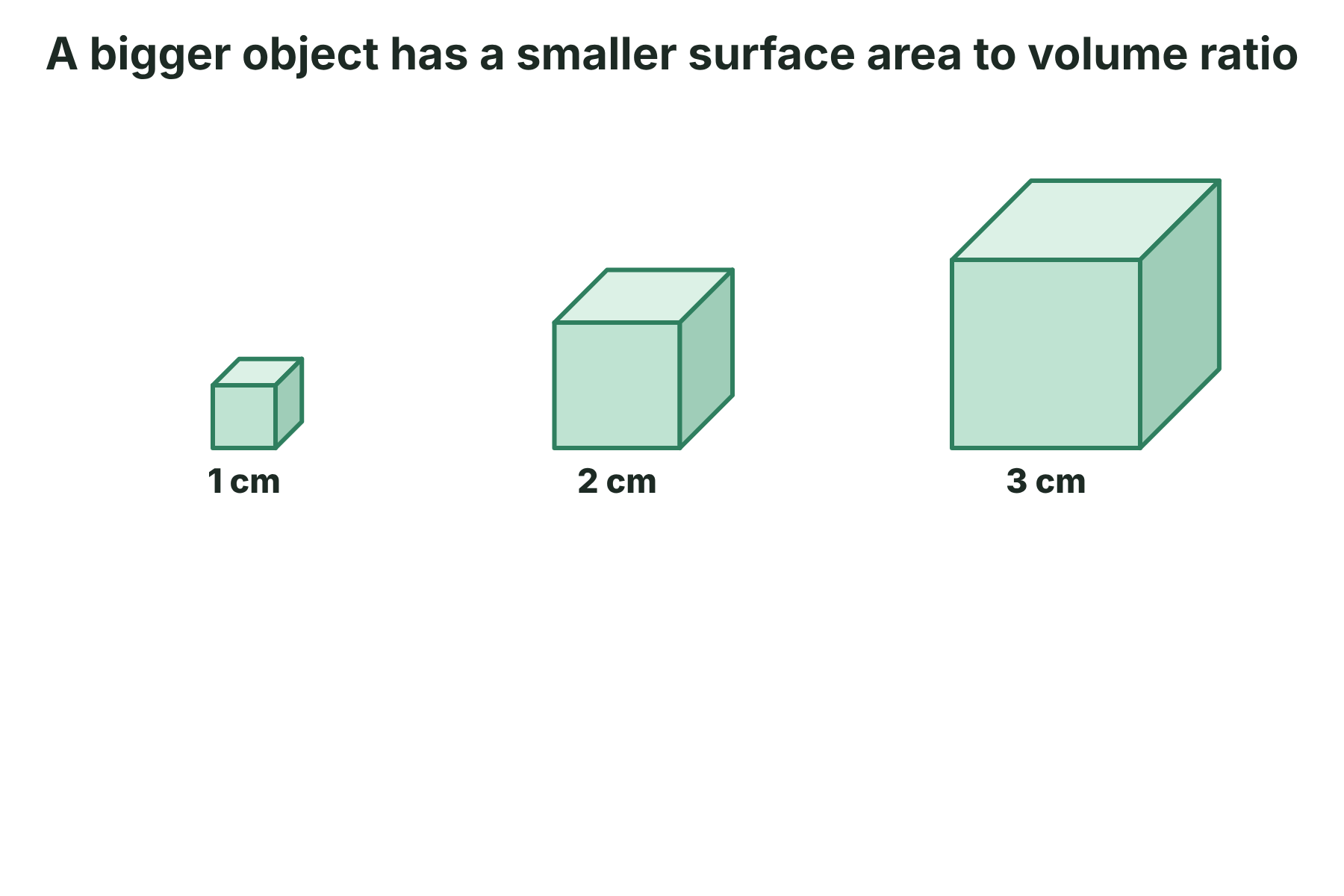 Work out the surface area to volume ratio of each cube.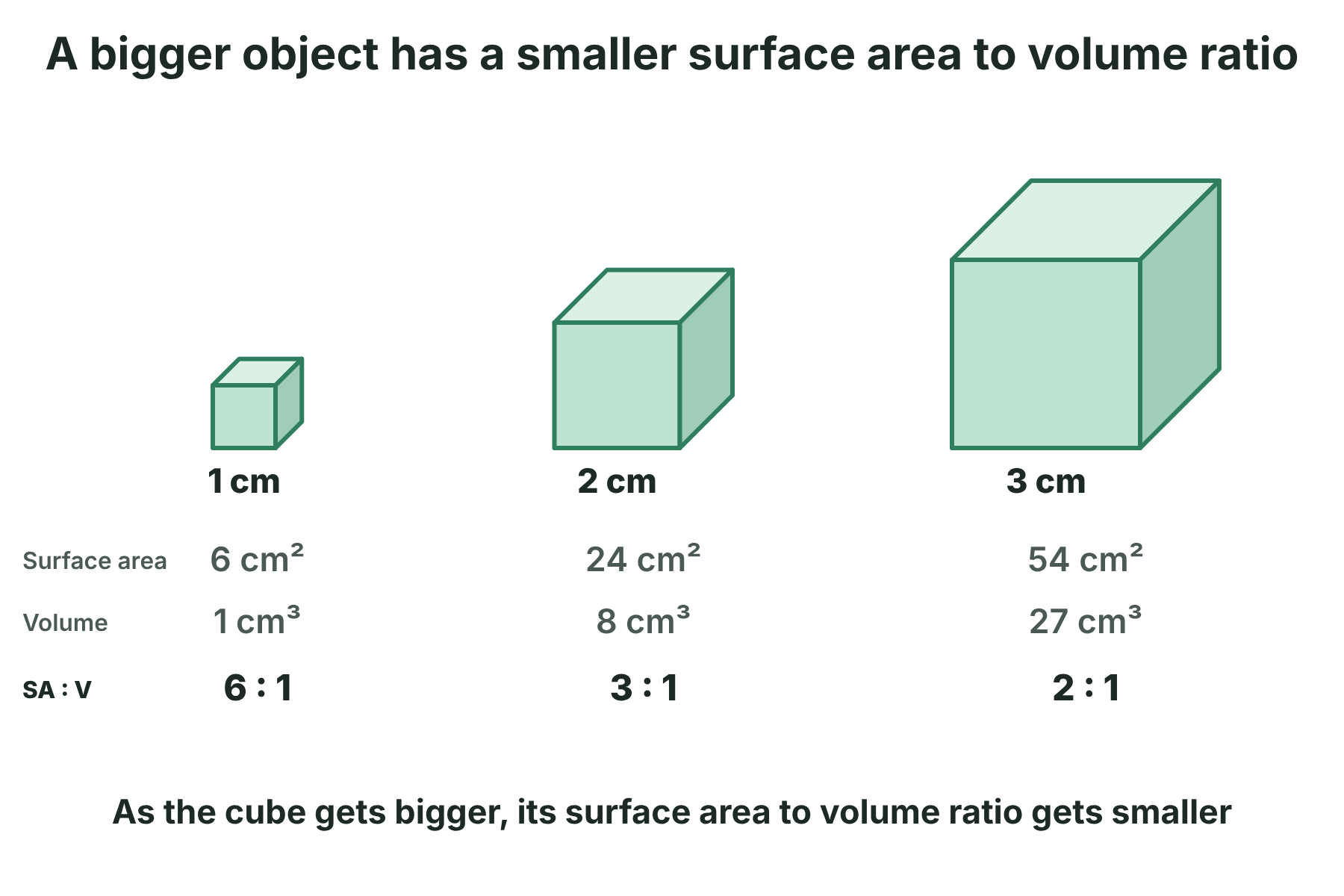
1 cm: 6 cm² ÷ 1 cm³ = 6 : 1. 2 cm: 24 ÷ 8 = 3 : 1. 3 cm: 54 ÷ 27 = 2 : 1. The bigger the cube, the smaller the ratio.
-
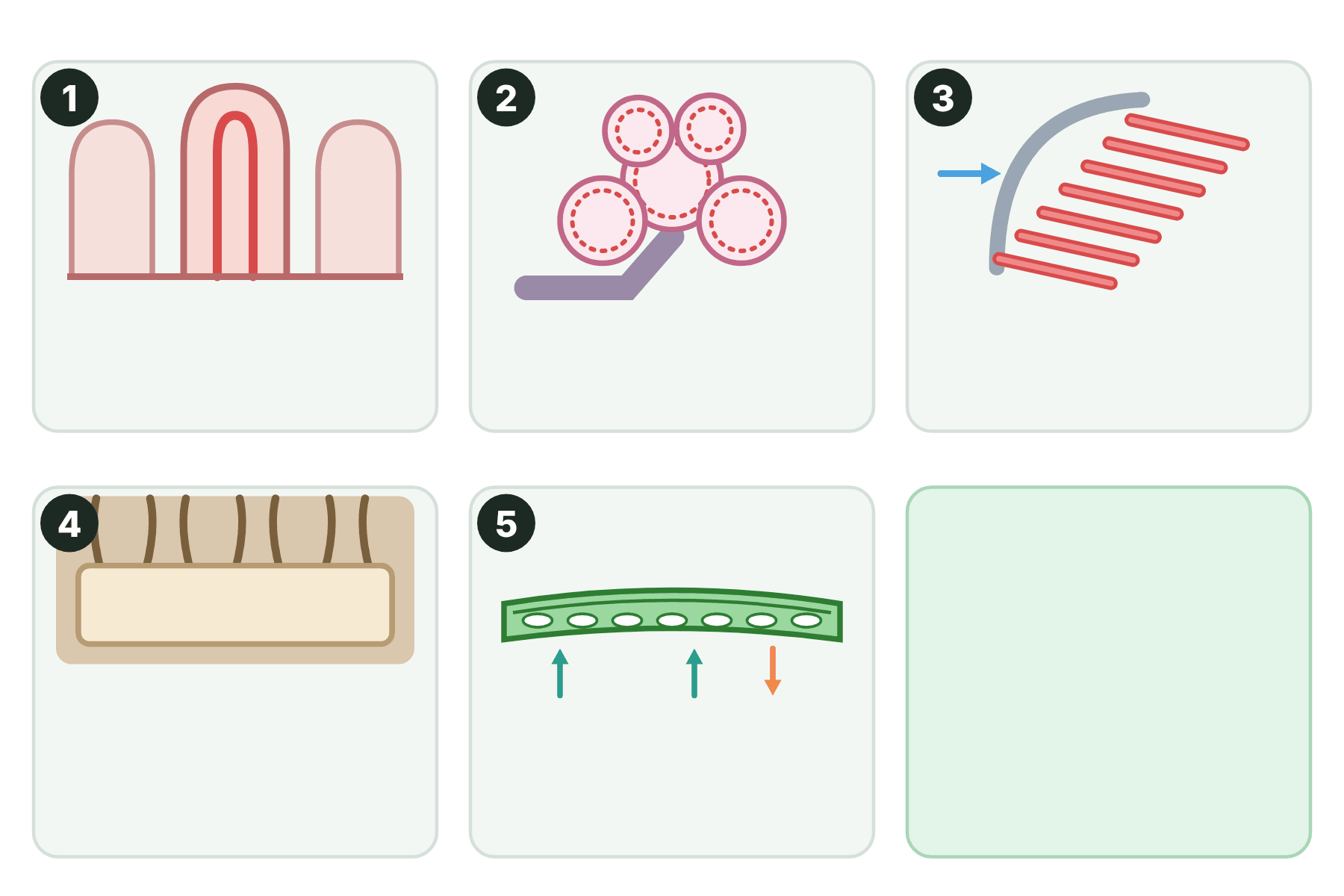 Describe how each of these exchange surfaces is adapted.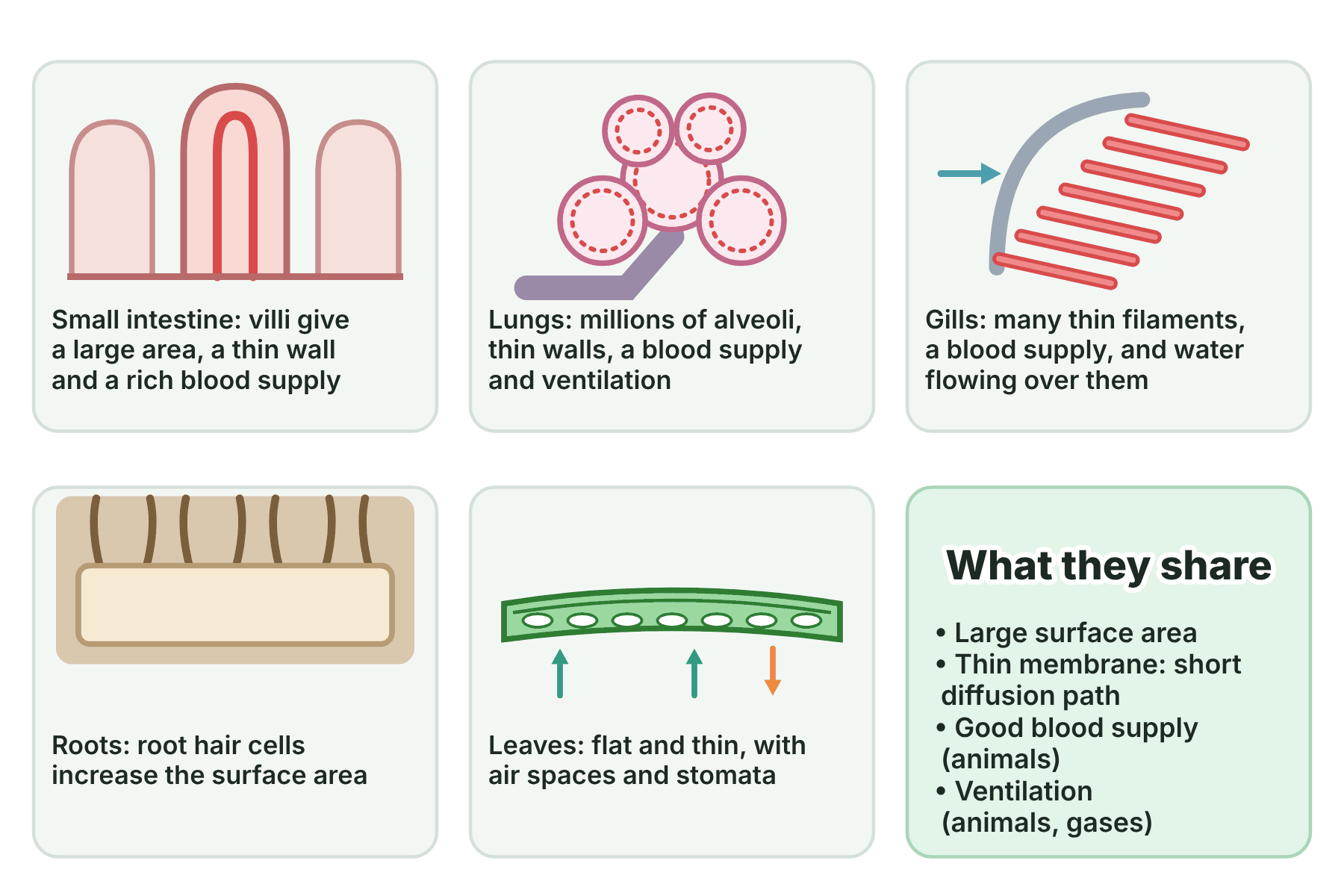
-
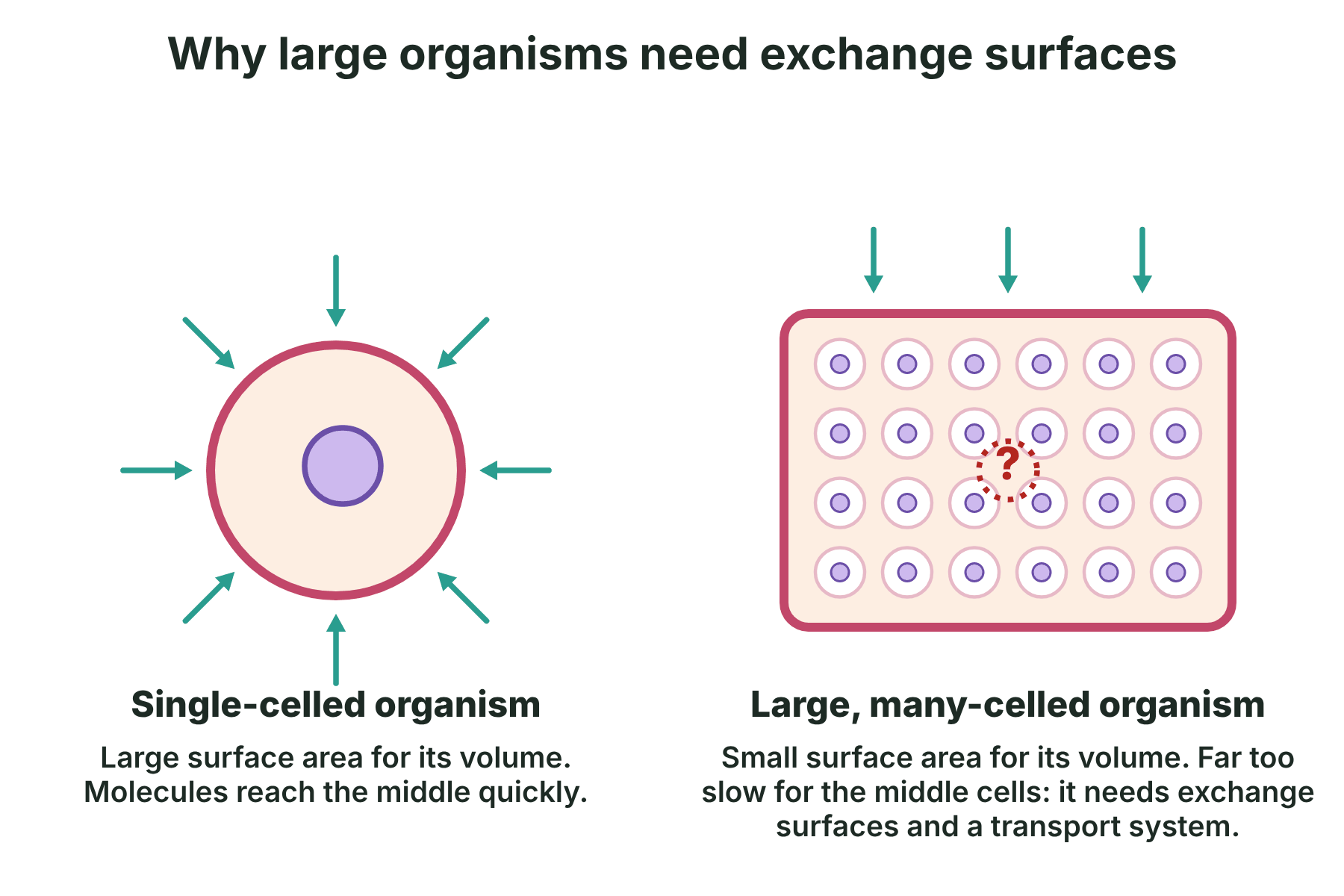 Why do the middle cells of a large organism need an exchange surface and a transport system?
 Its surface area to volume ratio is small, so diffusion from the outside would be too slow to reach them. Exchange surfaces and a transport system get substances to every cell.
-
What is osmosis?
The diffusion of water from a dilute solution to a concentrated solution through a partially permeable membrane.
-
What is a partially permeable membrane?
A membrane that lets small molecules such as water through, but not larger dissolved molecules.
-
In which direction does water move by osmosis?
From the more dilute solution to the more concentrated solution.
-
What is a dilute solution?
One with a low concentration of dissolved substance.
-
What is a concentrated solution?
One with a high concentration of dissolved substance.
-
What happens if two solutions have the same concentration?
There is no net movement of water.
-
Is osmosis a type of diffusion?
Yes. It is the diffusion of water through a partially permeable membrane.
-
What happens to a plant cell in a dilute solution?
Water enters by osmosis and the cell becomes turgid.
-
What does turgid mean?
Firm and swollen with water.
-
What stops a plant cell bursting in a dilute solution?
Its strong cell wall.
-
What happens to a plant cell in a concentrated solution?
Water leaves by osmosis and the cell becomes flaccid.
-
What does flaccid mean?
Soft and limp, because the cell has lost water.
-
What is plasmolysis?
When so much water leaves that the membrane pulls away from the cell wall.
-
Why does a plant wilt when it loses water?
Its cells go flaccid, so they cannot hold the stems and leaves up.
-
What happens to a red blood cell in pure water?
Water enters by osmosis, the cell swells and may burst.
-
Why can a red blood cell burst but a plant cell cannot?
An animal cell has no cell wall to resist the swelling.
-
What happens to an animal cell in a concentrated solution?
Water leaves by osmosis and the cell shrinks and shrivels.
-
Which way does water move if a cell is in a more dilute solution than its cell sap?
Into the cell.
-
What is the usual mistake about the direction of osmosis?
Saying water moves towards more water. It moves from more water (dilute) to less water (concentrated).
-
What is an isotonic drink?
One with the same concentration of dissolved substances as the body's fluids.
-
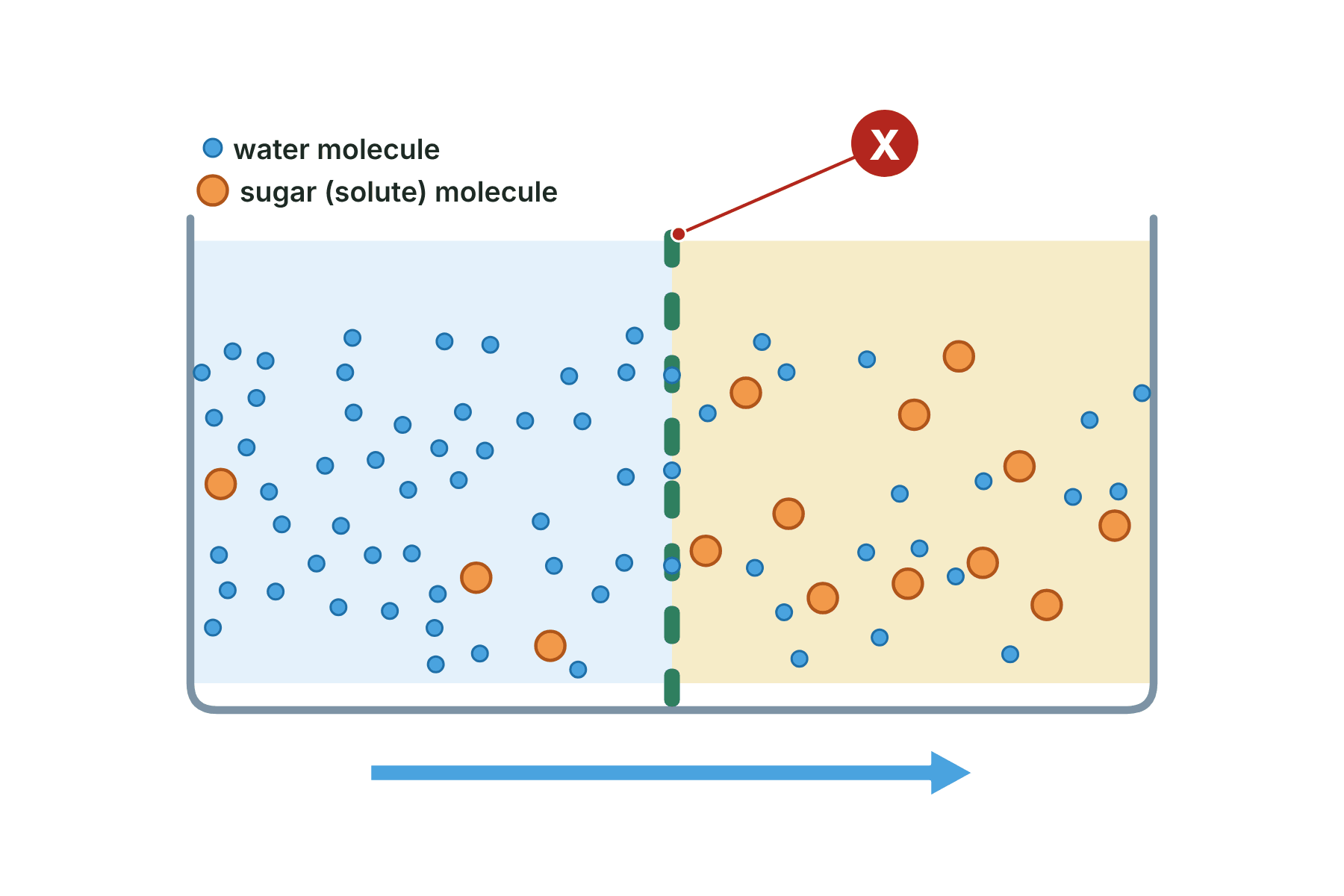 What is the structure marked X, and what does it let through?
 A partially permeable membrane. It lets small molecules such as water through, but not larger molecules such as sugar.
-
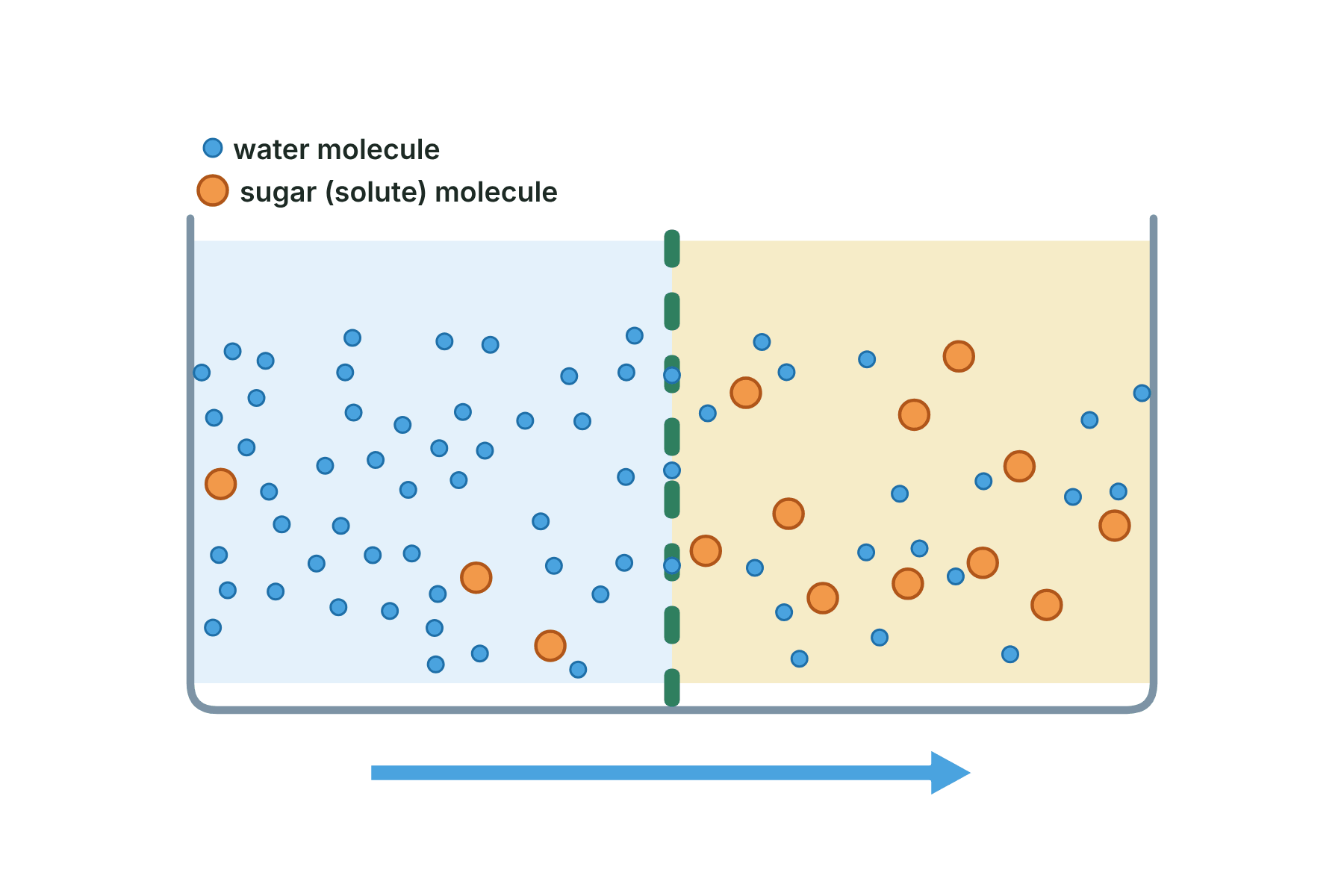 Label this diagram of osmosis and say which way the water moves.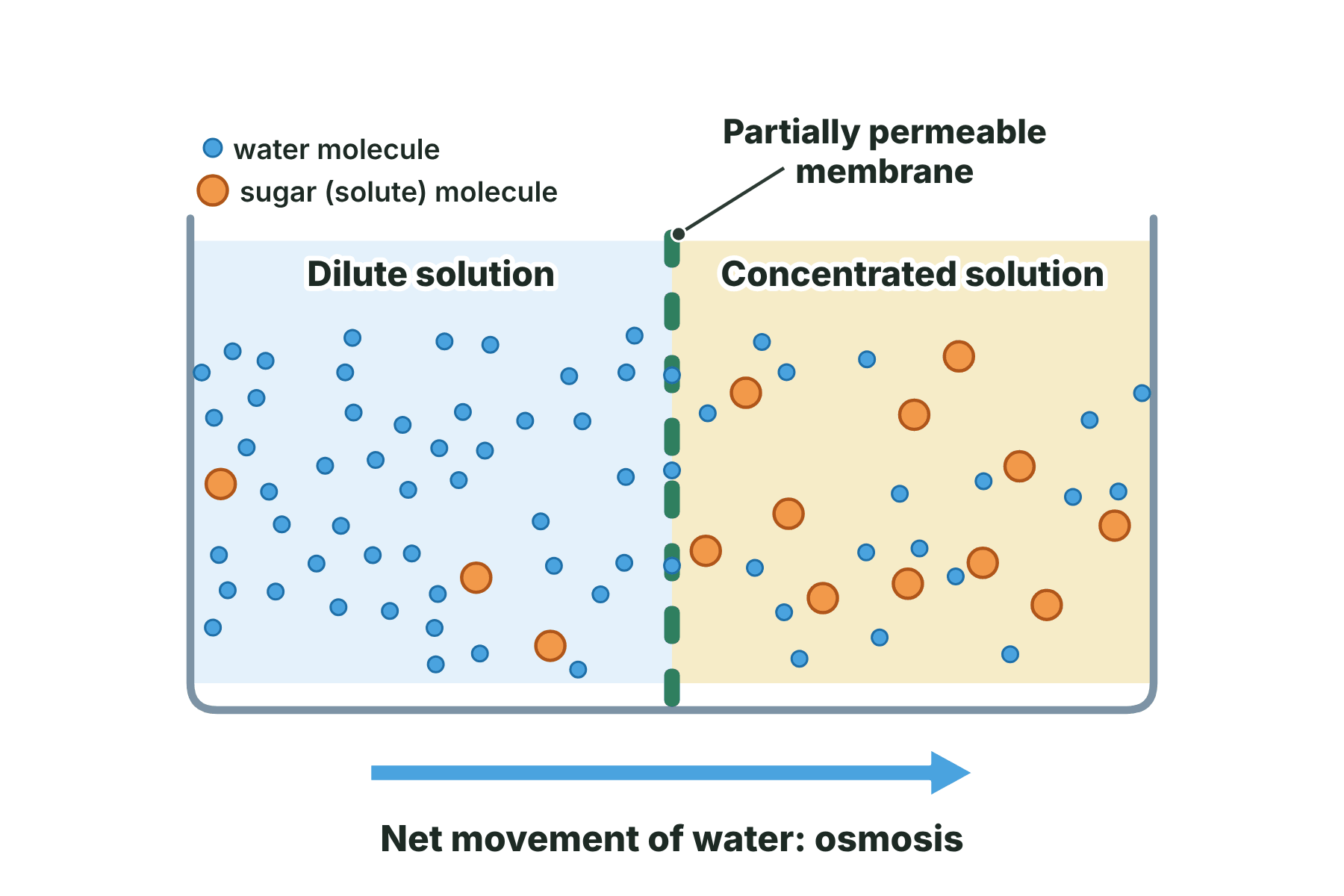
-
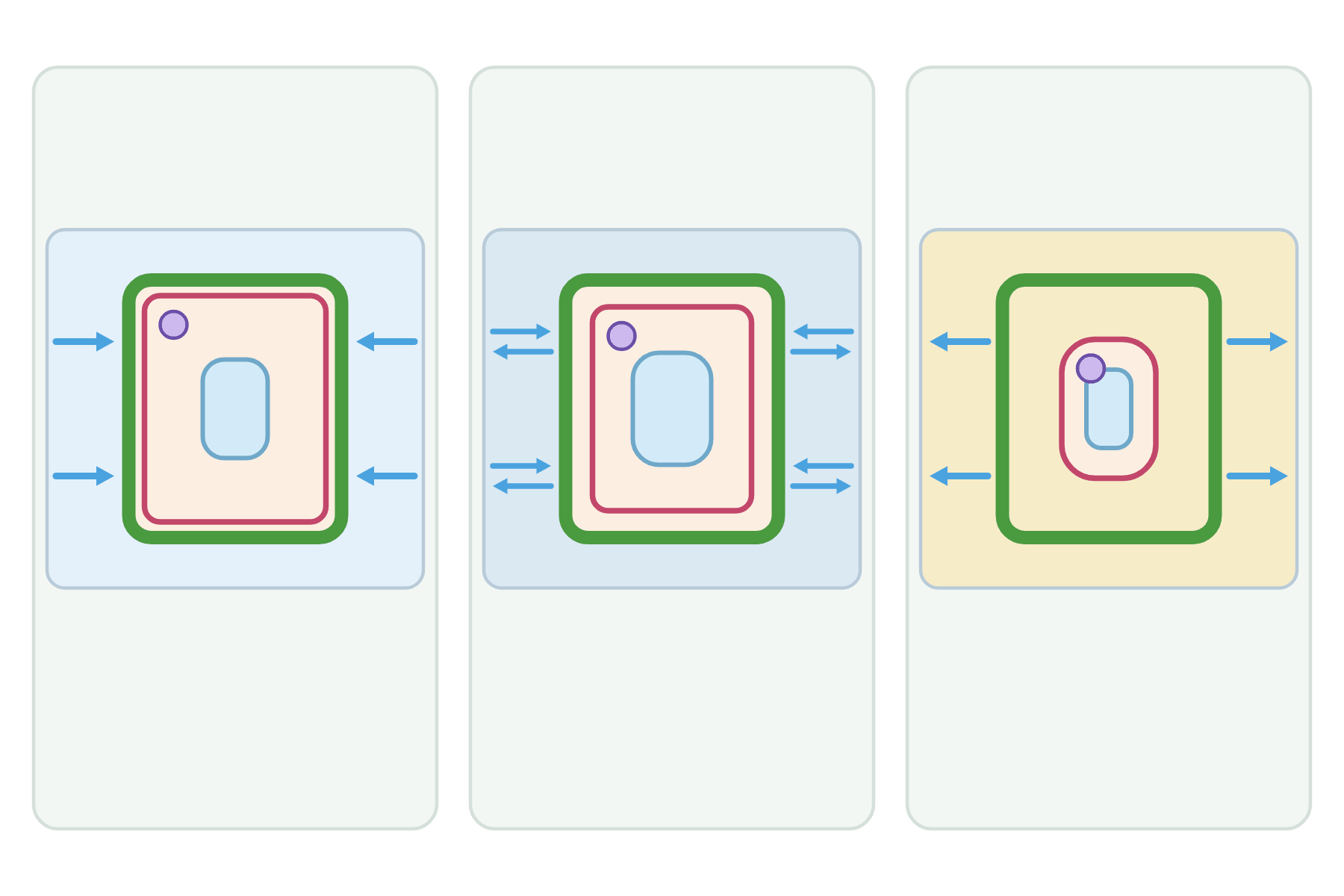 What will happen to a plant cell in each of these three solutions?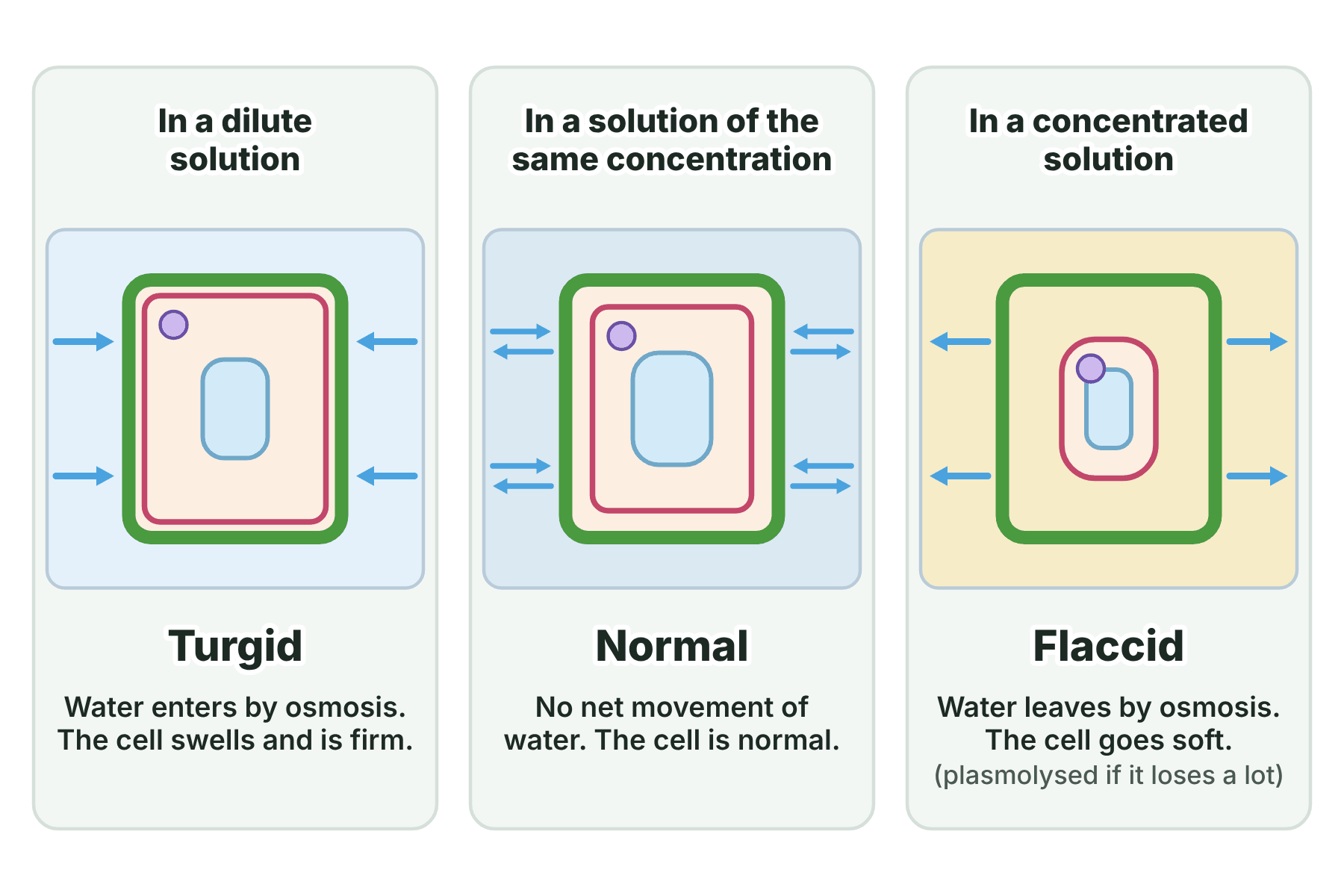
-
Describe what happens to a red blood cell in a dilute solution, in a solution of the same concentration and in a concentrated solution.
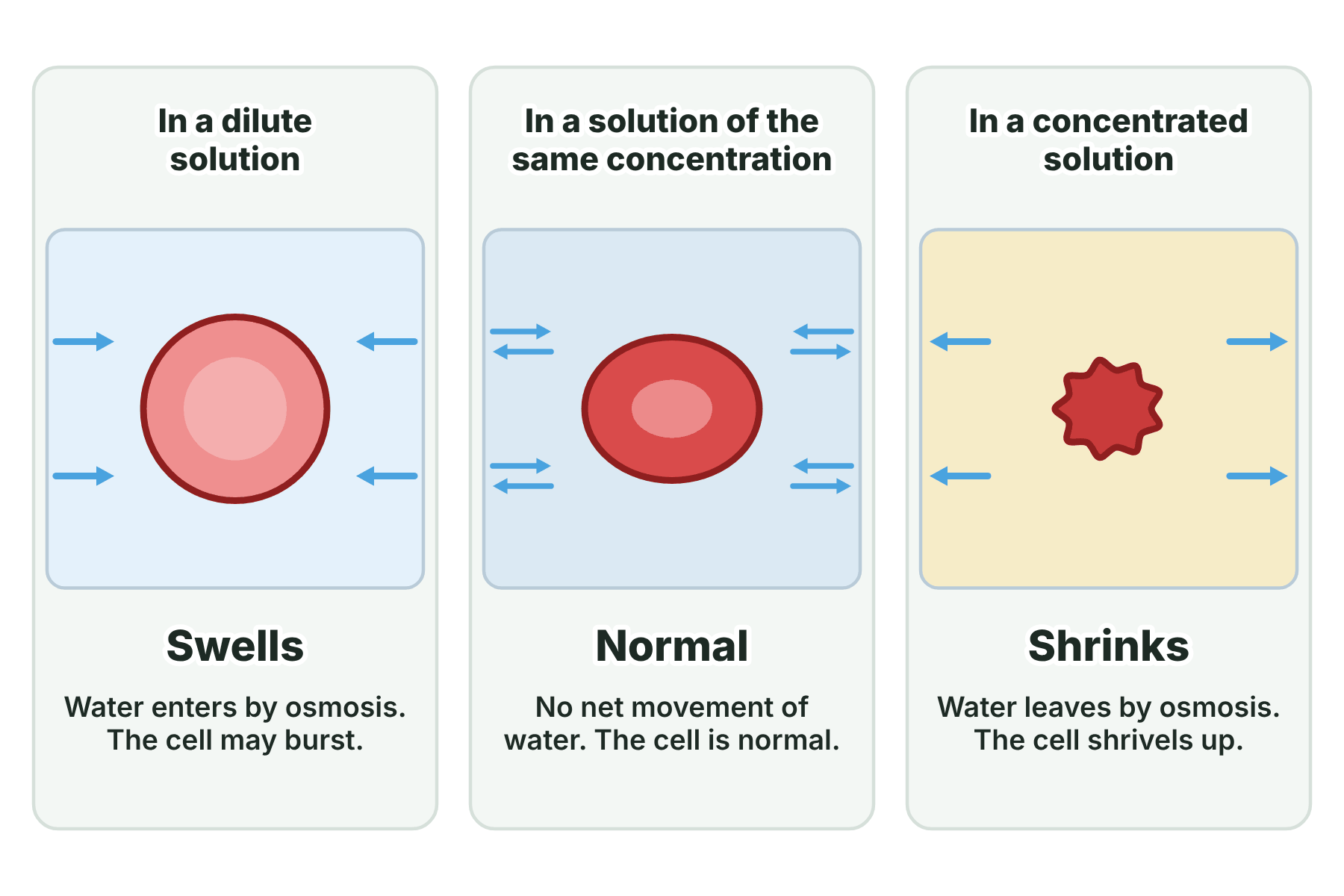
Dilute solution: water enters by osmosis, so the cell swells and may burst. Same concentration: no net movement of water, so it stays normal. Concentrated solution: water leaves by osmosis, so the cell shrinks.
-
What is the aim of the osmosis practical?
To investigate the effect of different concentrations of salt or sugar solution on the mass of plant tissue.
-
Why is potato used?
It is cheap, easy to cut into identical pieces, and made of cells with partially permeable membranes.
-
What tool cuts potato cylinders of equal width?
A cork borer.
-
What is the independent variable?
The concentration of the solution.
-
What is the dependent variable?
The percentage change in mass of the potato.
-
Name three control variables.
The size of the cylinders, the volume of solution, the time in solution (also the temperature and the type of potato).
-
Why do you blot the cylinders dry before weighing?
To remove liquid from the surface, which would add extra mass.
-
What is the formula for percentage change in mass?
(final mass − start mass) ÷ start mass × 100.
-
A cylinder goes from 2.00 g to 2.30 g. What is the percentage change?
+15%.
-
What does a negative percentage change mean?
The potato lost mass, because water left it by osmosis.
-
Why use percentage change and not just change in mass?
The cylinders start with slightly different masses, and percentages make the results fair to compare.
-
What does a gain in mass tell you about the solution?
It is more dilute than the potato cell sap.
-
What does a loss in mass tell you about the solution?
It is more concentrated than the potato cell sap.
-
What does it mean when the graph line crosses zero?
There is no change in mass, so the solution has the same concentration as the cell sap.
-
How do you find the concentration of the cell sap from the graph?
Read the concentration where the line crosses 0% change.
-
Why use pure water as one of the solutions?
It is the most dilute solution, and shows the most water entering the potato.
-
How can you make the results more reliable?
Repeat the test with several cylinders and calculate a mean.
-
What is an anomalous result?
A result that does not fit the pattern of the others.
-
How could you find the cell sap concentration more accurately?
Use extra solutions of concentrations close to where the line crosses zero.
-
Give one safety precaution.
Cut on a tile, with the blade pointing away from your hands.
-
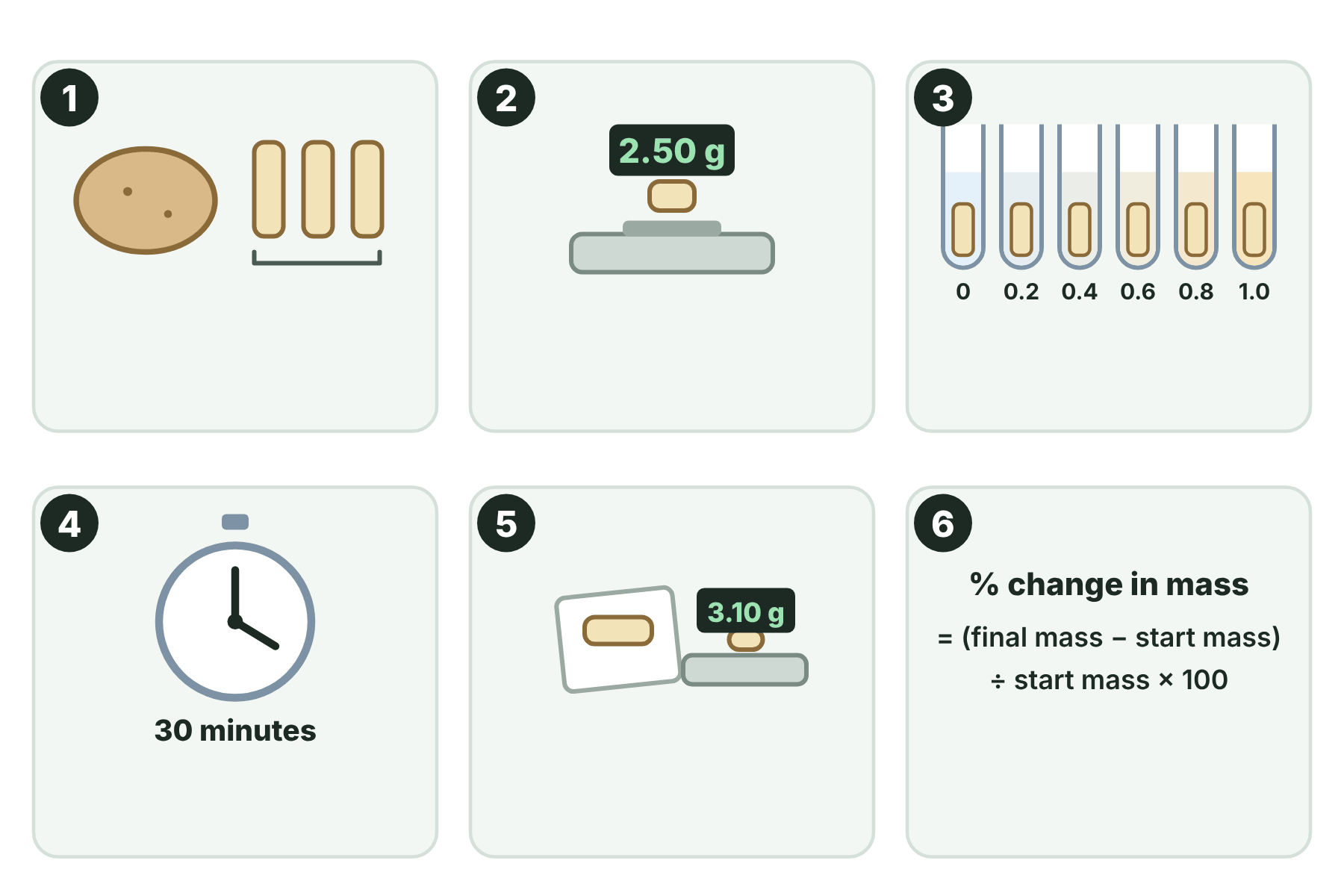 Describe the six steps of the potato osmosis investigation.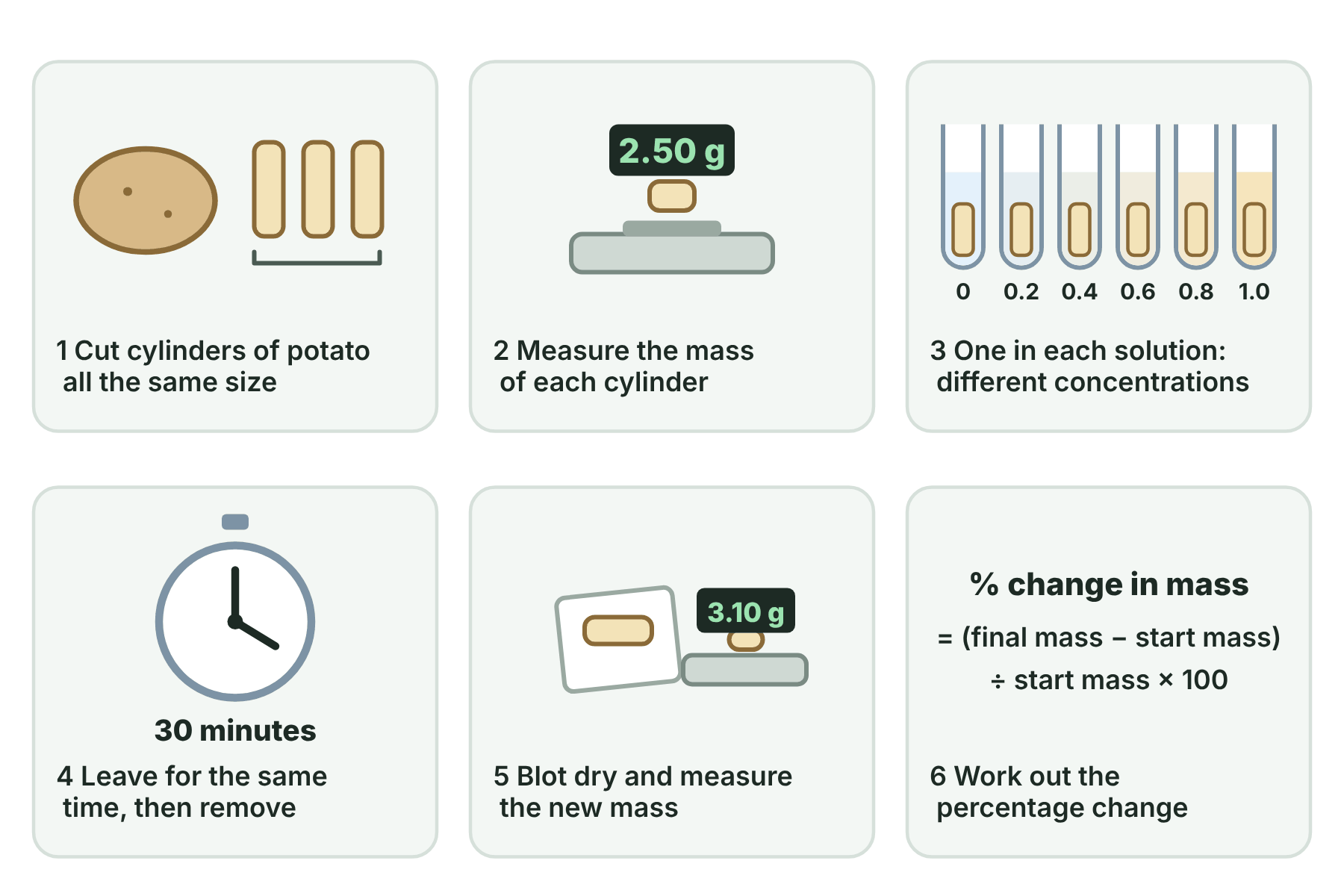
-
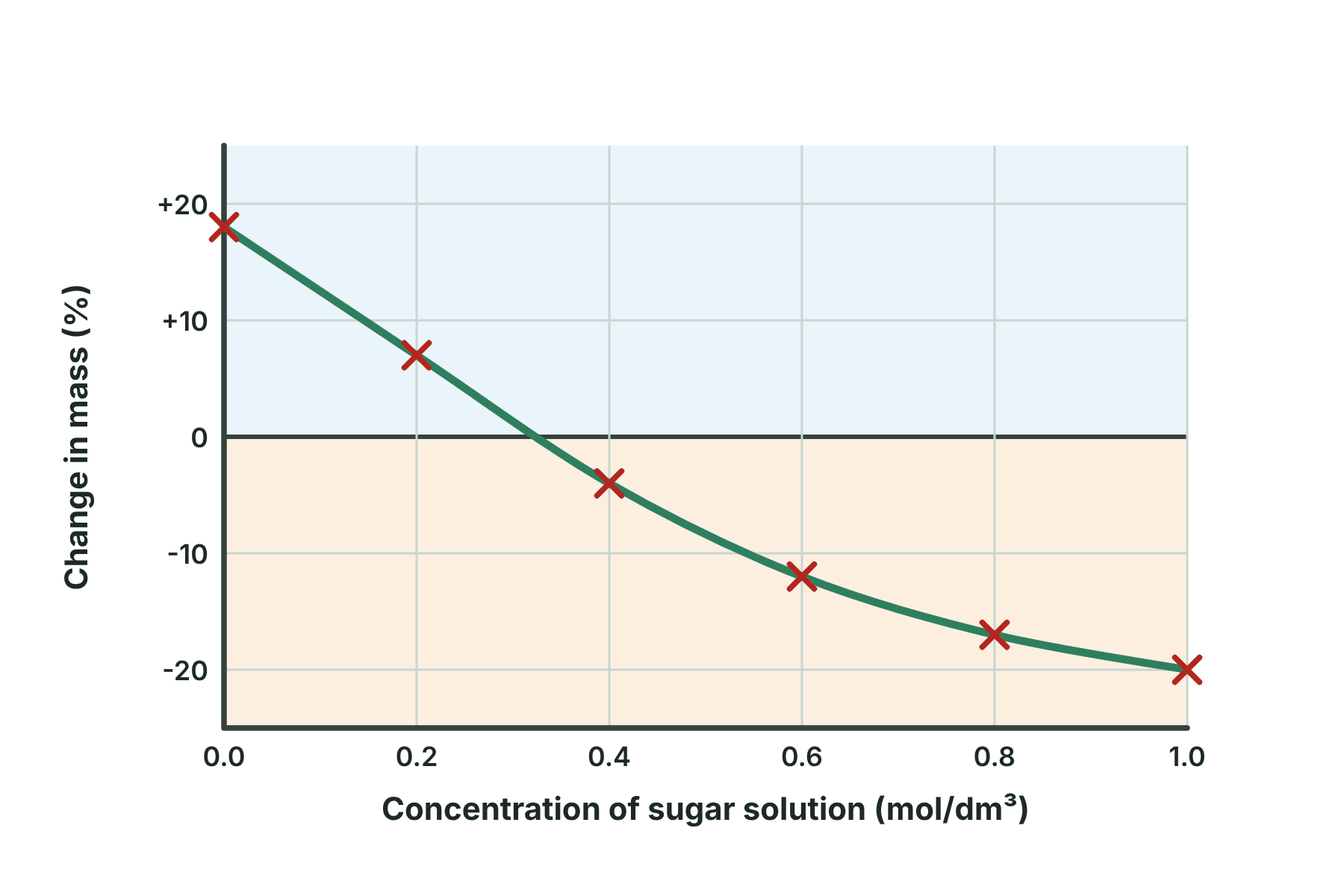 Read the concentration of the potato cell sap from this graph.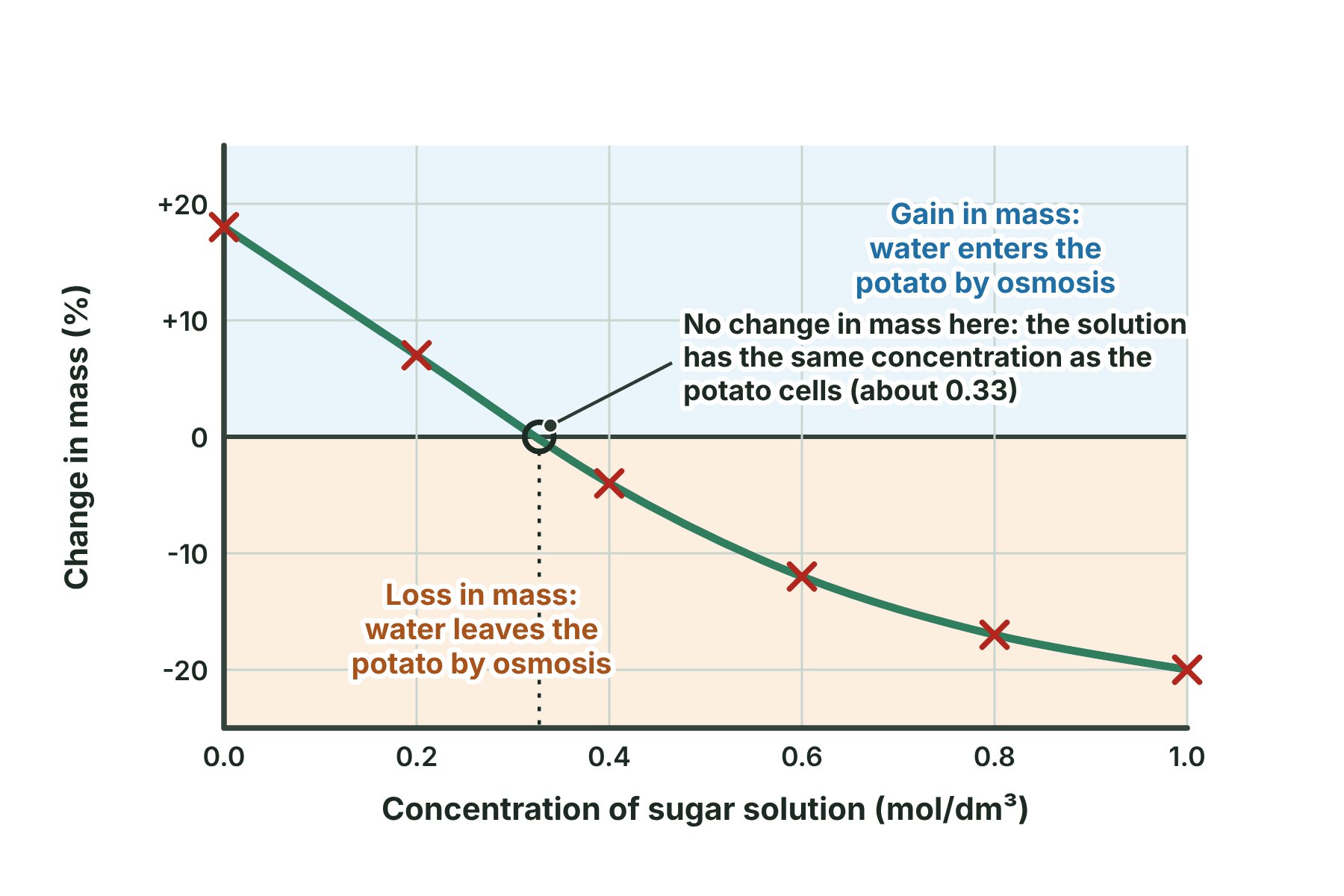
About 0.33 mol/dm³: where the line crosses 0% change, so there is no net movement of water.
-
A cylinder goes from 3.20 g to 2.72 g. What is the percentage change in mass?
−15%. The change is 2.72 − 3.20 = −0.48 g, then −0.48 ÷ 3.20 × 100 = −15%.
-
What is active transport?
The movement of substances from a more dilute to a more concentrated solution, against a concentration gradient, using energy from respiration.
-
What does active transport need?
Energy from respiration.
-
Does active transport move substances up or down the concentration gradient?
Up it: from low concentration to high concentration.
-
Which sub-cellular structures release the energy for active transport?
Mitochondria.
-
Why do cells that do a lot of active transport have many mitochondria?
They release the energy from respiration that active transport needs.
-
What is a carrier protein?
A protein in the cell membrane that picks up a particular substance and moves it across.
-
Give an example of active transport in plants.
Mineral ions being taken into root hair cells from the dilute soil solution.
-
Why do plants need mineral ions?
For healthy growth. For example nitrate for proteins and magnesium for chlorophyll.
-
Why can't root hair cells take up ions by diffusion?
The ions are at a lower concentration in the soil than in the cell.
-
Give an example of active transport in animals.
Sugar being absorbed from the gut into the blood.
-
Why is active transport needed to absorb sugar from the gut?
Sometimes the concentration of sugar in the gut is lower than in the blood.
-
Why must the body absorb sugar?
Sugar molecules are used for cell respiration.
-
What happens to active transport if a cell stops respiring?
It stops, because there is no energy.
-
Why does waterlogged soil reduce ion uptake?
Less oxygen means less respiration, so less energy for active transport.
-
How does active transport differ from diffusion?
It goes against the concentration gradient and needs energy. Diffusion goes down the gradient and needs none.
-
Which processes need no energy from the cell?
Diffusion and osmosis.
-
Which process moves only water?
Osmosis.
-
What does "against the concentration gradient" mean?
From a lower concentration to a higher concentration.
-
What is the usual mistake about active transport?
Saying it is the same as diffusion, or forgetting that it needs energy.
-
Is a ball rolling uphill a good picture of diffusion or active transport?
Active transport: it takes energy to push it up.
-
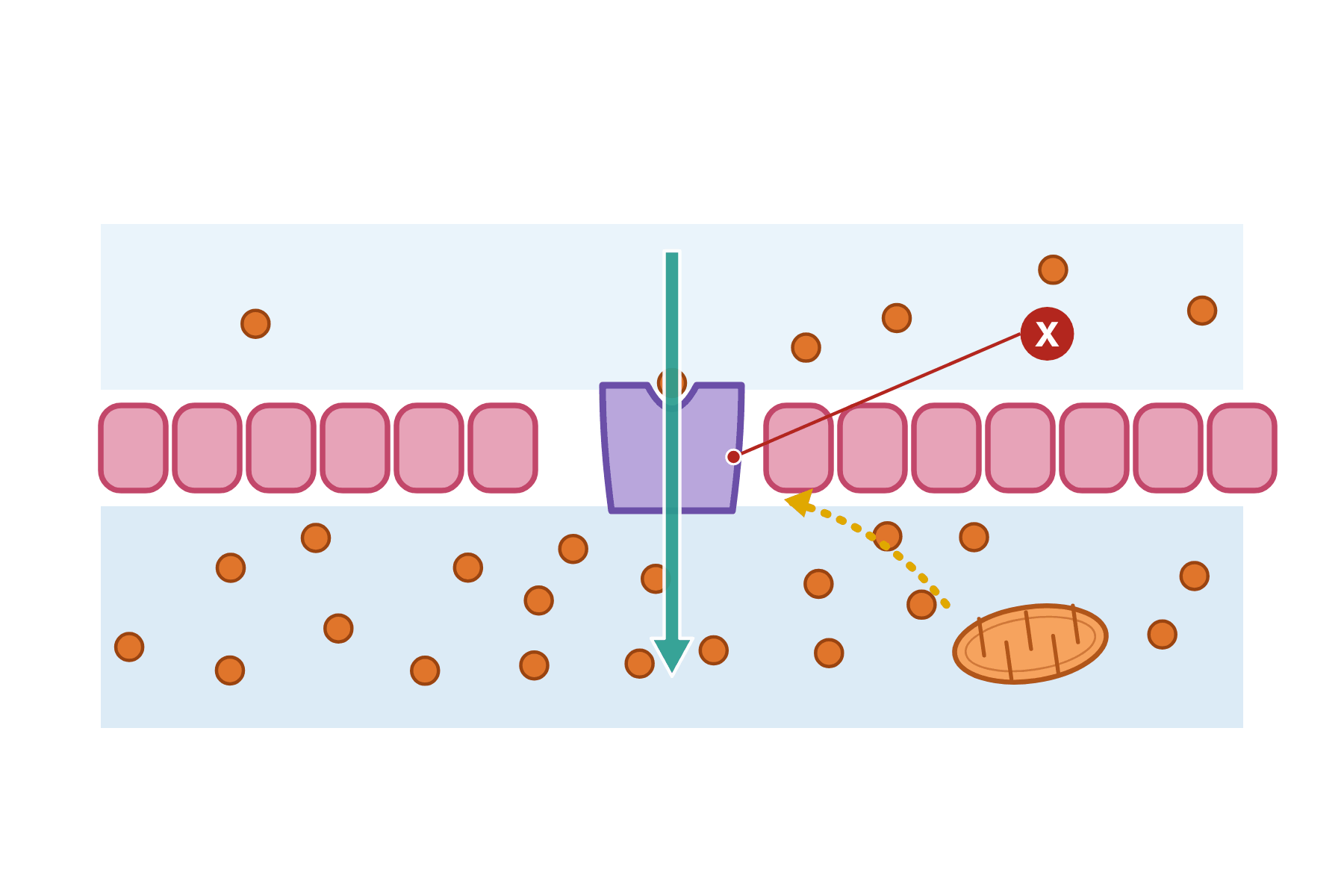 What is the structure marked X, and what does it do?
 A carrier protein. It picks up a substance and moves it across the cell membrane, against the concentration gradient, using energy from respiration.
-
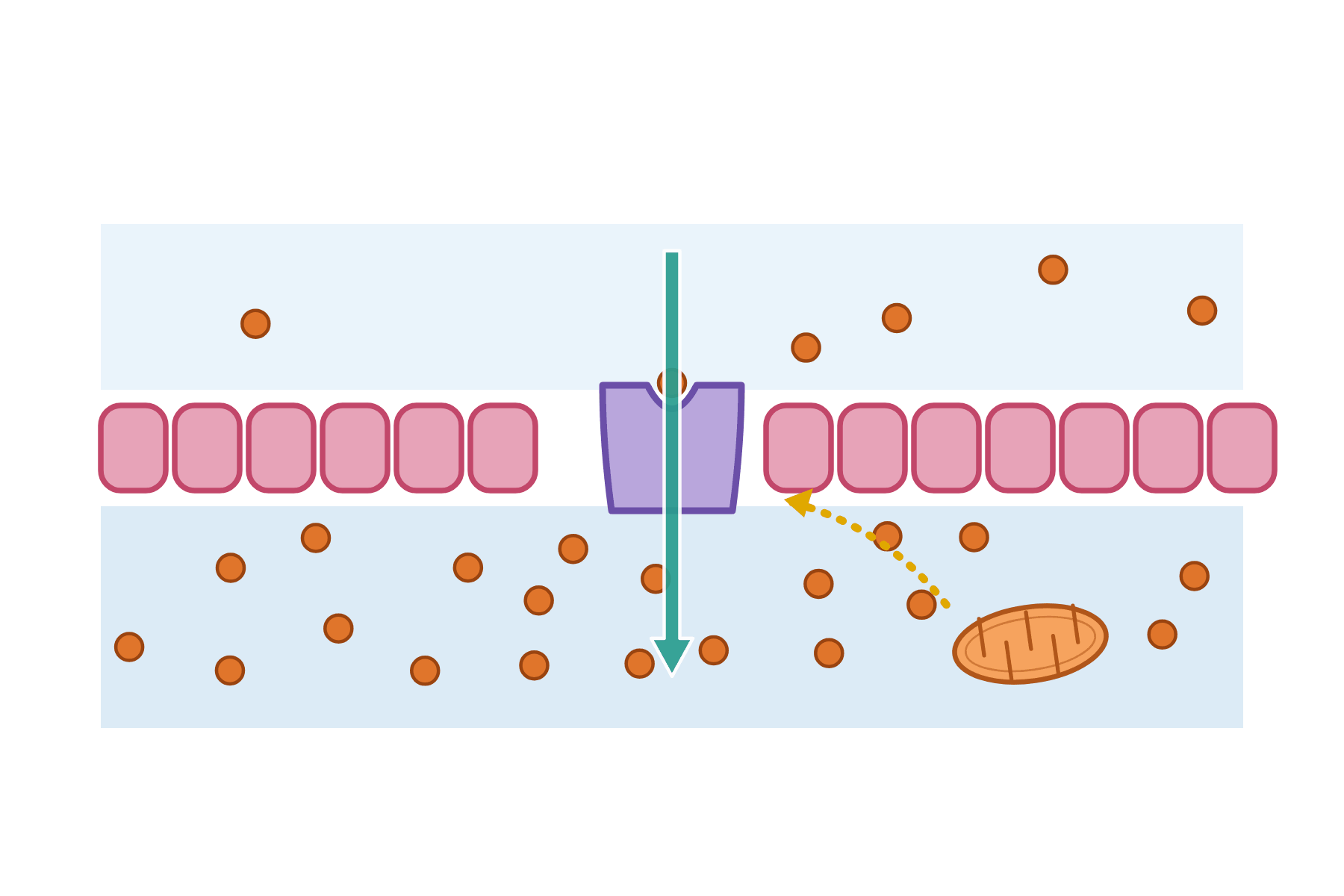 Label this diagram of active transport and say what the mitochondrion is for.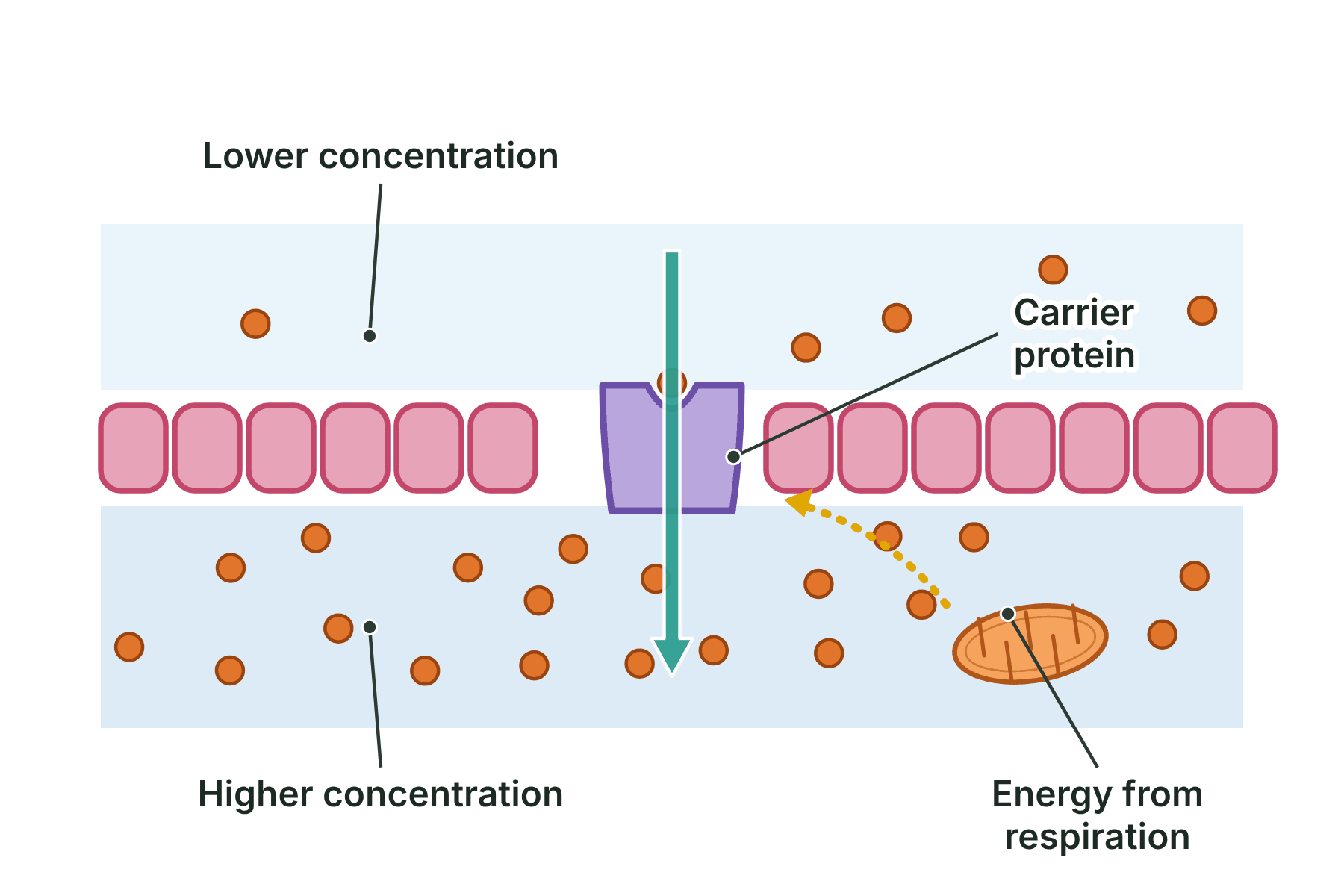
-
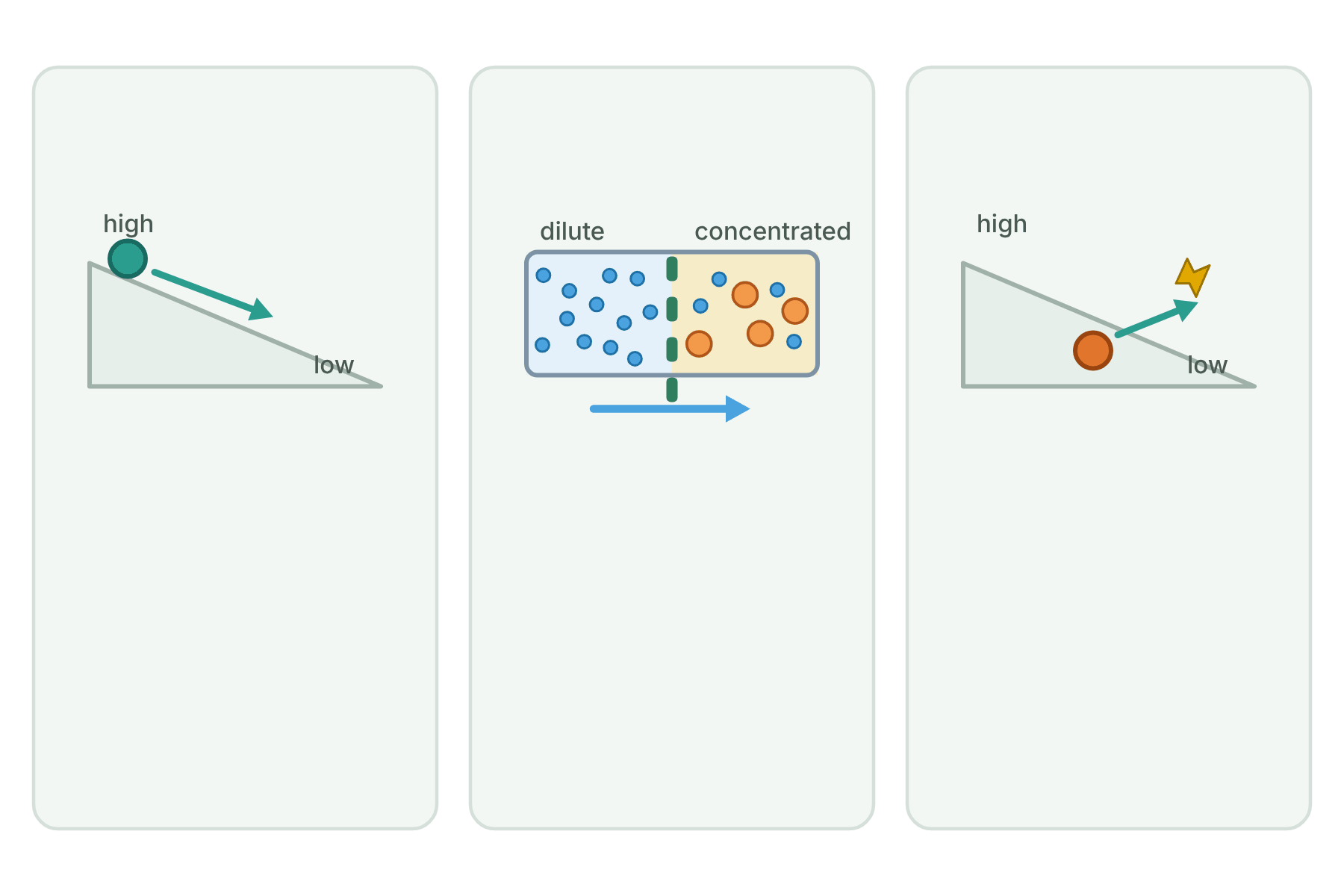 Name each process and say which needs energy.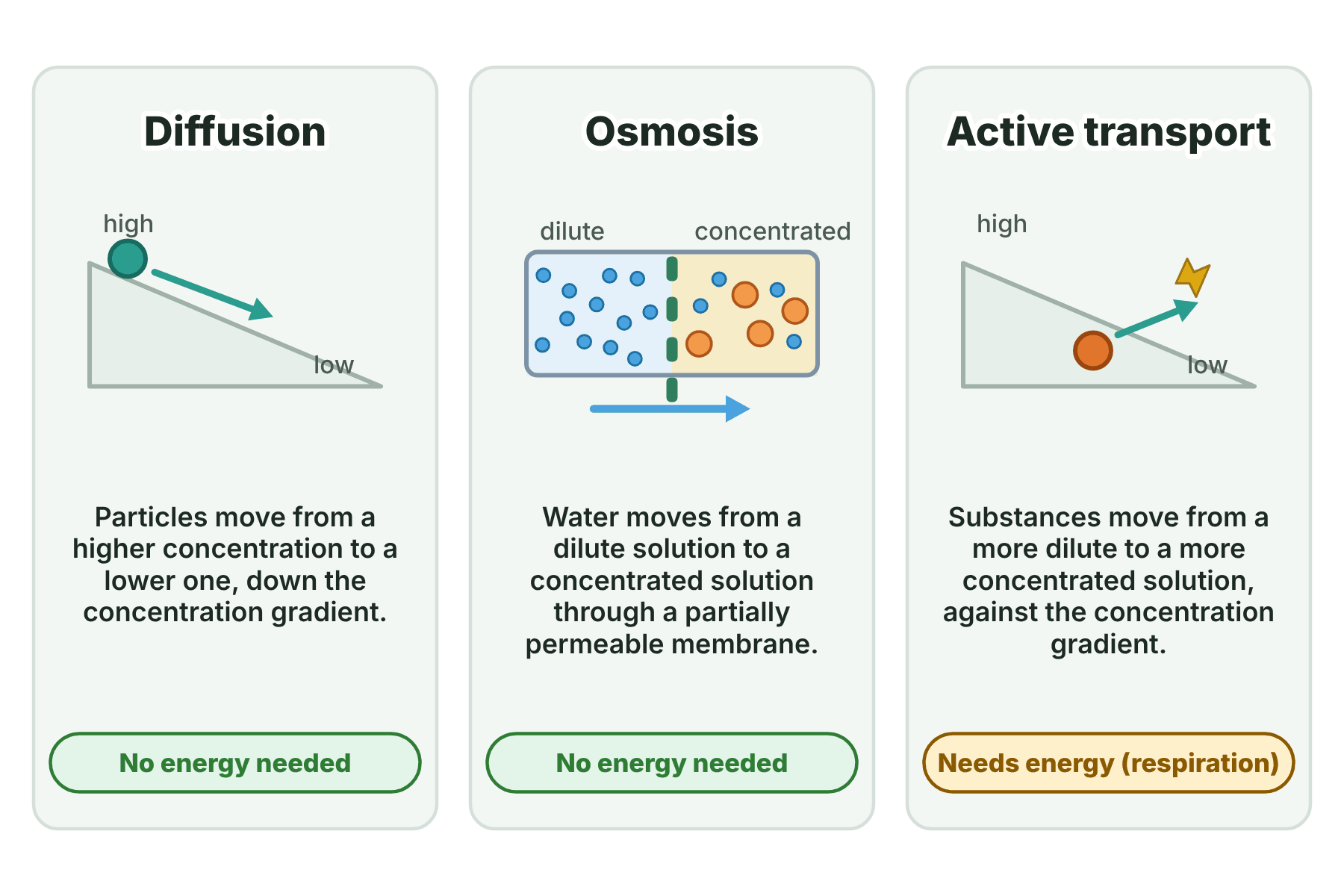
-
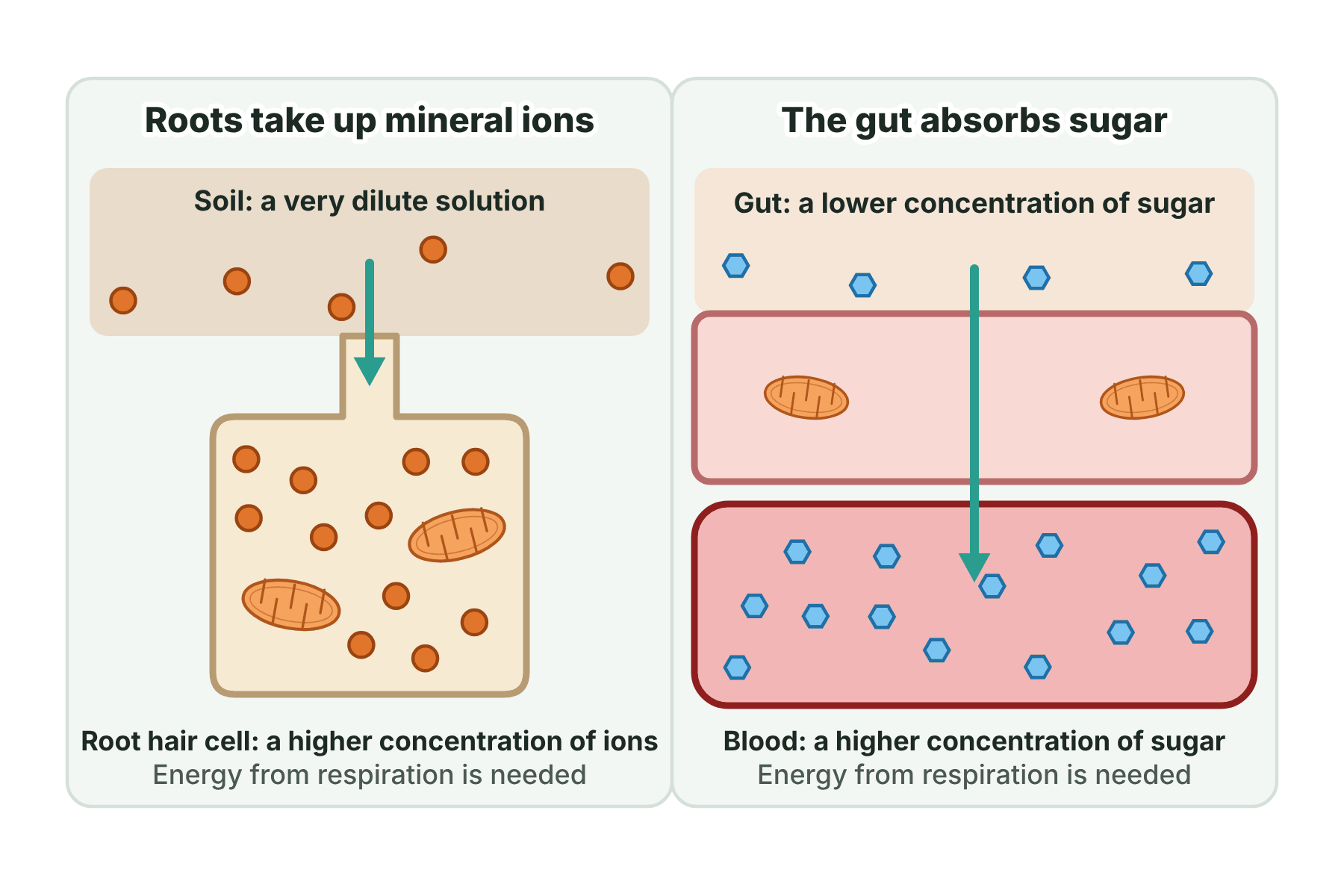 Why can't a root hair cell take in mineral ions by diffusion?
 The mineral ions are at a lower concentration in the soil than in the root hair cell, so they would diffuse out. Active transport moves them in against the gradient, using energy from respiration.