1.2 Animal and plant cells
6 exam questions worth 14 marks. Write your answer, open the mark scheme, then give yourself the marks you earned. Your answers are saved on this device.
0 / 14
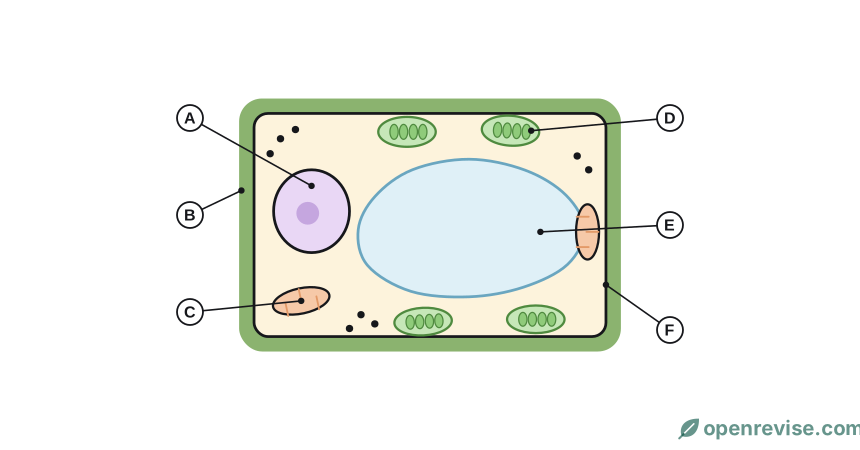
Name the parts labelled A, B and D.
Mark scheme
- A: nucleus (1)
- B: cell wall (1)
- D: chloroplast (1)
Model answer
A is the nucleus, B is the cell wall and D is a chloroplast.
Which structure is found in a plant cell but not in an animal cell?
Choose one answer.
Correct Not quite: the answer is Chloroplast
Mark scheme
C (Chloroplast)
Model answer
C: Chloroplast. Chloroplasts are found in the green parts of plants. Animal cells never have them.
Give the function of:
(a) mitochondria (1 mark)
(b) ribosomes (1 mark)
Mark scheme
(a) where aerobic respiration takes place / releases energy (for the cell) (1)
(b) where proteins are made / protein synthesis (1)
Model answer
(a) Mitochondria are where aerobic respiration takes place, releasing energy.
(b) Ribosomes make proteins.
A palisade cell in a leaf has many chloroplasts. A root hair cell has none.
Explain this difference.
Mark scheme
- palisade cells carry out photosynthesis (1)
- chloroplasts contain chlorophyll, which absorbs light (1)
- root cells are underground / there is no light, so they cannot photosynthesise (1)
Model answer
Palisade cells carry out photosynthesis, which needs chlorophyll in chloroplasts to absorb light. Root hair cells are underground where there is no light, so they cannot photosynthesise and have no chloroplasts.
Explain the difference between the job of the cell wall and the job of the cell membrane in a plant cell.
Mark scheme
- the cell wall strengthens / supports the cell (1)
- the cell membrane controls what enters and leaves the cell (1)
Model answer
The cell wall is made of cellulose and strengthens and supports the cell. The cell membrane controls which substances enter and leave the cell.
Describe three ways in which the structure of a plant cell differs from that of an animal cell.
Mark scheme
Any three from:
- plant cells have a cell wall (made of cellulose); animal cells do not (1)
- plant cells have chloroplasts; animal cells do not (1)
- plant cells have a permanent vacuole; animal cells do not (1)
- each point must make clear which cell has the structure
Model answer
A plant cell has a cellulose cell wall, chloroplasts and a permanent vacuole. An animal cell has none of these three structures.
Found a mistake?