1.3 Specialised cells
How the structure of specialised cells fits their function: sperm, egg, nerve, muscle and ciliated epithelial cells in animals, and root hair, xylem and phloem cells in plants.
Cells with a job to do
Key terms
- Specialised cell: a cell with a structure that is adapted to carry out a particular job.
- Adaptation: a feature of a cell, or an organism, that helps it to carry out its function.
- Haploid: having a single set of chromosomes, as in a gamete. A human sperm or egg has 23 chromosomes.
- Cilia: tiny hair-like structures on the surface of some cells that beat to move substances along (singular: cilium).
- Lignin: a tough material that strengthens the walls of xylem cells.
Most cells in a multicellular organism are specialised: their structure is adapted so that they can do one job well. To answer questions on specialised cells, always link the structure to the function: "The cell has many mitochondria, so it can release lots of energy for ..."
Specialised animal cells
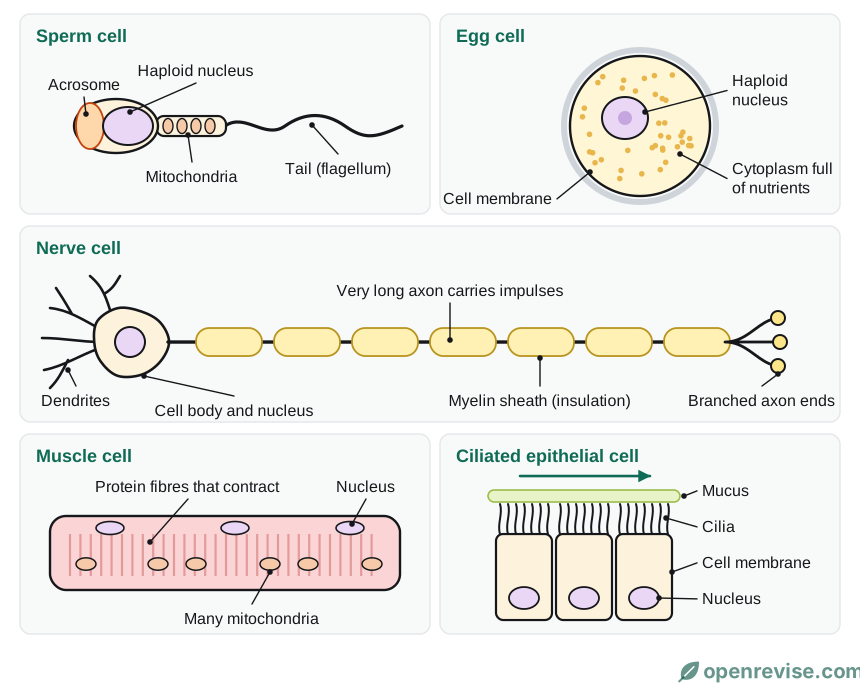
| Cell | Function | How it is adapted |
|---|---|---|
| Sperm cell | Carries the father's genetic information to the egg | Tail to swim; many mitochondria in the middle section to release energy for swimming; acrosome containing enzymes to digest the outer layers of the egg; haploid nucleus |
| Egg cell | Carries the mother's genetic information; feeds the early embryo | Large, with a cytoplasm full of nutrients; haploid nucleus; the membrane changes after fertilisation so that no more sperm can enter |
| Nerve cell | Carries electrical impulses from one part of the body to another | Very long, so one cell covers a long distance; branched ends connect to other nerve cells; an insulating sheath speeds up the impulse |
| Muscle cell | Contracts (gets shorter) to produce movement | Contains protein fibres that can slide over each other to shorten the cell; many mitochondria to release energy for contraction |
| Ciliated epithelial cell | Lines the airways and moves mucus | Cilia beat to sweep mucus, with trapped dust and microbes, away from the lungs |
Specialised plant cells
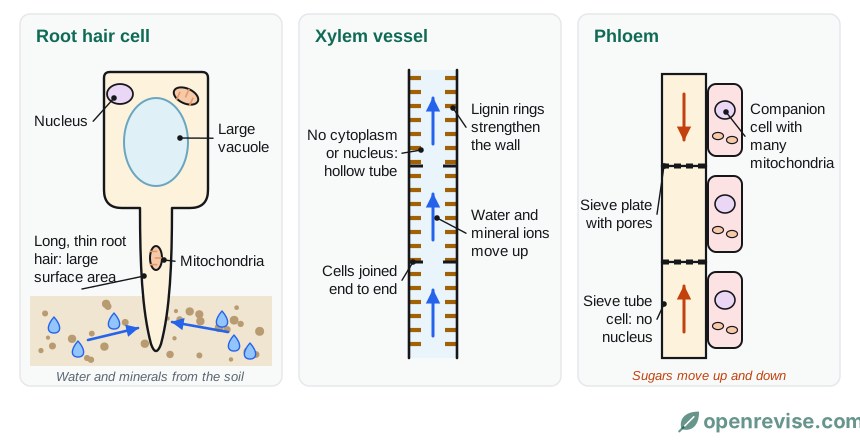
| Cell | Function | How it is adapted |
|---|---|---|
| Root hair cell | Absorbs water and mineral ions from the soil | A long, thin hair gives a large surface area; a large permanent vacuole speeds up the movement of water by osmosis; many mitochondria release energy for active transport of mineral ions |
| Xylem cell | Carries water and mineral ions up the plant, and supports it | Dead, hollow cells joined end to end to make a tube; no end walls, so water flows freely; walls strengthened with lignin so they do not collapse |
| Phloem cell | Carries dissolved sugars up and down the plant | Sieve tube cells have little cytoplasm and pores in their end walls (sieve plates), so sugars can pass through; companion cells have many mitochondria to release energy for moving sugars |
Writing a good answer
A good answer has three parts: the feature, what it does, and why that helps the cell do its job. For example: "A sperm cell has a tail. This lets it swim, so it can reach the egg."
Test yourself on this lesson
7 exam questions · 17 marks · with mark schemes and model answers
Found a mistake?