5.21 How the menstrual cycle hormones interact
6 exam questions worth 15 marks. Write your answer, open the mark scheme, then give yourself the marks you earned. Your answers are saved on this device.
0 / 15
Explain how oestrogen, LH and progesterone interact to control the menstrual cycle after an egg has started to mature.
Mark scheme
Level 3 (5-6): a clear, ordered account of the interactions, linking each hormone to its effect on other hormones and on the uterus/ovary. Level 2 (3-4): several correct effects, some interactions given. Level 1 (1-2): one or two correct roles, e.g. LH causes ovulation.
Indicative content:
- FSH stimulates the ovary to release oestrogen
- oestrogen causes the uterus lining to build up / thicken
- oestrogen inhibits FSH (release)
- oestrogen stimulates LH release
- LH surge causes ovulation / egg released (day 14)
- (empty follicle) releases progesterone
- progesterone maintains the uterus lining
- progesterone inhibits FSH and LH
- progesterone falls (if no pregnancy), lining breaks down, FSH no longer inhibited
Model answer
FSH stimulates the ovaries to release oestrogen. Oestrogen makes the uterus lining build up, and it acts on the pituitary gland to inhibit FSH release and stimulate LH release. A surge of LH at about day 14 causes ovulation. The empty follicle then releases progesterone, which maintains the uterus lining and inhibits both FSH and LH, so no more eggs mature. If the egg is not fertilised, progesterone falls, the lining breaks down, and FSH is no longer inhibited, so a new cycle starts.
Look at the graph of hormone levels during the menstrual cycle.
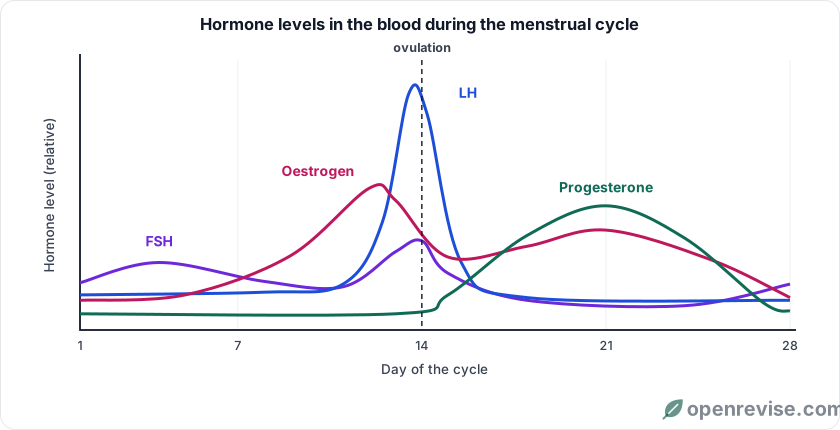
(a) On which day does ovulation happen? (b) Give the evidence from the graph for your answer.
Mark scheme
(a) day 14 (allow 13-15) (1) (b) LH peaks / surges (at this time) (1)
Model answer
(a) Day 14. (b) The LH level peaks sharply on that day, and LH stimulates the release of the egg.
Explain why only one egg usually matures in each cycle.
Mark scheme
- oestrogen (released as the egg matures) inhibits FSH (1)
- (later) progesterone inhibits FSH (and LH) (1)
- so no more eggs are stimulated to mature (1)
Max 2
Model answer
As the first egg matures, the ovary releases oestrogen, which inhibits FSH; after ovulation, progesterone also inhibits FSH. Without FSH no other eggs are stimulated to mature.
Explain why menstruation starts when the level of progesterone falls.
Mark scheme
- progesterone maintains the uterus lining (1)
- without it the lining is not maintained / breaks down (1)
Model answer
Progesterone maintains the uterus lining, so when its level falls the lining is no longer maintained and it breaks down.
Which hormone stimulates the release of LH from the pituitary gland?
Choose one answer.
Correct Not quite: the answer is Oestrogen
Mark scheme
C (oestrogen)
Model answer
C: oestrogen.
During pregnancy the progesterone level stays high.
Suggest two effects of this.
Mark scheme
- the uterus lining is maintained / no menstruation (1)
- FSH and LH are inhibited, so no eggs mature / are released (1)
Model answer
The uterus lining is maintained, so there are no periods, and FSH and LH are inhibited, so no more eggs mature or are released.
Found a mistake?