6.10 Blood groups and sex-linked disorders
Edexcel: inheritance of the ABO blood groups with multiple alleles and codominance, and sex-linked inheritance of red-green colour blindness and haemophilia on the X chromosome, including why males are more often affected.
Multiple alleles and codominance
Key terms
- Multiple alleles: when a gene has more than two alleles in the population.
- Codominance: when two alleles are both expressed in the phenotype.
- Sex-linked: a characteristic controlled by a gene on a sex chromosome, usually the X.
The ABO blood group gene has three alleles: I^{A}, I^{B} and I^{O}. Each person has two of them.
- I^{A} and I^{B} are codominant: if both are present, both are expressed (blood group AB).
- I^{O} is recessive to both.
| Genotype | Blood group |
|---|---|
| I^{A} I^{A} or I^{A} I^{O} | A |
| I^{B} I^{B} or I^{B} I^{O} | B |
| I^{A} I^{B} | AB |
| I^{O} I^{O} | O |
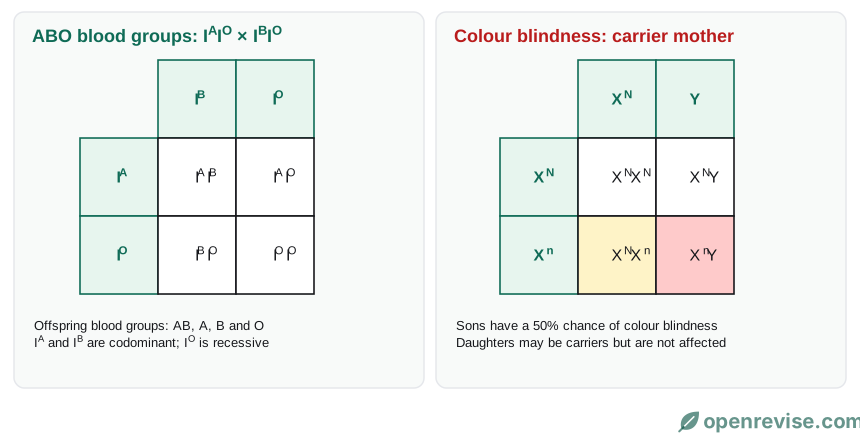
So two parents with blood groups A and B could have a child of any blood group, if they are I^{A} I^{O} and I^{B} I^{O}.
Sex-linked inheritance (Higher)
Some genes are carried on the X chromosome but not on the much smaller Y. Examples are red-green colour blindness and haemophilia (blood that does not clot properly). Both are caused by recessive alleles, written X^{n} (or X^{h}).
- A female (XX) needs two recessive alleles to be affected. With one, she is a carrier.
- A male (XY) has only one X, so a single recessive allele means he is affected.
That is why these disorders are much more common in males. A carrier mother (X^{N} X^{n}) and an unaffected father (X^{N} Y) have a 50% chance that each son is affected, and a 50% chance that each daughter is a carrier.
Test yourself on this lesson
5 exam questions · 12 marks · with mark schemes and model answers
Found a mistake?