6.14 Evolution by natural selection
The theory of evolution by natural selection: variation, competition, survival of the best adapted, reproduction and inheritance of alleles over many generations, with the peppered moth as an example, and how new species form.
The theory of evolution
Key terms
- Evolution: a change in the inherited characteristics of a population over time through natural selection, which may result in new species.
- Natural selection: the process by which individuals with characteristics best suited to their environment are more likely to survive and reproduce.
- Species: a group of organisms that can interbreed to produce fertile offspring.
The theory of evolution by natural selection states that all species of living things have evolved from simple life forms that first developed more than three billion years ago.
How natural selection works
- Variation: individuals in a population show variation, caused by differences in their genes (alleles), which arise by mutation.
- Competition: more offspring are produced than can survive. They compete for food, mates and space, and face predators and disease.
- Survival of the best adapted: individuals with characteristics most suited to the environment are more likely to survive.
- Reproduction and inheritance: the survivors breed and pass on their alleles to their offspring.
- Over many generations, the advantageous characteristic becomes more common in the population.
Example: peppered moths
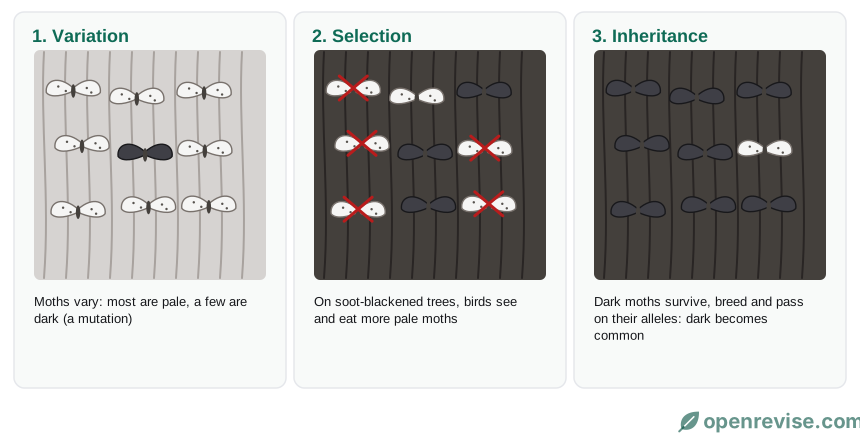
Before the Industrial Revolution, most peppered moths were pale, camouflaged on lichen-covered trees. When soot from factories blackened the trees, pale moths stood out and were eaten by birds. Dark moths were camouflaged, survived and bred, so within about 50 years most moths near cities were dark. Since the air has been cleaned up, pale moths have become common again.
New species
If two populations of a species become so different in phenotype that they can no longer interbreed to produce fertile offspring, they have formed two new species.
Test yourself on this lesson
5 exam questions · 11 marks · with mark schemes and model answers
Found a mistake?