1.4 Order of operations and inverse operations
The correct order of operations (BIDMAS) with brackets, powers, roots and fractions, using reciprocals, and using inverse operations to check calculations and to work backwards.
Why order matters
Key terms
- BIDMAS: the order for doing calculations: Brackets, Indices (powers and roots), Division and Multiplication, Addition and Subtraction.
- Inverse operation: an operation that undoes another, for example subtracting undoes adding.
- Reciprocal: the number you multiply by to get 1. The reciprocal of 5 is \frac{1}{5}.
- Index (power): a small raised number that tells you how many times to multiply a number by itself.
What is 3 + 4 \times 5? If you add first you get 7 \times 5 = 35, but if you multiply first you get 3 + 20 = 23. There is only one correct answer, so mathematicians have agreed an order.
| Order | Letter | Operation | Example |
|---|---|---|---|
| 1st | B | Brackets (and the top and bottom of a fraction) | (2 + 3) |
| 2nd | I | Indices: powers and roots | 3^2, \sqrt{16} |
| 3rd | D, M | Division and multiplication, from left to right | 12 \div 3 \times 2 |
| 4th | A, S | Addition and subtraction, from left to right | 10 - 4 + 1 |
Division and multiplication have equal priority, and so do addition and subtraction. When operations are equal, work from left to right: 12 \div 3 \times 2 = 4 \times 2 = 8, not 12 \div 6 = 2.
Worked examples
Example 1. Work out 18 - 2 \times 3^2 + 4.

Indices first: 3^2 = 9. Then multiplication: 2 \times 9 = 18. Then left to right: 18 - 18 + 4 = 4.
Example 2. Work out (5 + 3) \times 6 \div 4. Brackets: 8 \times 6 \div 4. Left to right: 48 \div 4 = 12.
Example 3. Work out 2 + 3 \times 4 - 6 \div 2. Multiplication and division first: 2 + 12 - 3. Then left to right: 11.
Example 4 (fractions and roots). The fraction bar and the root sign act like brackets. \dfrac{12 + 8}{7 - 2} = \dfrac{20}{5} = 4 and \sqrt{9 + 16} = \sqrt{25} = 5.
Example 5 (negatives and powers). 6 - (-2)^2 = 6 - 4 = 2. Be careful with the brackets: (-3)^2 = 9 but -3^2 = -(3^2) = -9. On a calculator, type the brackets: (-3)^2.
Reciprocals
The reciprocal of a number is 1 divided by that number, because a number multiplied by its reciprocal gives 1.
- The reciprocal of 5 is \frac{1}{5}, and the reciprocal of \frac{1}{5} is 5.
- The reciprocal of \frac{2}{3} is \frac{3}{2}: turn the fraction upside down.
- The reciprocal of 0.25 is \frac{1}{0.25} = 4.
- Zero has no reciprocal, because you cannot divide by zero.
Inverse operations
Every operation has an inverse that undoes it.
| Operation | Inverse | Example |
|---|---|---|
| Add | Subtract | 8 + 5 = 13, so 13 - 5 = 8 |
| Multiply | Divide | 6 \times 4 = 24, so 24 \div 4 = 6 |
| Square | Square root | 7^2 = 49, so \sqrt{49} = 7 |
| Cube | Cube root | 2^3 = 8, so \sqrt[3]{8} = 2 |
Checking. Use the inverse to check an answer. If 391 \div 17 = 23, then 23 \times 17 should equal 391.
Using a known fact. If 36 \times 14 = 504, then 504 \div 14 = 36 and 504 \div 36 = 14.
Cancelling. An operation followed by its inverse leaves the number unchanged: 23 \times 17 \div 17 = 23.
Working backwards
To find a starting number, reverse the steps in reverse order, using the inverse of each.
Worked example. A number is multiplied by 3 and then 5 is added. The answer is 26. Find the number.
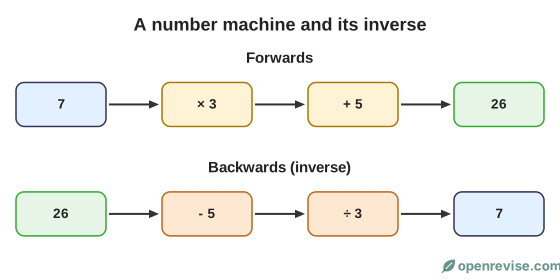
Work backwards from 26: subtract 5 to get 21, then divide by 3 to get 7. Check: 7 \times 3 = 21 and 21 + 5 = 26.
More worked examples
Example 6. Work out 5 + 2 \times (8 - 3)^2.
Brackets: 8 - 3 = 5. Indices: 5^2 = 25. Multiplication: 2 \times 25 = 50. Addition: 5 + 50 = 55.
Example 7. Compare 3 \times 4^2 and (3 \times 4)^2.
In the first, only the 4 is squared: 3 \times 16 = 48. In the second, the brackets mean the whole product is squared: 12^2 = 144. The brackets change the answer, so never leave them out.
Example 8. Work out \dfrac{3^2 + 4^2}{10 - 5} + \sqrt{49}.
The top of the fraction is 9 + 16 = 25 and the bottom is 10 - 5 = 5, so the fraction is 5. Then 5 + 7 = 12.
Example 9 (inserting brackets). Put one pair of brackets in 4 + 6 \times 3 - 1 so that it equals 29.
Try (4 + 6) \times 3 - 1 = 30 - 1 = 29. The brackets go around 4 + 6.
Using a calculator
A scientific calculator has keys for brackets, powers and roots. Check that your calculator gives 2 + 3 \times 4 = 14, which shows that it follows the correct order. Use the fraction key for fractions such as \dfrac{12 + 8}{7 - 2}, or use brackets around the top and the bottom. To enter -3^2 as (-3)^2 you must press the brackets, otherwise the calculator may give the answer -9.
Exam-style example
Question. Anna works out 24 \div 4 \times 2 + 1 and gets 4. Show that she has made a mistake, and work out the correct answer.
Answer. Anna has done 4 \times 2 first, which is 8, then 24 \div 8 = 3, and then 3 + 1 = 4. Division and multiplication have equal priority, so they are done from left to right: 24 \div 4 = 6, then 6 \times 2 = 12, then 12 + 1 = 13. The correct answer is 13.
Summary
- Work in the order Brackets, Indices, Division and Multiplication, Addition and Subtraction.
- Equal-priority operations are done left to right.
- Fraction bars and root signs work like brackets.
- The reciprocal of x is \frac{1}{x}; the reciprocal of \frac{a}{b} is \frac{b}{a}.
- To work backwards, use the inverse operations in reverse order.
Test yourself on this lesson
9 exam questions · 19 marks · with mark schemes and model answers
Found a mistake?