7.7 Generators: alternators and dynamos
Higher tier: how a generator works using a rotating coil in a magnetic field, alternators with slip rings giving a.c., dynamos with a split-ring commutator giving d.c., and the effect of rotating faster. For Separate Science.
Generators
Key terms
- Generator: a device that uses electromagnetic induction to transfer kinetic energy to electrical energy.
- Alternator: a generator that produces an alternating current (a.c.).
- Dynamo: a generator that produces a direct current (d.c.).
- Slip rings: two complete rings that rotate with the coil, and connect it to the brushes, so the output is a.c.
A generator does the opposite job of a motor. A motor uses electrical energy to produce motion, and a generator uses motion to produce electrical energy. It works because of electromagnetic induction: if a coil rotates in a magnetic field, its sides cut the field lines, so a potential difference is induced across the coil.
An alternator (a.c. generator)
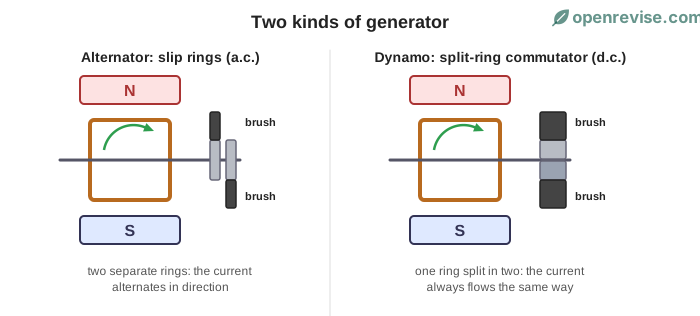
An alternator has:
- a coil that is turned by something, such as a turbine, an engine or a wheel;
- a magnetic field, produced by magnets (or electromagnets);
- two slip rings, one connected to each end of the coil, which turn with it;
- two carbon brushes that press on the slip rings and connect the coil to the external circuit.
How it works. As the coil rotates, the sides of the coil cut the field lines, so a p.d. is induced. After half a turn, each side of the coil is moving in the opposite direction through the field, so the induced p.d. reverses. The slip rings keep each brush connected to the same end of the coil, so the output alternates: it is alternating current (a.c.).
The output of an alternator
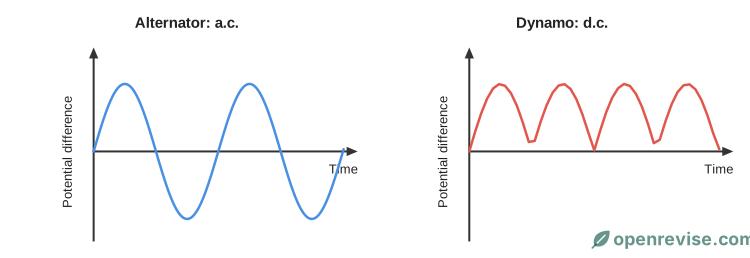
The p.d. depends on how quickly the coil is cutting the field lines:
- When the coil is parallel to the field lines (the plane of the coil along the field), its sides are moving at right angles to the field lines and cut them at the fastest rate, so the induced p.d. is at its maximum.
- When the coil is at right angles to the field lines, its sides are moving parallel to the field lines, and cut none, so the induced p.d. is zero.
This gives a sinusoidal graph. The p.d. is positive for one half turn and negative for the next half turn. One complete turn of the coil gives one complete cycle of the output, so the frequency of the a.c. is the same as the rotation rate of the coil. UK mains has a frequency of 50 Hz, so the generators in power stations turn 50 times per second.
A dynamo (d.c. generator)
A dynamo is built in the same way, but with a split-ring commutator instead of two slip rings. The commutator swaps the connections to the brushes every half turn, at the instant that the induced p.d. reverses. The current in the external circuit therefore always flows in the same direction: it is direct current (d.c.). The size of the p.d. still varies and goes to zero twice each turn, which makes a graph of humps. A dynamo on a bicycle is a small generator driven by the wheel, which powers the lights.
| Feature | Alternator | Dynamo |
|---|---|---|
| Connection to the coil | Two slip rings | Split-ring commutator |
| Type of output | Alternating current (a.c.) | Direct current (d.c.) |
| Graph of output | Sine wave, positive and negative | Humps, always positive |
Increasing the output
The size of the induced p.d. is bigger, if you:
- rotate the coil faster: a bigger and more frequent p.d., so the graph has a higher peak and a higher frequency (more waves in the same time);
- use stronger magnets;
- use more turns of wire on the coil;
- use a coil with a larger area.
Worked example. A coil rotates 25 times each second. The frequency of the a.c. output is 25 Hz, and the period is \frac{1}{25} = 0.040 \text{ s}. If the speed of rotation is doubled to 50 times each second, the frequency becomes 50 Hz, the period is 0.020 s, and the peak p.d. is twice as high.
Generators in power stations
Most of the electricity we use comes from alternators in power stations. A turbine, turned by steam, water or wind, rotates large electromagnets inside fixed coils. This gives a large a.c. output at about 25 000 V, which is fed to the National Grid.
Test yourself on this lesson
10 exam questions · 24 marks · with mark schemes and model answers
Found a mistake?