8.5 Observing the Universe
Edexcel: how telescopes have changed from Galileo's refractor to reflectors, radio telescopes and space telescopes, why some telescopes are in space, and what different wavelengths tell us. For Separate Science.
Telescopes
Key terms
- Telescope: an instrument that collects electromagnetic radiation from distant objects to make them appear brighter and larger or to detect them.
- Refracting telescope: a telescope that uses lenses to collect and focus light.
- Reflecting telescope: a telescope that uses curved mirrors to collect and focus light.
- Radio telescope: a telescope that collects radio waves from space, usually with a large dish.
- Absorption (by the atmosphere): when the atmosphere takes in some wavelengths of radiation so that they never reach the ground.
We learn about the Universe by collecting the electromagnetic radiation that comes from stars, galaxies and other objects. Telescopes collect this radiation. Telescopes have changed a great deal since they were first used, and many new discoveries have been possible as a result.
How telescopes have developed
- Refracting telescopes (early 1600s). Galileo used a refracting telescope made with lenses in 1609, to see mountains on the Moon, the moons of Jupiter and the phases of Venus. The size of lenses is limited, as they are heavy and can only be supported at the edge.
- Reflecting telescopes (from about 1668). Isaac Newton built a telescope using a curved mirror to collect and focus light. Mirrors can be made much bigger than lenses, because they can be supported from behind. Modern optical telescopes, such as the Keck telescopes (10 m wide), are reflectors made of many mirror segments.
- Cameras and computers. Photographic plates replaced the eye, and then digital sensors (CCDs) were developed, which are far more sensitive and can store and analyse images using computers.
- Radio telescopes (from the 1930s and 1940s). These use large dishes to collect radio waves, which can pass through the atmosphere, clouds and dust. The Lovell Telescope at Jodrell Bank has a dish 76 m wide. Several telescopes can be joined in an array, and combine their signals, to give much sharper images.
- Telescopes for other wavelengths and space telescopes (from the 1960s and 1970s). Telescopes now detect infrared, ultraviolet, X-rays and gamma rays, and many are carried by satellites in orbit.
A bigger telescope collects more radiation, so it can detect fainter and more distant objects, and gives a sharper image (better resolution).
Why are some telescopes in space?

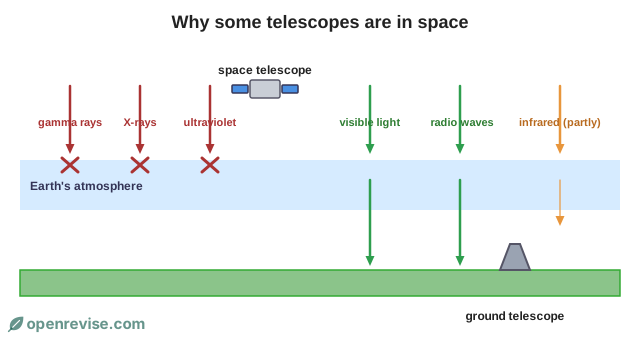
The Earth's atmosphere absorbs most of the gamma rays, X-rays and ultraviolet from space (which is fortunate, since these are harmful), and much of the infrared (absorbed by water vapour and carbon dioxide). Only visible light, radio waves and some infrared and microwaves reach the ground. To observe the other wavelengths, telescopes have to be above the atmosphere, on satellites.
| Telescope | Detects | What it can show |
|---|---|---|
| Hubble Space Telescope | Visible light, ultraviolet and near infrared | Sharp images of galaxies and stars |
| James Webb Space Telescope | Infrared | Star formation, and very distant, early galaxies |
| Chandra X-ray Observatory | X-rays | Black holes and very hot gas |
| Fermi Gamma-ray Space Telescope | Gamma rays | Violent events, such as exploding stars |
Space telescopes also avoid the other effects of the atmosphere: the air moves, which makes the stars "twinkle" and blurs the images, and clouds, dust and light pollution from cities. Optical telescopes on the ground are built on high mountains in dry places, such as Mauna Kea in Hawaii and the Atacama desert in Chile, where the air above is thin, dry and clear. They also use adaptive optics, which uses a computer to change the shape of the mirror many times a second to correct for the movement of the atmosphere.
Different wavelengths show different things
Observing the same object at different wavelengths gives different information:
- Radio waves: cold gas clouds, pulsars, and the very distant galaxies;
- Infrared: cooler objects, and areas where stars are forming, since infrared passes through dust;
- Visible light: stars and galaxies as we see them;
- Ultraviolet: hot young stars;
- X-rays and gamma rays: the most energetic events, including black holes and supernovae.
Astronomers combine the images made at different wavelengths to build up a complete picture of an object.
How science works
Modern telescopes are costly, and are often built by international teams. The data are shared, analysed by different scientists, and the results are peer reviewed, so that conclusions can be checked.
Test yourself on this lesson
9 exam questions · 25 marks · with mark schemes and model answers
Found a mistake?