Maths · Algebra
Viewing as
Teaching this? The teacher view opens every answer and mark scheme.
Simplifying and Expanding Expressions
Algebraic notation, collecting like terms, and expanding single brackets, double brackets and squared brackets.
Learning Objectives
- 1Use algebraic notation correctly and tell apart an expression, an equation, a formula and an identity.
- 2Simplify expressions by collecting like terms and using the laws of indices.
- 3Expand single brackets and pairs of brackets, including squared brackets.
- 4Expand and simplify expressions such as \((3x - 2)(x + 5)\) without making sign errors.
Algebra is arithmetic with letters
A letter in algebra stands for a number that is unknown or that can change, so every rule of arithmetic still applies. The skills in this lesson, simplifying and expanding, are used in almost every later topic: solving equations, factorising, sequences, graphs and proof. Most of the marks lost in algebra come from sign errors and from missing terms, so the habit of working one careful line at a time pays off straight away.
Algebraic notation
Algebra is written in a shorthand that you must read and write fluently.
-
Multiplication
The multiplication sign is left out: \(3 \times a = 3a\), \(a \times b = ab\) and \(a \times a = a^2\). The number always goes in front of the letter.
-
Division
Division is written as a fraction: \(a \div b = \dfrac{a}{b}\) and \(\dfrac{12x}{3} = 4x\).
-
Terms
A term is a single part of an expression, and it includes the sign in front of it. The expression \(5x^2 - 3x + 7\) has three terms: \(5x^2\), \(-3x\) and \(+7\).
-
Coefficient
The number multiplying a letter is its coefficient. In \(-3x\) the coefficient of \(x\) is \(-3\).
Expression, equation, formula or identity?
Four words that look similar and mean different things.
-
Expression
A collection of terms with no equals sign, such as \(3x + 5\). You can simplify or expand it, but you cannot solve it.
-
Equation
Two expressions joined by an equals sign that is true only for particular values, such as \(3x + 5 = 20\). You solve it to find the unknown.
-
Formula
A rule that links two or more quantities, such as \(A = lw\) for the area of a rectangle.
-
Identity
An equation that is true for every value of the letter, such as \(2(x + 3) \equiv 2x + 6\). It is written with the symbol \(\equiv\).
Collecting like terms
Like terms have exactly the same letters with exactly the same powers.
-
Spotting like terms
\(3x\) and \(5x\) are like terms, and so are \(4x^2\) and \(-x^2\). But \(3x\) and \(3x^2\) are not, and neither are \(3x\) and \(3y\).
-
Collecting
Add or subtract the coefficients and keep the letters, taking the sign in front of each term with it. \(4a + 3b - a + 5b = 3a + 8b\).
-
Multiplying terms
Multiply the numbers and add the powers of the same letter. \(3x \times 4x^2 = 12x^3\).
-
Dividing terms
Divide the numbers and subtract the powers. \(12x^5 \div 3x^2 = 4x^3\).
Collecting like terms
Simplify \(5x^2 + 3x - 2x^2 + 7 - 4x\).
Show the solutionHide the solution
- 1 Group the \(x^2\) terms \(5x^2 - 2x^2 = 3x^2\).
- 2 Group the \(x\) terms \(3x - 4x = -x\).
- 3 Keep the number \(+7\) has no like term, so it stays as it is.
- 4 Write the answer \(3x^2 - x + 7\).
Answer\(3x^2 - x + 7\)
Expanding single brackets
Expanding means removing the brackets by multiplying every term inside by the term outside.
-
The basic rule
\(3(2x - 5) = 3 \times 2x + 3 \times (-5) = 6x - 15\). Every term inside the bracket must be multiplied.
-
Negative outside
A negative outside changes every sign inside: \(-2(x - 4) = -2x + 8\), not \(-2x - 8\).
-
Letters outside
\(x(x + 3) = x^2 + 3x\) and \(2x(3x - 4) = 6x^2 - 8x\).
-
Expand and simplify
Expand each bracket, then collect like terms: \(3(x + 2) + 2(x - 5) = 3x + 6 + 2x - 10 = 5x - 4\).
Expanding double brackets with a grid
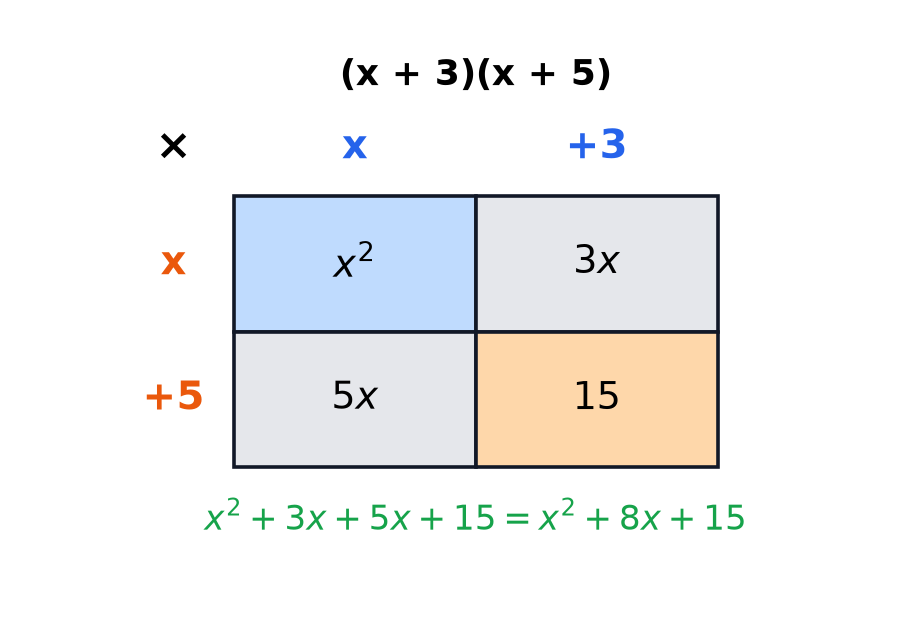
Every term in the first bracket must multiply every term in the second bracket, so two brackets give four products. A grid makes sure none is missed.
Using the grid
- Multiply each pair \(x \times x = x^2\), \(x \times 3 = 3x\), \(5 \times x = 5x\) and \(5 \times 3 = 15\).
- Add the four boxes \(x^2 + 3x + 5x + 15\).
- Collect like terms \(3x + 5x = 8x\), so the answer is \(x^2 + 8x + 15\).
Brackets with a negative number
Expand and simplify \((x + 7)(x - 4)\).
Show the solutionHide the solution
- 1 Multiply every pair \(x \times x = x^2\), \(x \times (-4) = -4x\), \(7 \times x = 7x\) and \(7 \times (-4) = -28\).
- 2 Write all four terms \(x^2 - 4x + 7x - 28\).
- 3 Collect like terms \(-4x + 7x = 3x\).
- 4 Answer \(x^2 + 3x - 28\).
Answer\(x^2 + 3x - 28\)
Brackets with a coefficient
Expand and simplify \((2x + 3)(x - 5)\).
Show the solutionHide the solution
- 1 Multiply every pair \(2x \times x = 2x^2\), \(2x \times (-5) = -10x\), \(3 \times x = 3x\) and \(3 \times (-5) = -15\).
- 2 Write all four terms \(2x^2 - 10x + 3x - 15\).
- 3 Collect like terms \(-10x + 3x = -7x\).
- 4 Answer \(2x^2 - 7x - 15\).
Answer\(2x^2 - 7x - 15\)
Squaring a bracket
A squared bracket is two identical brackets multiplied, so it has a middle term.
-
Write it out twice
\((x + 3)^2 = (x + 3)(x + 3) = x^2 + 3x + 3x + 9 = x^2 + 6x + 9\).
-
The middle term
The \(6x\) comes from \(2 \times x \times 3\). Forgetting it, and writing \(x^2 + 9\), is the most common mistake in this topic.
-
With a coefficient
\((2x - 1)^2 = (2x - 1)(2x - 1) = 4x^2 - 2x - 2x + 1 = 4x^2 - 4x + 1\).
-
Check with a number
Put \(x = 1\) into both sides: \((1 + 3)^2 = 16\) and \(1 + 6 + 9 = 16\).
Common mistakes when expanding
What students write
- \((x + 3)^2 = x^2 + 9\)
- \(-2(x - 4) = -2x - 8\)
- \(3x \times 4x = 12x\)
What is correct
- \((x + 3)^2 = x^2 + 6x + 9\)
- \(-2(x - 4) = -2x + 8\)
- \(3x \times 4x = 12x^2\)
Expressions in context: perimeter and area
Many exam questions use algebraic expressions for the sides of shapes.
-
Perimeter
Add all the sides and collect like terms. A rectangle \((3x + 1)\) by \((x + 4)\) has perimeter \(2(3x + 1 + x + 4) = 2(4x + 5) = 8x + 10\).
-
Area
Multiply the length by the width and expand. \((3x + 1)(x + 4) = 3x^2 + 12x + x + 4 = 3x^2 + 13x + 4\).
-
Compound shapes
Add or subtract the areas of simple shapes, then simplify.
-
"Show that" questions
Start from one side and work to the stated result, showing every line. Do not start from the answer.
Expanding three terms
Expand and simplify \(x(x + 2) - 3(x - 4)\).
Show the solutionHide the solution
- 1 Expand the first bracket \(x(x + 2) = x^2 + 2x\).
- 2 Expand the second bracket \(-3(x - 4) = -3x + 12\), because \(-3 \times (-4) = +12\).
- 3 Write both together \(x^2 + 2x - 3x + 12\).
- 4 Collect like terms \(2x - 3x = -x\), so the answer is \(x^2 - x + 12\).
Answer\(x^2 - x + 12\)
A coefficient in both brackets
Expand and simplify \((2x - 3)(3x + 4)\).
Show the solutionHide the solution
- 1 Multiply every pair \(2x \times 3x = 6x^2\), \(2x \times 4 = 8x\), \(-3 \times 3x = -9x\) and \(-3 \times 4 = -12\).
- 2 Write all four terms \(6x^2 + 8x - 9x - 12\).
- 3 Collect like terms \(8x - 9x = -x\).
- 4 Answer \(6x^2 - x - 12\).
Answer\(6x^2 - x - 12\)
A special case: no middle term
Expand and simplify \((x + 3)(x - 3)\).
Show the solutionHide the solution
- 1 Multiply every pair \(x \times x = x^2\), \(x \times (-3) = -3x\), \(3 \times x = 3x\) and \(3 \times (-3) = -9\).
- 2 Collect like terms \(-3x + 3x = 0\), so the middle terms cancel out.
- 3 Answer \(x^2 - 9\). This pattern, a difference of two squares, is used a lot in factorising.
Answer\(x^2 - 9\)
Expanding three brackets (Higher tier)
Expand two brackets first, and then multiply the result by the third.
-
Two at a time
Expand the first pair of brackets and tidy it up before bringing in the third.
-
Example
\((x + 1)(x + 2)(x + 3)\). First \((x + 1)(x + 2) = x^2 + 3x + 2\).
-
Multiply by the third bracket
\((x^2 + 3x + 2)(x + 3) = x^3 + 3x^2 + 3x^2 + 9x + 2x + 6 = x^3 + 6x^2 + 11x + 6\).
-
Check
Put \(x = 1\) into both forms. \(2 \times 3 \times 4 = 24\) and \(1 + 6 + 11 + 6 = 24\).
Using algebra to prove results
Algebra lets you show that something is true for every number, which examples alone cannot do.
-
Even and odd numbers
An even number can be written \(2n\) and an odd number can be written \(2n + 1\), where \(n\) is an integer.
-
Example
Two consecutive integers are \(n\) and \(n + 1\), so their sum is \(n + n + 1 = 2n + 1\), which is always odd.
-
Say what the letters mean
Write "let \(n\) be an integer" at the start of the proof.
-
Finish with a sentence
End by stating what you have shown, such as "so the sum is always odd".
Test yourself
-
1
Simplify \(3x + 2y - x - 5y\).
Show answerHide answer
\(2x - 3y\).
-
2
Expand \(4(x - 3)\).
Show answerHide answer
\(4x - 12\).
-
3
Expand and simplify \((x + 2)(x + 5)\).
Show answerHide answer
\(x^2 + 7x + 10\).
-
4
Simplify \(2a \times 3a^2\).
Show answerHide answer
\(6a^3\).
-
5
Expand and simplify \((x - 1)^2\).
Show answerHide answer
\(x^2 - 2x + 1\).
Exam technique: expanding
Expanding is quick, but each of the usual errors costs marks.
-
Write every term before you collect
Four products from two brackets means four terms to show, even if two of them cancel.
-
Watch every sign
A negative times a negative is a positive, which is the most common slip.
-
Check by substituting
Put \(x = 1\) or \(x = 2\) into the original and your answer. If they differ, there is an error.
-
"Expand and simplify" needs both
Expanding without collecting like terms usually loses the last mark.
Summary and exam focus
- Terms include their sign, and only like terms with identical letters and powers can be collected.
- When multiplying terms, multiply the numbers and add the powers; when dividing, divide the numbers and subtract the powers.
- Expanding a single bracket means multiplying every term inside, taking care of negative signs.
- For two brackets, multiply every term in the first by every term in the second and then collect like terms.
- A squared bracket is two brackets, and it always has a middle term.
Exam focus
Expand and simplify \((3x - 2)(x + 5)\). (3 marks) (3 marks)
Write out all four products on one line before you collect like terms, so you can see that you have four terms. A grid is fine if you are asked to show your working, and a correct four-term expansion earns the method marks even if the final sign is wrong.
Key terms
The words this lesson expects you to use. Each one is linked from the first place it appears above.
- Consecutive
- Following one after another in order, such as the consecutive integers 7, 8 and 9.
- Term
- A single part of an expression, with the sign in front of it, such as \(-3x\).
- Expression
- A collection of terms with no equals sign, such as \(3x + 5\).
- Equation
- A statement that two expressions are equal, which is true only for certain values.
- Formula
- A rule that links quantities using letters, such as \(A = lw\).
- Identity
- An equation that is true for all values of the letters, written with the symbol \(\equiv\).
- Like terms
- Terms with the same letters raised to the same powers.
- Coefficient
- The number that multiplies a letter in a term.
- Expand
- Multiply out brackets to remove them.
- Simplify
- Write an expression in its shortest form by collecting like terms.
You've finished the notes
Check your understanding
Test yourself while it is fresh. Start with the flashcards, then try the exam questions.
Something here looks wrong?
Tell us what and we will go and look. It goes to whoever writes these pages, nobody else, and we do not ask who you are — so there is nothing to sign and nothing comes back to you.