Maths · Circle Theorems
Viewing as
Teaching this? The teacher view opens every answer and mark scheme.
Angles at the Centre and in a Semicircle
Using the angle at the centre and the angle in a semicircle, with reasons and radii.
Learning Objectives
- 1Name the parts of a circle: centre, radius, diameter, chord, arc, segment, sector and tangent.
- 2Use the theorem that the angle at the centre is twice the angle at the circumference.
- 3Use the theorem that the angle in a semicircle is a right angle.
- 4Give a reason for every angle, using the exact words of the theorem.
Angles in circles
Circle theorems are rules about the angles made by lines drawn inside a circle. This is Higher tier content on every board, and the questions are always the same kind: a diagram with some angles given, and a request to find another angle and give a reason. The marks are for the angle and for the reason, so you must learn the theorems in their exact wording and write each reason in a short sentence. This first lesson covers the two theorems that involve the centre, and the later lessons add the others.
Parts of a circle
The words are used in every circle theorem question.
-
Centre, radius and diameter
The radius goes from the centre to the edge, and the diameter goes through the centre from edge to edge.
-
Chord
A straight line joining two points on the circle. The diameter is the longest chord.
-
Arc
A part of the circumference.
-
Tangent
A straight line that touches the circle at exactly one point.
The angle at the centre
The angle at the centre is twice the angle at the circumference, when both angles are made by the same arc.
-
The theorem
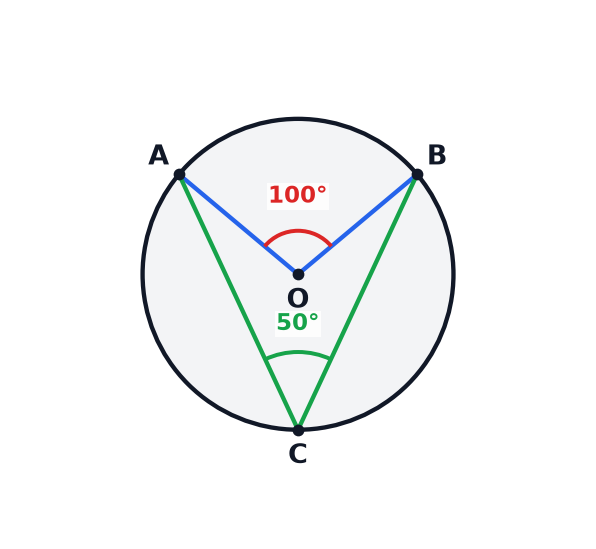
If \(A\), \(B\) and \(C\) are on a circle with centre \(O\), then angle \(AOB\) is twice angle \(ACB\).
-
Same arc
Both angles are made from the chord \(AB\), with the angle at \(C\) on the other side from the arc \(AB\) that makes the angle at \(O\).
-
Using it
If the angle at the centre is \(100^\circ\), the angle at the circumference is \(50^\circ\). If the angle at the circumference is \(35^\circ\), the angle at the centre is \(70^\circ\).
-
The reason
"The angle at the centre is twice the angle at the circumference."
Centre and circumference
Both angles are made by the chord \(AB\). The angle at the centre, \(100^\circ\), is twice the angle at the circumference, \(50^\circ\).
Reading the diagram
- Find the matching angles Both angles come from the same two points on the circle, \(A\) and \(B\).
- The big angle The angle at the centre is the bigger one.
- Halve or double Halve to go from the centre to the circumference, and double to go the other way.
- Reflex angles If the angle at the centre is more than \(180^\circ\), the theorem still holds with the reflex angle.
Using the centre theorem
\(A\), \(B\) and \(C\) are points on a circle with centre \(O\). Angle \(AOB = 112^\circ\). Work out angle \(ACB\), and give a reason.
Show the solutionHide the solution
- 1 Identify \(AOB\) is the angle at the centre, and \(ACB\) is the angle at the circumference, both on the chord \(AB\).
- 2 Halve \(112 \div 2 = 56\).
- 3 Write the answer Angle \(ACB = 56^\circ\).
- 4 Reason The angle at the centre is twice the angle at the circumference.
Answer\(56^\circ\), because the angle at the centre is twice the angle at the circumference
The angle in a semicircle
The angle in a semicircle is \(90^\circ\).
-
The theorem
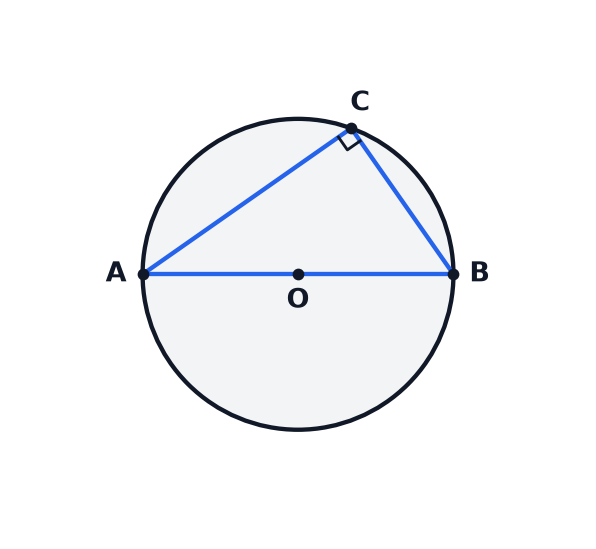
If \(AB\) is a diameter and \(C\) is any other point on the circle, then angle \(ACB = 90^\circ\).
-
Why
The angle at the centre on a diameter is \(180^\circ\), and half of that is \(90^\circ\).
-
Using it
Once you have a right-angled triangle, the other two angles add up to \(90^\circ\), and you can use Pythagoras too.
-
The reason
"The angle in a semicircle is \(90^\circ\)."
The angle in a semicircle
The line \(AB\) passes through the centre \(O\), so it is a diameter. For any point \(C\) on the circle, the angle \(ACB\) is a right angle.
Spotting the diameter
- Through the centre Check that the line goes through \(O\).
- Any point It does not matter where \(C\) is on the circle.
- Right angle The triangle \(ABC\) is right-angled at \(C\).
- Other angles The angles at \(A\) and \(B\) add up to \(90^\circ\).
Using the semicircle theorem
\(AB\) is a diameter of a circle. \(C\) is a point on the circle, and angle \(CAB = 34^\circ\). Work out angle \(ABC\), and give reasons.
Show the solutionHide the solution
- 1 Right angle Angle \(ACB = 90^\circ\), because the angle in a semicircle is \(90^\circ\).
- 2 Angles in a triangle \(34^\circ + 90^\circ = 124^\circ\).
- 3 Subtract \(180^\circ - 124^\circ = 56^\circ\).
- 4 Reasons The angle in a semicircle is \(90^\circ\), and the angles in a triangle add up to \(180^\circ\).
Answer\(56^\circ\)
Test yourself
-
1
What is a chord?
Show answerHide answer
A straight line joining two points on a circle.
-
2
What is the angle at the centre in terms of the angle at the circumference?
Show answerHide answer
Twice as big.
-
3
What is the angle in a semicircle?
Show answerHide answer
\(90^\circ\).
-
4
What line makes the angle in a semicircle?
Show answerHide answer
A diameter.
-
5
What do you give with every angle in the exam?
Show answerHide answer
A reason.
Exam technique: circle theorems
The reason is worth as much as the angle.
-
Use the exact wording
"Angle at the centre is twice the angle at the circumference."
-
One reason per step
Do not combine several reasons in one sentence.
-
Mark the diagram
Write each angle you find on the diagram.
-
Look for isosceles triangles
Two radii make an isosceles triangle, a useful fact for later lessons.
Summary and exam focus
- The angle at the centre is twice the angle at the circumference on the same arc.
- The angle in a semicircle is \(90^\circ\).
- Every angle needs a reason, using the exact words.
- Two radii form an isosceles triangle.
Exam focus
\(A\), \(B\) and \(C\) are points on a circle with centre \(O\). Angle \(ACB = 38^\circ\). Work out angle \(AOB\), and give a reason for your answer. (2 marks) (2 marks)
The angle at the centre is twice the angle at the circumference, so \(AOB = 2 \times 38 = 76^\circ\). Write the reason in full: "The angle at the centre is twice the angle at the circumference."
Key terms
The words this lesson expects you to use. Each one is linked from the first place it appears above.
- Circle theorem
- A rule about angles and lines in a circle.
- Chord
- A straight line joining two points on a circle.
- Arc
- A part of the circumference.
- Tangent
- A line that touches a circle at one point.
- Diameter
- A chord through the centre of a circle.
- Circumference
- The distance around a circle, or the circle itself.
- Subtend
- To make an angle from a chord or arc at a point.
- Semicircle
- Half of a circle, cut by a diameter.
- Reason
- A statement of the theorem that justifies an angle.
You've finished the notes
Check your understanding
Test yourself while it is fresh. Start with the flashcards, then try the exam questions.
Something here looks wrong?
Tell us what and we will go and look. It goes to whoever writes these pages, nobody else, and we do not ask who you are — so there is nothing to sign and nothing comes back to you.