Maths · Geometry and Measures
Viewing as
Teaching this? The teacher view opens every answer and mark scheme.
Trigonometry in Right-Angled Triangles
Using sine, cosine and tangent, and the exact trigonometric values, to find sides and angles.
Learning Objectives
- 1Label the hypotenuse, opposite and adjacent sides of a right-angled triangle for a given angle.
- 2Use sine, cosine and tangent to find a missing side or a missing angle.
- 3Recall the exact values of sin, cos and tan for 0, 30, 45, 60 and 90 degrees.
- 4Use exact values to solve problems without a calculator, including answers with surds (Higher tier).
Why trigonometry on a non-calculator paper
Pythagoras only links the sides of a right-angled triangle. Trigonometry links the sides to the angles, so it is what you use whenever an angle is involved. A calculator makes the arithmetic easy, so on Paper 1 the questions are designed in other ways: you are given the ratio, such as \(\sin\theta = \dfrac{5}{13}\), or the angle is one of the special angles with exact values, such as \(30^\circ\) or \(45^\circ\). The method is the same as on a calculator paper, so learn it carefully and the other papers will be easy as well.
Naming the sides
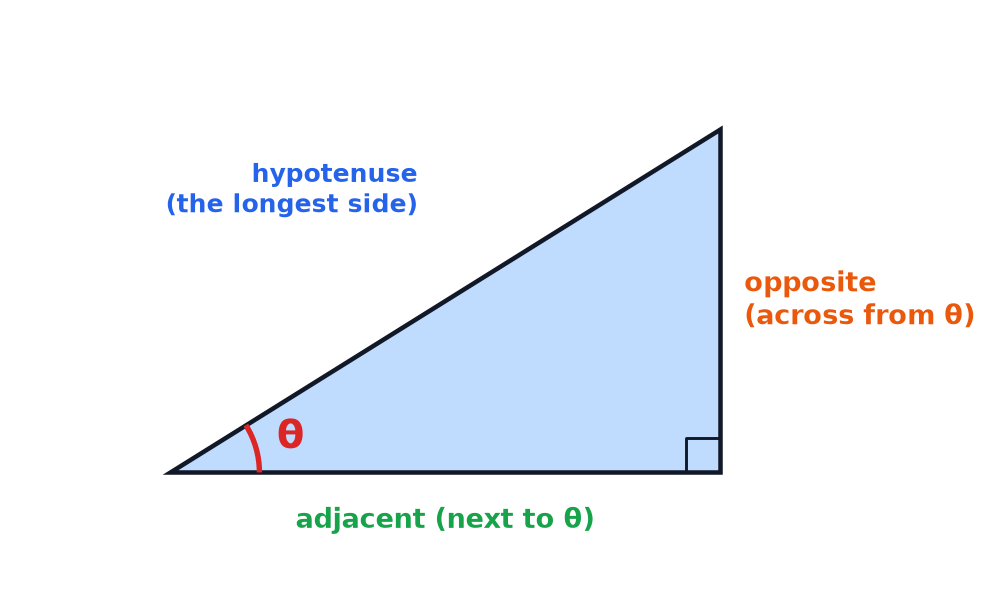
The names depend on which angle you are using. The hypotenuse is always opposite the right angle. The opposite side is across from the angle theta, and the adjacent side is the one next to it, other than the hypotenuse.
Labelling a triangle
- Hypotenuse The longest side, opposite the right angle. It never changes.
- Opposite The side that does not touch the angle \(\theta\).
- Adjacent The side that touches the angle \(\theta\), apart from the hypotenuse.
- If the angle changes The opposite and adjacent sides swap over, but the hypotenuse stays the same.
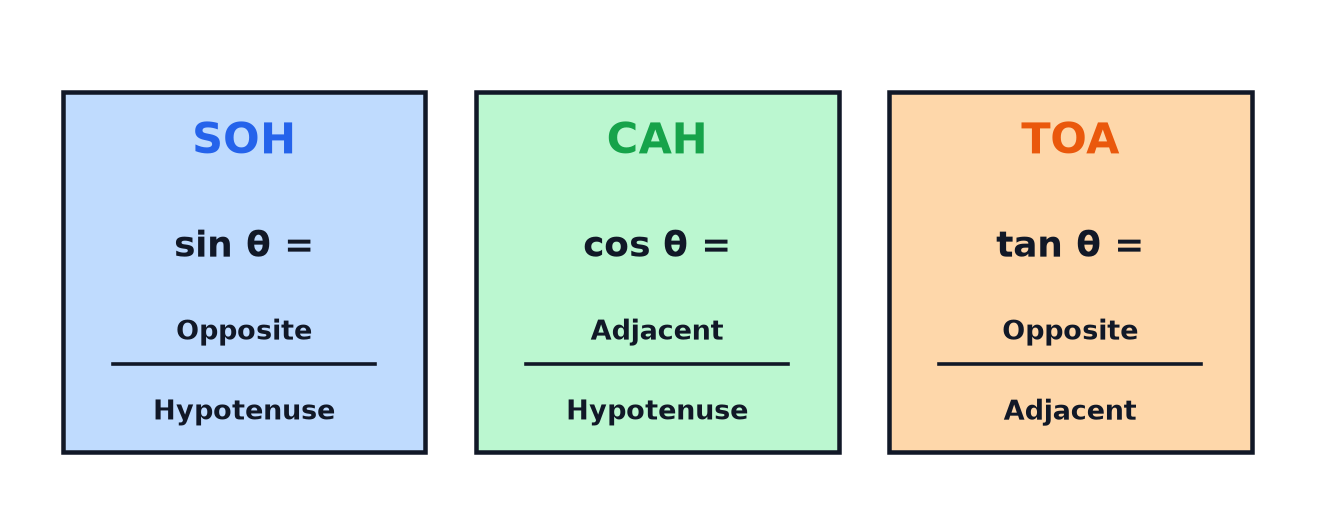
SOH CAH TOA
The three ratios are remembered with the word SOH CAH TOA. Each one links an angle with two sides.
Choosing the ratio
- Step 1 Label the sides O, A and H for the angle in the question.
- Step 2 Decide which two sides you have, or want to find. The letters you need tell you which ratio to use.
- Step 3 Write the ratio with the numbers in, then solve the equation.
Finding a side from a ratio
In a right-angled triangle, \(\sin\theta = \dfrac{5}{13}\) and the hypotenuse is 39 cm. Work out the length of the side opposite \(\theta\).
Show the solutionHide the solution
- 1 Choose the ratio The question has opposite and hypotenuse, so use \(\sin\theta = \dfrac{O}{H}\).
- 2 Substitute \(\dfrac{5}{13} = \dfrac{x}{39}\).
- 3 Solve \(x = \dfrac{5}{13} \times 39 = 5 \times 3 = 15\).
- 4 Units The opposite side is 15 cm.
Answer15 cm
Finding a missing side
A trigonometry equation is solved by rearranging, and the position of the unknown decides how.
-
Unknown on top
If the unknown is the numerator, multiply: \(\sin\theta = \dfrac{x}{10}\) gives \(x = 10\sin\theta\).
-
Unknown on the bottom
If the unknown is the denominator, rearrange and divide: \(\cos\theta = \dfrac{6}{x}\) gives \(x = \dfrac{6}{\cos\theta}\).
-
Write the equation first
Show \(\sin 30^\circ = \dfrac{x}{8}\) before you rearrange, because this equation earns the first mark.
-
Check
The hypotenuse is always the longest side, and a side opposite a small angle is short.
Finding a missing angle
To find an angle you use the inverse function, written \(\sin^{-1}\), \(\cos^{-1}\) or \(\tan^{-1}\).
-
The idea
If \(\sin\theta = \dfrac{1}{2}\), then \(\theta = \sin^{-1}\left(\dfrac{1}{2}\right) = 30^\circ\).
-
Calculator papers
Enter the ratio and press the inverse key. Papers 2 and 3 expect this.
-
Non-calculator papers
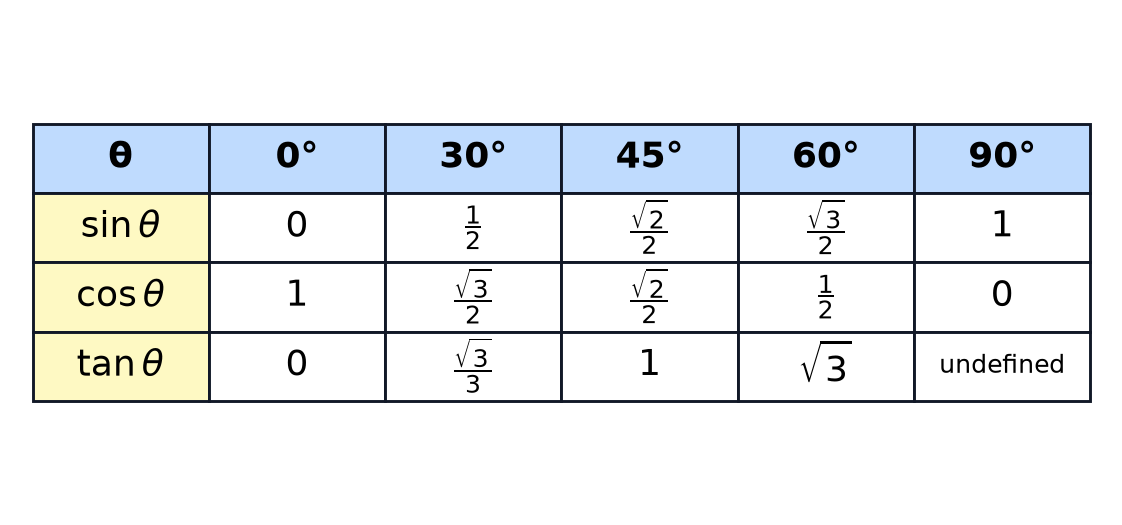
The ratio will match an exact value, so read it off the table below.
-
Check
The angle in a right-angled triangle is always less than \(90^\circ\).
Exact trigonometric values
These values are used on a non-calculator paper when the angle is 30, 45 or 60 degrees. They are not given in the exam, so you must learn them.
Easy ways to remember
- Sin goes up \(\sin\) at \(0, 30, 45, 60, 90\) is \(\dfrac{\sqrt{0}}{2}, \dfrac{\sqrt{1}}{2}, \dfrac{\sqrt{2}}{2}, \dfrac{\sqrt{3}}{2}, \dfrac{\sqrt{4}}{2}\), which is \(0, \dfrac{1}{2}, \dfrac{\sqrt{2}}{2}, \dfrac{\sqrt{3}}{2}, 1\).
- Cos is sin backwards \(\cos\) takes the same values in reverse order.
- Tan is sin divided by cos \(\tan 45^\circ = 1\) because the two are equal at \(45^\circ\).
Using exact values
A right-angled triangle has a hypotenuse of 8 cm and an angle of \(30^\circ\). Work out the length of the side opposite the \(30^\circ\) angle.
Show the solutionHide the solution
- 1 Choose the ratio Opposite and hypotenuse, so \(\sin 30^\circ = \dfrac{x}{8}\).
- 2 Use the exact value \(\sin 30^\circ = \dfrac{1}{2}\), so \(\dfrac{1}{2} = \dfrac{x}{8}\).
- 3 Solve \(x = \dfrac{1}{2} \times 8 = 4\) cm.
- 4 Check The side opposite a \(30^\circ\) angle is half the hypotenuse, which is a useful fact to remember.
Answer4 cm
Finding an angle
A right-angled triangle has opposite side 5 cm and adjacent side 5 cm. Work out the angle \(\theta\).
Show the solutionHide the solution
- 1 Choose the ratio Opposite and adjacent, so use \(\tan\theta = \dfrac{O}{A}\).
- 2 Substitute \(\tan\theta = \dfrac{5}{5} = 1\).
- 3 Use the exact values \(\tan 45^\circ = 1\), so \(\theta = 45^\circ\).
- 4 Check Two equal short sides make an isosceles right-angled triangle, with two \(45^\circ\) angles.
Answer\(45^\circ\)
Answers with surds (Higher tier)
When the angle is \(45^\circ\), \(60^\circ\) or \(30^\circ\) and the side is not a multiple that cancels, the answer contains a surd.
-
Tan 60
\(\tan 60^\circ = \sqrt{3}\), so a triangle with adjacent 5 cm and angle \(60^\circ\) has opposite \(5\sqrt{3}\) cm.
-
Sin 45
With hypotenuse 10 cm and angle \(45^\circ\), the opposite is \(10 \times \dfrac{\sqrt{2}}{2} = 5\sqrt{2}\) cm.
-
Simplify
Cancel before you multiply, so \(10 \times \dfrac{\sqrt{2}}{2}\) becomes \(5\sqrt{2}\).
-
Rationalising
Denominators with a surd are tidied up by multiplying the top and bottom by that surd.
A surd answer
(Higher tier) A right-angled triangle has an angle of \(45^\circ\) and a hypotenuse of 10 cm. Work out the length of the side opposite the \(45^\circ\) angle. Give your answer in the form \(a\sqrt{2}\).
Show the solutionHide the solution
- 1 Choose the ratio Opposite and hypotenuse, so \(\sin 45^\circ = \dfrac{x}{10}\).
- 2 Use the exact value \(\dfrac{\sqrt{2}}{2} = \dfrac{x}{10}\).
- 3 Rearrange \(x = 10 \times \dfrac{\sqrt{2}}{2}\).
- 4 Simplify \(x = 5\sqrt{2}\) cm.
Answer\(5\sqrt{2}\) cm
What the Edexcel exam gives you
Edexcel prints a formulae page in the question paper, so some formulae are given to you.
-
Given
The right-angled triangle ratios, written with the sides called \(a\), \(b\) and \(c\), such as \(\sin A = \dfrac{a}{c}\), \(\cos A = \dfrac{b}{c}\) and \(\tan A = \dfrac{a}{b}\) when \(c\) is the hypotenuse.
-
Translate the letters
The page uses \(a\) for the side opposite angle \(A\) and \(b\) for the adjacent side, so check which sides you have before using it.
-
Not given
The exact values of sin, cos and tan for \(0^\circ\), \(30^\circ\), \(45^\circ\), \(60^\circ\) and \(90^\circ\) are not on the page, so learn the table.
Test yourself
-
1
What does SOH stand for?
Show answerHide answer
\(\sin\theta = \dfrac{\text{Opposite}}{\text{Hypotenuse}}\).
-
2
What does TOA stand for?
Show answerHide answer
\(\tan\theta = \dfrac{\text{Opposite}}{\text{Adjacent}}\).
-
3
What is \(\sin 30^\circ\)?
Show answerHide answer
\(\dfrac{1}{2}\).
-
4
What is \(\tan 45^\circ\)?
Show answerHide answer
1.
-
5
What is \(\cos 60^\circ\)?
Show answerHide answer
\(\dfrac{1}{2}\).
Exam technique: trigonometry
Most lost marks are in the first step, choosing the wrong ratio.
-
Label the triangle
Write O, A and H on the diagram for the angle you are using.
-
Say which ratio
Write "\(\sin\theta = \dfrac{O}{H}\)" before you put numbers in.
-
Show the equation
\(\sin 30^\circ = \dfrac{x}{8}\) scores a mark, even if you solve it incorrectly.
-
Check the answer
A side opposite a small angle should be short, and the hypotenuse is always longest.
Summary and exam focus
- Label the hypotenuse, opposite and adjacent sides for the angle you are using.
- SOH CAH TOA: \(\sin = \dfrac{O}{H}\), \(\cos = \dfrac{A}{H}\) and \(\tan = \dfrac{O}{A}\).
- Use the inverse functions to find an angle.
- Learn the exact values for \(0^\circ\), \(30^\circ\), \(45^\circ\), \(60^\circ\) and \(90^\circ\), which are needed on a non-calculator paper.
- Answers with surds are likely at Higher tier.
Exam focus
A right-angled triangle has a hypotenuse of 12 cm and an angle of \(30^\circ\). Work out the length of the side opposite the \(30^\circ\) angle. (3 marks) (3 marks)
Write \(\sin 30^\circ = \dfrac{x}{12}\), then use \(\sin 30^\circ = \dfrac{1}{2}\) to get \(x = 6\) cm. The first line is a mark, and the exact value is another. Do not use Pythagoras, because only one side is known.
Key terms
The words this lesson expects you to use. Each one is linked from the first place it appears above.
- Trigonometry
- The study of the links between the sides and angles of triangles.
- Sine
- The ratio of the opposite side to the hypotenuse in a right-angled triangle.
- Cosine
- The ratio of the adjacent side to the hypotenuse in a right-angled triangle.
- Tangent
- The ratio of the opposite side to the adjacent side in a right-angled triangle.
- Opposite
- The side across from the angle being used.
- Adjacent
- The side next to the angle being used, other than the hypotenuse.
- Inverse function
- A function that undoes another, such as sin\(^{-1}\), which turns a ratio back into an angle.
- Exact value
- A value written as a fraction or surd instead of a rounded decimal.
- SOH CAH TOA
- A memory aid for the three trigonometric ratios.
You've finished the notes
Check your understanding
Test yourself while it is fresh. Start with the flashcards, then try the exam questions.
Something here looks wrong?
Tell us what and we will go and look. It goes to whoever writes these pages, nobody else, and we do not ask who you are — so there is nothing to sign and nothing comes back to you.