Viewing as
Teaching this? The teacher view adds 2 files, the mark schemes and the model answers.
Maths · Algebra
Expanding and factorising
Expanding multiplies brackets out; factorising puts them back. They are the same skill run in opposite directions, and between them they turn up in almost every algebra question on the paper.
Last Lesson and Before
Answer each one, then check.
-
1
Simplify \(3a + 5a - 2a\).
Show answerHide answer
\(6a\)
-
2
Work out \(-3 \times -4\).
Show answerHide answer
\(12\)
-
3
What is the HCF of 12 and 18?
Show answerHide answer
\(6\)
-
4
Last lesson: simplify \(x \times x\).
Show answerHide answer
\(x^2\)
-
5
Last lesson: simplify \(2x \times 5x^2\).
Show answerHide answer
\(10x^3\)
Learning Objectives
- 1Expand single brackets and simplify.
- 2Factorise expressions by taking out the highest common factor.
- 3Expand double brackets.
- 4Factorise quadratic expressions of the form \(x^2 + bx + c\).
- 5Factorise the difference of two squares, \(x^2 - a^2\).
The Words You Need
-
Term
One part of an expression: \(3x\), \(-5\) and \(x^2\) are terms.
-
Expression
Terms added or subtracted, with no equals sign: \(3x^2 - 5x + 2\).
-
Coefficient
The number in front of a letter: the 3 in \(3x^2\).
-
Like terms
Same letters and powers: \(4x\) and \(-7x\), but not \(4x\) and \(4x^2\).
-
Expand
Multiply out the brackets.
-
Factorise
Put back into brackets - the opposite of expanding.
Expanding Single Brackets
Multiply every term inside the bracket by the term outside.
-
Numbers
\(4(3x - 7) = 12x - 28\).
-
Letters
\(x(x + 5) = x^2 + 5x\).
-
Negative outside
\(-3(x - 4) = -3x + 12\): a negative times a negative is positive.
-
Expand and simplify
Expand every bracket, then collect like terms.
Expand and Simplify
Expand and simplify \(5(2x + 3) - 3(x - 4)\)
Show the solutionHide the solution
- 1 Expand the first bracket \(5(2x + 3) = 10x + 15\)
- 2 Expand the second: the \(-3\) multiplies both terms \(-3(x - 4) = -3x + 12\)
- 3 Write it all out \(10x + 15 - 3x + 12\)
- 4 Collect like terms \(10x - 3x = 7x\) and \(15 + 12 = 27\)
Answer\(7x + 27\)
Factorising Fully
Factorise fully \(12x^2y - 18xy^2\)
Show the solutionHide the solution
- 1 Find the HCF of the numbers HCF of 12 and 18 \(= 6\)
- 2 Find the HCF of the letters Both terms have \(x\) and \(y\): \(xy\)
- 3 The HCF goes outside \(6xy(\ \ldots\ )\)
- 4 Divide each term by the HCF \(12x^2y \div 6xy = 2x\) and \(18xy^2 \div 6xy = 3y\)
Answer\(6xy(2x - 3y)\)
The Grid Method for (x + 4)(x - 3)
Multiply each row by each column, then collect like terms: \(x^2 - 3x + 4x - 12 = x^2 + x - 12\).
-
\(x\)
x: \(x^2\). −3: \(-3x\)
-
\(+4\)
x: \(+4x\). −3: \(-12\)
Squaring a Bracket
Expand and simplify \((2x - 5)^2\)
Show the solutionHide the solution
- 1 Write it as two brackets \((2x - 5)(2x - 5)\)
- 2 First times first \(2x \times 2x = 4x^2\)
- 3 Outer and inner \(2x \times (-5) = -10x\) and \((-5) \times 2x = -10x\)
- 4 Last times last \((-5) \times (-5) = +25\)
- 5 Collect like terms \(4x^2 - 20x + 25\)
Answer\(4x^2 - 20x + 25\) (not \(4x^2 + 25\))
Factorising x² + bx + c
Find two numbers that MULTIPLY to give \(c\) and ADD to give \(b\).
-
The brackets
\(x^2 + bx + c = (x + p)(x + q)\), where \(pq = c\) and \(p + q = b\).
-
\(c\) positive
Both numbers have the same sign as \(b\): \(x^2 - 7x + 12 = (x - 3)(x - 4)\).
-
\(c\) negative
The numbers have opposite signs: \(x^2 + x - 12 = (x + 4)(x - 3)\).
-
Check
Expand your answer: it should give the expression you started with.
Factorising a Quadratic
Factorise \(x^2 - 2x - 15\)
Show the solutionHide the solution
- 1 List pairs that multiply to \(-15\) \(1\) and \(-15\), \(-1\) and \(15\), \(3\) and \(-5\), \(-3\) and \(5\)
- 2 Pick the pair that adds to \(-2\) \(3 + (-5) = -2\)
- 3 Write the brackets \((x + 3)(x - 5)\)
- 4 Check by expanding \(x^2 - 5x + 3x - 15 = x^2 - 2x - 15\)
Answer\((x + 3)(x - 5)\)
The Difference of Two Squares
One square number (or square term) minus another factorises straight away.
-
The rule
\(x^2 - a^2 = (x + a)(x - a)\).
-
Examples
\(x^2 - 49 = (x + 7)(x - 7)\). \(x^2 - 1 = (x + 1)(x - 1)\).
-
Why it works
\((x + 7)(x - 7) = x^2 - 7x + 7x - 49\): the middle terms cancel.
-
Spot it
Two terms, both square, with a MINUS between them. \(x^2 + 49\) does not factorise.
Match the Expression to Its Factors
-
\(x^2 + 5x + 6\)
\((x + 2)(x + 3)\)
-
\(x^2 - 9\)
\((x + 3)(x - 3)\)
-
\(x^2 + x - 6\)
\((x + 3)(x - 2)\)
-
\(x^2 - 5x + 6\)
\((x - 2)(x - 3)\)
-
\(4x + 12\)
\(4(x + 3)\)
-
\(x^2 + 3x\)
\(x(x + 3)\)
Expand, Then Undo
Work in pairs. Partner A expands (a) \((x + 5)(x + 2)\) (b) \((x - 4)(x + 6)\) (c) \((x - 3)^2\). Partner B factorises (d) \(x^2 + 9x + 14\) (e) \(x^2 - 4x - 21\) (f) \(x^2 - 100\). Then swap papers and check each other's answers by doing the opposite process.
1. Partner A: expand.
2. Partner B: factorise.
3. Swap and check by reversing.
A good answer shows: (a) \(x^2 + 7x + 10\) (b) \(x^2 + 2x - 24\) (c) \(x^2 - 6x + 9\) (d) \((x + 2)(x + 7)\) (e) \((x - 7)(x + 3)\) (f) \((x + 10)(x - 10)\)
Can I...?
- 1Expand a single bracket.
- 2Expand and simplify two single brackets.
- 3Factorise by taking out the HCF.
- 4Factorise fully.
- 5Expand double brackets.
- 6Square a bracket.
- 7Factorise \(x^2 + bx + c\).
- 8Factorise the difference of two squares.
Summary & Exam Focus
- Expand: multiply every term inside by every term outside.
- Factorise: take out the HCF of the numbers AND the letters.
- Double brackets: four multiplications, then collect like terms.
- \(x^2 + bx + c\): find two numbers that multiply to \(c\) and add to \(b\).
- \(x^2 - a^2 = (x + a)(x - a)\).
Exam focus
Factorise \(x^2 + 9x + 20\) (2 marks) (2 marks)
Always check a factorisation by expanding it again. It takes ten seconds and catches sign errors that would cost the mark.
Key terms
The vocabulary this lesson expects you to use. Each one is linked from the first place it appears above.
- Expand
- Multiply out brackets.
- Factorise
- Write an expression as a product of factors, using brackets.
- Factorise fully
- Take out the highest common factor, so no common factor is left inside.
- Quadratic expression
- An expression whose highest power is \(x^2\), such as \(x^2 + 5x + 6\).
- Difference of two squares
- An expression of the form \(x^2 - a^2\), which factorises to \((x + a)(x - a)\).
- Identity
- Two expressions that are equal for every value of \(x\), written with \(\equiv\).
Practice questions
Have a go at each one before you open its answer.
-
Question 1 Non-calculator 1 mark
Expand \(4(3x - 7)\)
Show answerHide answer
Model answer
\(12x - 28\)
Mark scheme
- \(12x - 28\) — B1
-
Question 2 Non-calculator 2 marks
Expand and simplify \(3(2y + 5) - 2(y - 4)\)
Show answerHide answer
Model answer
\(6y + 15 - 2y + 8 = 4y + 23\)
Mark scheme
- \(6y + 15\) or \(-2y + 8\) correct — M1
- \(4y + 23\) — A1
-
Question 3 Non-calculator 2 marks
Factorise fully \(15y^2 + 10y\)
Show answerHide answer
Model answer
\(5y(3y + 2)\)
Mark scheme
- \(5y(3y + 2)\) — B2
- A correct partial factorisation, e.g. \(5(3y^2 + 2y)\) or \(y(15y + 10)\) — B1
-
Question 4 Non-calculator 2 marks
Expand and simplify \((x + 6)(x - 2)\)
Show answerHide answer
Model answer
\(x^2 - 2x + 6x - 12 = x^2 + 4x - 12\)
Mark scheme
- At least 3 of the 4 terms correct: \(x^2\), \(-2x\), \(+6x\), \(-12\) — M1
- \(x^2 + 4x - 12\) — A1
-
Question 5 Non-calculator 2 marks
Factorise \(x^2 + 9x + 20\)
Show answerHide answer
Model answer
\((x + 4)(x + 5)\)
Mark scheme
- \((x + 4)(x + 5)\) — B2
- \((x \pm 4)(x \pm 5)\) — B1
-
Question 6 Non-calculator 1 mark
Factorise \(x^2 - 64\)
Show answerHide answer
Model answer
\((x + 8)(x - 8)\)
Mark scheme
- \((x + 8)(x - 8)\) — B1
-
Question 7 Non-calculator · Show that 3 marks
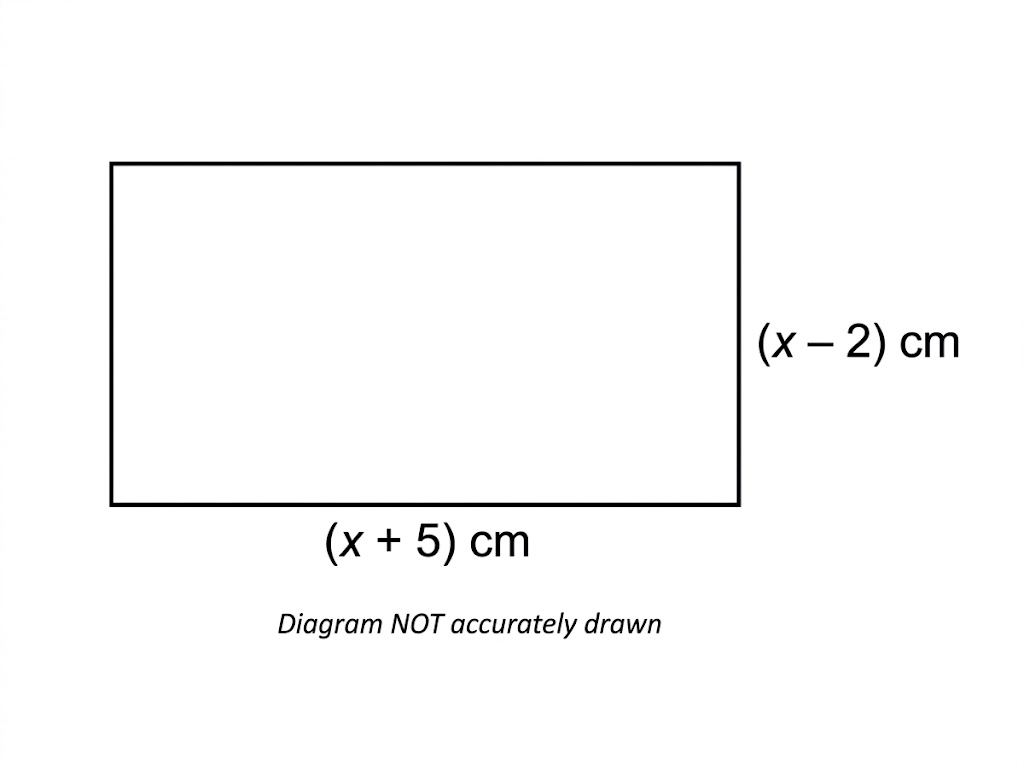
The diagram shows a rectangle. The length is \((x + 5)\) cm and the width is \((x - 2)\) cm. Show that the area of the rectangle, in cm², is \(x^2 + 3x - 10\).
Show answerHide answer
Model answer
Area \(= (x + 5)(x - 2) = x^2 - 2x + 5x - 10 = x^2 + 3x - 10\)
Mark scheme
- Area \(= (x + 5)(x - 2)\) — M1
- At least 3 of the 4 terms correct — M1
- Fully correct expansion reaching \(x^2 + 3x - 10\) — A1
Quick check
-
Expand \(3(x - 5)\)
Show answerHide answer
B: \(3x - 15\)
Multiply both terms by 3: \(3 \times x = 3x\) and \(3 \times -5 = -15\).
-
Factorise \(x^2 + 7x + 10\)
Show answerHide answer
A: \((x + 2)(x + 5)\)
\(2 \times 5 = 10\) and \(2 + 5 = 7\).
-
Expand and simplify \((x - 4)^2\)
Show answerHide answer
D: \(x^2 - 8x + 16\)
\((x - 4)(x - 4) = x^2 - 4x - 4x + 16 = x^2 - 8x + 16\).
Downloads
Free to keep, print and annotate.
- Expanding and factorising.pptx Built from the lesson script on 28 September 2026. View
- Expanding and factorising - Completed Notes.docx The full notes for the lesson, to revise from. Built from the lesson script on 28 September 2026. View
- Expanding and factorising - Exam Questions.docx Built from the lesson script on 28 September 2026. View
Something here looks wrong?
Tell us what and we will go and look. It goes to whoever writes these pages, nobody else, and we do not ask who you are — so there is nothing to sign and nothing comes back to you.