Viewing as
Teaching this? The teacher view adds 2 files, the mark schemes and the model answers.
Maths · Algebra
Non-linear sequences
Not every sequence goes up by the same amount. Square, cube and triangular numbers, Fibonacci sequences and geometric sequences all follow rules of their own - and at Higher, quadratic sequences have an nth term you can find from their second differences.
Last Lesson and Before
Answer each one, then check.
-
1
Last lesson: find the nth term of 5, 8, 11, ...
Show answerHide answer
\(3n + 2\)
-
2
Last lesson: work out the 10th term of \(4n - 1\).
Show answerHide answer
\(39\)
-
3
Write down the first four square numbers.
Show answerHide answer
1, 4, 9, 16
-
4
Work out \(2 \times 2 \times 2 \times 2\).
Show answerHide answer
\(16 = 2^4\)
-
5
From the Number chapter: simplify \(\sqrt{2} \times \sqrt{2}\).
Show answerHide answer
\(2\)
Learning Objectives
- 1Recognise square, cube and triangular numbers and Fibonacci-type sequences.
- 2Continue geometric sequences and find their common ratio.
- 3Work out terms of a geometric sequence from its first term and ratio.
- 4Find the nth term of a quadratic sequence. (Higher)
- 5Work with geometric sequences with a surd as the ratio. (Higher)
Special Sequences
-
Square numbers
1, 4, 9, 16, 25, ... - nth term \(n^2\).
-
Cube numbers
1, 8, 27, 64, 125, ... - nth term \(n^3\).
-
Triangular numbers
1, 3, 6, 10, 15, ... - add 2, then 3, then 4, ...
-
Fibonacci sequence
1, 1, 2, 3, 5, 8, ... - each term is the sum of the two before it.
-
Powers of 2
2, 4, 8, 16, 32, ... - nth term \(2^n\).
-
Geometric sequences
Multiply by the same number each time: 3, 6, 12, 24, ...
Triangular Numbers
Triangular numbers count the dots in triangles like these. Each new triangle adds a row one dot longer than the last, so the differences go up by one each time: \(+2\), \(+3\), \(+4\), ... That is what makes the sequence non-linear.
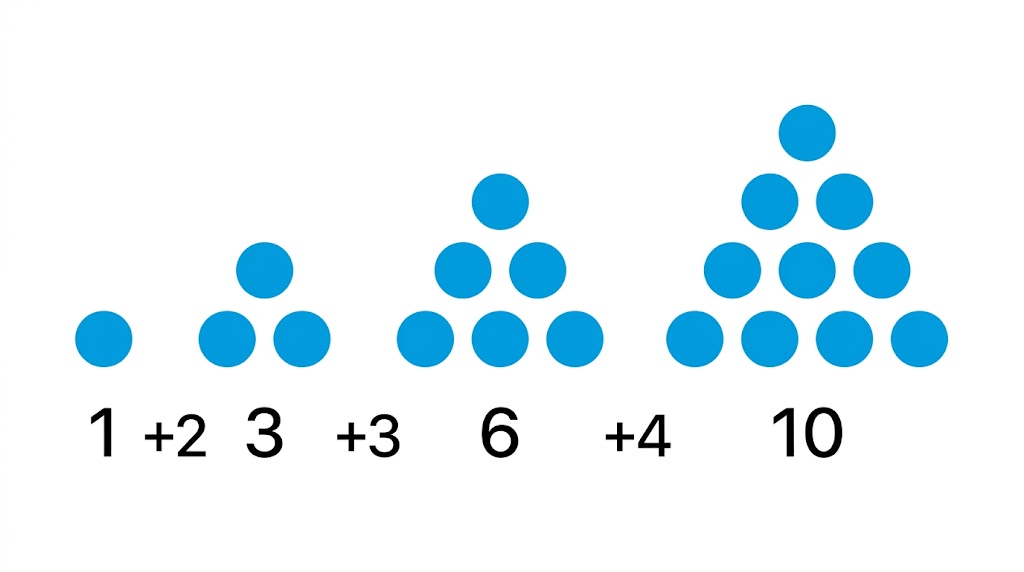
Each triangle adds a new row with one more dot than the last.
Fibonacci-Type Sequences
In a Fibonacci-type sequence, each term is the sum of the two terms before it.
-
Fibonacci
1, 1, 2, 3, 5, 8, 13, 21, ...
-
Any start
2, 5, 7, 12, 19, 31, ... follows the same rule from a different start.
-
With letters
Starting \(a\), \(b\), the terms are \(a\), \(b\), \(a + b\), \(a + 2b\), \(2a + 3b\), ...
-
Working back
If two neighbouring terms are 13 and 21, the one before is \(21 - 13 = 8\).
Geometric Sequences
A geometric sequence is multiplied by the same number, the common ratio \(r\), every time.
-
Growing
3, 6, 12, 24, ... has \(r = 2\).
-
Shrinking
64, 32, 16, 8, ... has \(r = \frac{1}{2}\).
-
Finding \(r\)
Divide any term by the one before it: \(24 \div 12 = 2\).
-
Any term
The nth term is (first term) \(\times\ r^{n-1}\): the first term is multiplied by \(r\) once for each step after it.
A Geometric Sequence
A geometric sequence starts 5, 15, 45, 135, ... Find the common ratio and the 8th term.
Show the solutionHide the solution
- 1 Divide a term by the one before \(15 \div 5 = 3\), so \(r = 3\)
- 2 The 8th term is 7 steps after the first \(5 \times 3^7\)
- 3 Work out \(3^7\) \(3^7 = 2187\)
- 4 Multiply \(5 \times 2187 = 10\,935\)
Answer\(r = 3\); 8th term \(= 10\,935\)
Second Differences
2, 7, 14, 23, 34, ... The first differences change, but the second differences are all 2: the sequence is quadratic.
-
1
Term: 2
-
2
Term: 7. First difference: \(+5\)
-
3
Term: 14. First difference: \(+7\). Second difference: \(+2\)
-
4
Term: 23. First difference: \(+9\). Second difference: \(+2\)
-
5
Term: 34. First difference: \(+11\). Second difference: \(+2\)
The nth Term of a Quadratic Sequence
The nth term has the form \(an^2 + bn + c\).
-
1
Second difference
Find it: it is always \(2a\).
-
2
The squared part
Halve the second difference to get \(a\), and write \(an^2\).
-
3
Subtract
Take \(an^2\) away from each term.
-
4
The linear part
Find the nth term of what is left (\(bn + c\)).
-
5
Combine and check
\(an^2 + bn + c\). Check with \(n = 1\) and \(n = 2\).
The nth Term of a Quadratic Sequence
Find the nth term of 2, 7, 14, 23, 34, ...
Show the solutionHide the solution
- 1 Second difference 2, so \(a = 1\) \(n^2\)
- 2 \(n^2\) gives 1, 4, 9, 16, 25
- 3 Sequence minus \(n^2\) 1, 3, 5, 7, 9
- 4 The nth term of 1, 3, 5, 7, 9 \(2n - 1\)
- 5 Combine \(n^2 + 2n - 1\)
Answer\(n^2 + 2n - 1\) (check \(n = 3\): \(9 + 6 - 1 = 14\))
A Harder Quadratic Sequence
Find the nth term of 4, 13, 26, 43, 64, ...
Show the solutionHide the solution
- 1 First differences 9, 13, 17, 21
- 2 Second difference 4, so \(a = 2\) \(2n^2\)
- 3 \(2n^2\) gives 2, 8, 18, 32, 50
- 4 Sequence minus \(2n^2\) 2, 5, 8, 11, 14, with nth term \(3n - 1\)
- 5 Combine \(2n^2 + 3n - 1\)
Answer\(2n^2 + 3n - 1\) (check \(n = 2\): \(8 + 6 - 1 = 13\))
Geometric Sequences with Surds
The common ratio can be a surd.
-
Example
\(\sqrt{2}\), 2, \(2\sqrt{2}\), 4, \(4\sqrt{2}\), ... has \(r = \sqrt{2}\), because \(\sqrt{2} \times \sqrt{2} = 2\).
-
Every other term
Two steps multiply by \((\sqrt{2})^2 = 2\), so every second term doubles.
-
Finding a term
The 7th term of \(\sqrt{3}\), 3, \(3\sqrt{3}\), ... is \(\sqrt{3} \times (\sqrt{3})^6 = \sqrt{3} \times 27 = 27\sqrt{3}\).
Case study
Fibonacci and His Rabbits
In 1202 the Italian mathematician Leonardo of Pisa, later known as Fibonacci, published Liber Abaci, the book that helped bring Hindu-Arabic numerals to Europe. In it he set a puzzle about a pair of rabbits that breeds a new pair every month. The number of pairs month by month gives 1, 1, 2, 3, 5, 8, 13, ... - the sequence now named after him. Divide each term by the one before (\(8 \div 5 = 1.6\), \(13 \div 8 = 1.625\), \(21 \div 13 = 1.615\ldots\)) and the answers close in on \(1.618\ldots\), the golden ratio.
What Kind of Sequence?
For each sequence, say whether it is linear, geometric, Fibonacci-type or quadratic, and write down the next two terms. (a) 2, 6, 18, 54, ... (b) 3, 4, 7, 11, 18, ... (c) 4, 9, 14, 19, ... (d) 1, 4, 9, 16, ... (e) 80, 40, 20, 10, ... (f) 3, 6, 11, 18, 27, ... Higher: find the nth term of (f).
1. Check the differences.
2. Check the ratios.
3. Check whether each term is the sum of the two before.
A good answer shows: (a) Geometric, \(r = 3\): 162, 486. (b) Fibonacci-type: 29, 47. (c) Linear: 24, 29. (d) Quadratic (square numbers): 25, 36. (e) Geometric, \(r = \frac{1}{2}\): 5, 2.5. (f) Quadratic: 38, 51; nth term \(n^2 + 2\).
Can I...?
- 1Recognise square, cube and triangular numbers.
- 2Continue a Fibonacci-type sequence.
- 3Find the common ratio of a geometric sequence.
- 4Work out a term of a geometric sequence.
- 5Find second differences. (Higher)
- 6Find the nth term of a quadratic sequence. (Higher)
- 7Use a surd as a common ratio. (Higher)
- 8Work backwards in a Fibonacci-type sequence.
Summary & Exam Focus
- Special sequences: square, cube, triangular, Fibonacci, powers of 2.
- Geometric: multiply by the common ratio \(r\) each time.
- Fibonacci-type: add the two previous terms.
- (Higher) Quadratic: constant second difference; \(a\) = second difference \(\div\ 2\), then find the linear part of what is left.
Exam focus
Find an expression for the nth term of the quadratic sequence 3, 9, 19, 33, 51, ... (3 marks) (3 marks)
Write the first and second differences under the sequence before you do anything else. They tell you what kind of sequence it is and give you the first part of a quadratic nth term.
Key terms
The vocabulary this lesson expects you to use. Each one is linked from the first place it appears above.
- Triangular numbers
- 1, 3, 6, 10, 15, ... - the numbers of dots in triangular patterns.
- Fibonacci-type sequence
- Each term is the sum of the two terms before it.
- Geometric sequence
- Each term is multiplied by the same number to get the next.
- Common ratio
- The number a geometric sequence is multiplied by each time.
- Quadratic sequence (Higher)
- A sequence whose second differences are all the same; its nth term includes \(n^2\).
- Second difference (Higher)
- The difference between neighbouring first differences.
Practice questions
Have a go at each one before you open its answer.
-
Question 1 Non-calculator 1 mark
Here are the first six terms of a Fibonacci sequence: 1, 1, 2, 3, 5, 8. Write down the next term.
Show answerHide answer
Model answer
13
Mark scheme
- 13 — B1
-
Question 2 Non-calculator 2 marks
Here are the first four terms of a geometric sequence: 2, 6, 18, 54. (a) Write down the next term. (b) Work out the 6th term.
Show answerHide answer
Model answer
(a) \(54 \times 3 = 162\) (b) \(162 \times 3 = 486\)
Mark scheme
- (a) 162 — B1
- (b) 486 — B1
-
Question 3 Non-calculator · Higher 3 marks
The first two terms of a Fibonacci-type sequence are \(a\) and \(b\). The 3rd term is 7 and the 5th term is 18. Find the values of \(a\) and \(b\).
Show answerHide answer
Model answer
The terms are \(a\), \(b\), \(a + b\), \(a + 2b\), \(2a + 3b\). So \(a + b = 7\) and \(2a + 3b = 18\). Doubling the first: \(2a + 2b = 14\), so \(b = 4\) and \(a = 3\).
Mark scheme
- Terms written in terms of \(a\) and \(b\), at least to \(a + 2b\) — M1
- \(a + b = 7\) and \(2a + 3b = 18\) — M1
- \(a = 3\) and \(b = 4\) — A1
-
Question 4 Non-calculator · Higher 3 marks
Find an expression for the nth term of the quadratic sequence 3, 9, 19, 33, 51, ...
Show answerHide answer
Model answer
First differences 6, 10, 14, 18; second difference 4, so \(2n^2\). \(2n^2\) gives 2, 8, 18, 32, 50; the sequence minus \(2n^2\) is 1, 1, 1, 1, 1. nth term \(2n^2 + 1\).
Mark scheme
- Second difference of 4, or \(2n^2\) seen — M1
- Sequence minus \(2n^2\) found, e.g. 1, 1, 1, ... — M1
- \(2n^2 + 1\) — A1
-
Question 5 Non-calculator · Higher 3 marks
Find an expression for the nth term of the quadratic sequence 0, 5, 12, 21, 32, ...
Show answerHide answer
Model answer
First differences 5, 7, 9, 11; second difference 2, so \(n^2\). \(n^2\) gives 1, 4, 9, 16, 25; the sequence minus \(n^2\) is \(-1\), 1, 3, 5, 7, with nth term \(2n - 3\). nth term \(n^2 + 2n - 3\).
Mark scheme
- Second difference of 2, or \(n^2\) seen — M1
- \(-1\), 1, 3, 5, 7 or \(2n - 3\) found — M1
- \(n^2 + 2n - 3\) — A1
-
Question 6 Non-calculator · Higher 2 marks
The first term of a geometric sequence is \(\sqrt{3}\) and the common ratio is \(\sqrt{3}\). Show that the 5th term is \(9\sqrt{3}\).
Show answerHide answer
Model answer
5th term \(= \sqrt{3} \times (\sqrt{3})^4 = \sqrt{3} \times 9 = 9\sqrt{3}\)
Mark scheme
- \(\sqrt{3} \times (\sqrt{3})^4\), or the terms \(\sqrt{3}\), 3, \(3\sqrt{3}\), 9, \(9\sqrt{3}\) listed — M1
- Correct working showing \(9\sqrt{3}\) — A1
Quick check
-
What are the next two terms of the triangular numbers 1, 3, 6, 10, ...?
Show answerHide answer
B: 15, 21
The differences go \(+2\), \(+3\), \(+4\), then \(+5\) and \(+6\): 15 and 21.
-
What is the common ratio of the geometric sequence 81, 27, 9, 3, ...?
Show answerHide answer
D: \(\frac{1}{3}\)
\(27 \div 81 = \frac{1}{3}\). Each term is a third of the one before.
-
(Higher) What is the nth term of 2, 5, 10, 17, 26, ...?
Show answerHide answer
A: \(n^2 + 1\)
Second difference 2 gives \(n^2\): 1, 4, 9, 16, 25. The sequence is 1 more each time: \(n^2 + 1\).
Downloads
Free to keep, print and annotate.
- Non-linear sequences.pptx Built from the lesson script on 28 September 2026. View
- Non-linear sequences - Completed Notes.docx The full notes for the lesson, to revise from. Built from the lesson script on 28 September 2026. View
- Non-linear sequences - Exam Questions.docx Built from the lesson script on 28 September 2026. View
Something here looks wrong?
Tell us what and we will go and look. It goes to whoever writes these pages, nobody else, and we do not ask who you are — so there is nothing to sign and nothing comes back to you.