Viewing as
Teaching this? The teacher view adds 2 files, the mark schemes and the model answers.
Maths · Angles and trigonometry
Interior angles of a polygon
Split any polygon into triangles from one corner and the angle sum drops out: \((n - 2) \times 180^\circ\). Use it to find missing angles and the angle of a regular polygon.
Last Lesson and Before
Answer each one, then check.
-
1
Last lesson: what do the angles in a quadrilateral add up to?
Show answerHide answer
\(360^\circ\)
-
2
How many sides does a hexagon have?
Show answerHide answer
6
-
3
Work out \(8 \times 180\).
Show answerHide answer
1440
-
4
Solve \(\frac{x}{5} = 108\).
Show answerHide answer
\(x = 540\)
Learning Objectives
- 1Name polygons up to 10 sides.
- 2Work out the sum of the interior angles of any polygon.
- 3Find a missing interior angle.
- 4Work out the interior angle of a regular polygon.
Polygons
A polygon is a 2D shape with straight sides.
-
Names
Triangle 3, quadrilateral 4, pentagon 5, hexagon 6, heptagon 7, octagon 8, nonagon 9, decagon 10.
-
Interior angle
An angle inside the polygon, at a vertex (corner).
-
Regular
All sides equal AND all angles equal.
-
Irregular
Sides or angles not all equal - the angle sum is still the same.
Why the Formula Works
Draw lines from one vertex to every other vertex. A polygon with \(n\) sides always splits into \(n - 2\) triangles, and each triangle holds \(180^\circ\). So the interior angles add up to \((n - 2) \times 180^\circ\).
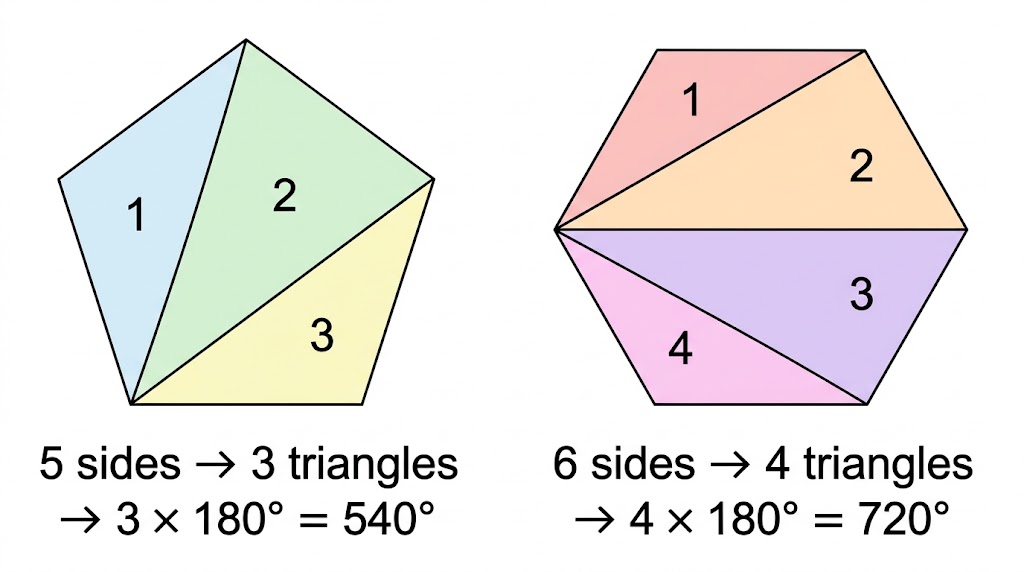
An n-sided polygon splits into \(n - 2\) triangles.
Interior Angle Sums
-
Triangle
Sides: 3. Triangles: 1. Angle sum: \(180^\circ\)
-
Quadrilateral
Sides: 4. Triangles: 2. Angle sum: \(360^\circ\)
-
Pentagon
Sides: 5. Triangles: 3. Angle sum: \(540^\circ\)
-
Hexagon
Sides: 6. Triangles: 4. Angle sum: \(720^\circ\)
-
Octagon
Sides: 8. Triangles: 6. Angle sum: \(1080^\circ\)
-
Decagon
Sides: 10. Triangles: 8. Angle sum: \(1440^\circ\)
A Missing Angle in a Pentagon
Four of the angles of a pentagon are \(100^\circ\), \(120^\circ\), \(95^\circ\) and \(110^\circ\). Work out the fifth angle.
Show the solutionHide the solution
- 1 Angle sum of a pentagon \((5 - 2) \times 180 = 540\)
- 2 Add the known angles \(100 + 120 + 95 + 110 = 425\)
- 3 Subtract \(540 - 425 = 115\)
Answer\(115^\circ\)
Regular Polygons
In a regular polygon every interior angle is the same, so share the angle sum equally.
-
Interior angle
Interior angle of a regular polygon \(= \dfrac{(n - 2) \times 180}{n}\).
-
Regular hexagon
\(\dfrac{720}{6} = 120^\circ\).
-
Regular octagon
\(\dfrac{1080}{8} = 135^\circ\).
-
Growing
The more sides, the closer the interior angle gets to \(180^\circ\) - but it never reaches it.
The Interior Angle of a Regular Decagon
Work out the size of each interior angle of a regular decagon.
Show the solutionHide the solution
- 1 A decagon has 10 sides \(n = 10\)
- 2 Angle sum \((10 - 2) \times 180 = 1440\)
- 3 Share equally between 10 angles \(1440 \div 10 = 144\)
Answer\(144^\circ\)
Working Back to the Number of Sides
Each interior angle of a regular polygon is \(150^\circ\). How many sides does it have?
Show the solutionHide the solution
- 1 Write the angle sum two ways \((n - 2) \times 180 = 150n\)
- 2 Expand \(180n - 360 = 150n\)
- 3 Solve \(30n = 360\), so \(n = 12\)
Answer12 sides (a dodecagon). Next lesson shows a quicker way.
Does It Tessellate?
A regular polygon tessellates (tiles a flat surface with no gaps) if copies of it fit exactly around a point. Work out the interior angles of the regular triangle, square, pentagon, hexagon and octagon, and decide which of them tessellate on their own.
1. Work out each interior angle.
2. Check whether it divides exactly into \(360^\circ\).
3. Explain your answer.
A good answer shows: Interior angles: 60, 90, 108, 120, 135. Only the triangle (\(6 \times 60 = 360\)), square (\(4 \times 90\)) and hexagon (\(3 \times 120\)) divide exactly into \(360^\circ\), so only those three tessellate.
Can I...?
- 1Name polygons up to 10 sides.
- 2Explain why the angle sum is \((n - 2) \times 180^\circ\).
- 3Find the angle sum of any polygon.
- 4Find a missing interior angle.
- 5Find the interior angle of a regular polygon.
- 6Find the number of sides from the interior angle.
Summary & Exam Focus
- Angle sum \(= (n - 2) \times 180^\circ\).
- Regular polygon: each interior angle \(= \dfrac{(n - 2) \times 180}{n}\).
- Missing angle: angle sum minus the angles you know.
Exam focus
Work out the size of each interior angle of a regular nonagon (9 sides). (2 marks) (2 marks)
Write the formula before you substitute. If you only remember one thing, remember that a polygon splits into \(n - 2\) triangles - you can rebuild the formula from that.
Key terms
The vocabulary this lesson expects you to use. Each one is linked from the first place it appears above.
- Polygon
- A closed 2D shape with straight sides.
- Vertex
- A corner of a shape (plural: vertices).
- Interior angle
- An angle inside a polygon at a vertex.
- Regular polygon
- A polygon with all sides and all angles equal.
- Diagonal
- A straight line joining two vertices that are not next to each other.
Practice questions
Have a go at each one before you open its answer.
-
Question 1 Non-calculator 2 marks
Work out the sum of the interior angles of a polygon with 9 sides.
Show answerHide answer
Model answer
\((9 - 2) \times 180 = 7 \times 180 = 1260^\circ\)
Mark scheme
- \((9 - 2) \times 180\) — M1
- \(1260^\circ\) — A1
-
Question 2 Non-calculator 2 marks
Work out the size of each interior angle of a regular nonagon.
Show answerHide answer
Model answer
\(1260 \div 9 = 140^\circ\)
Mark scheme
- \(\dfrac{(9 - 2) \times 180}{9}\) — M1
- \(140^\circ\) — A1
-
Question 3 Non-calculator 3 marks
A hexagon has angles \(2x\), \(2x\), \(3x\), \(3x\), \(4x\) and \(4x\), in degrees. Work out the value of \(x\).
Show answerHide answer
Model answer
Angle sum \((6 - 2) \times 180 = 720\). \(2x + 2x + 3x + 3x + 4x + 4x = 18x = 720\), so \(x = 40\).
Mark scheme
- 720 — M1
- \(18x = 720\) — M1
- \(x = 40\) — A1
-
Question 4 Non-calculator 3 marks
Each interior angle of a regular polygon is \(140^\circ\). Show that the polygon has 9 sides.
Show answerHide answer
Model answer
\((n - 2) \times 180 = 140n\), so \(180n - 360 = 140n\), \(40n = 360\), \(n = 9\). (Or: exterior angle \(180 - 140 = 40\), and \(360 \div 40 = 9\).)
Mark scheme
- An equation \((n - 2) \times 180 = 140n\), or the exterior angle 40 — M1
- \(40n = 360\), or \(360 \div 40\) — M1
- \(n = 9\) with full working shown — A1
Quick check
-
What do the interior angles of a hexagon add up to?
Show answerHide answer
C: \(720^\circ\)
\((6 - 2) \times 180 = 720\).
-
What is each interior angle of a regular octagon?
Show answerHide answer
A: \(135^\circ\)
\(1080 \div 8 = 135\).
-
Could a regular polygon have interior angles of \(130^\circ\)?
Show answerHide answer
B: No - the number of sides would not be a whole number
Solving \((n - 2) \times 180 = 130n\) gives \(n = 7.2\), which is not a whole number of sides.
Downloads
Free to keep, print and annotate.
- Interior angles of a polygon.pptx Built from the lesson script on 29 September 2026. View
- Interior angles of a polygon - Completed Notes.docx The full notes for the lesson, to revise from. Built from the lesson script on 29 September 2026. View
- Interior angles of a polygon - Exam Questions.docx Built from the lesson script on 29 September 2026. View
Something here looks wrong?
Tell us what and we will go and look. It goes to whoever writes these pages, nobody else, and we do not ask who you are — so there is nothing to sign and nothing comes back to you.