Viewing as
Teaching this? The teacher view adds 2 files, the mark schemes and the model answers.
Maths · Graphs
Line segments
The midpoint and length of a line segment from its end points, working back from a midpoint to a missing end - and at Higher, the equation of the perpendicular bisector.
Last Lesson and Before
Answer each one, then check.
-
1
What is the mean of 2 and 8?
Show answerHide answer
5
-
2
Distance between \((1, 1)\) and \((4, 5)\)?
Show answerHide answer
5
-
3
Work out \(\frac{-3 + 7}{2}\).
Show answerHide answer
2
-
4
(Higher) Gradient perpendicular to 2?
Show answerHide answer
\(-\frac{1}{2}\)
Learning Objectives
- 1Find the midpoint of a line segment.
- 2Find the length of a line segment.
- 3Find a missing end point from the midpoint.
- 4(Higher) Find the equation of the perpendicular bisector of a line segment.
Midpoints
A line segment is the part of a line between two end points. Its midpoint is exactly halfway along.
-
The mean of the ends
Midpoint of \((x_1, y_1)\) and \((x_2, y_2)\) is \(\left(\dfrac{x_1 + x_2}{2}, \dfrac{y_1 + y_2}{2}\right)\).
-
Example
Midpoint of \((2, 3)\) and \((8, 11)\) is \(\left(\frac{10}{2}, \frac{14}{2}\right) = (5, 7)\).
-
Negatives
Take care adding negatives: midpoint of \((-3, 5)\) and \((7, 1)\) is \((2, 3)\).
-
Length
Use Pythagoras with the horizontal and vertical differences.
Midpoint and Length
To get from A to B you go 6 across and 8 up. The midpoint is half of each: 3 across and 4 up from A, which is \((5, 7)\). The length of AB is \(\sqrt{6^2 + 8^2} = \sqrt{100} = 10\).
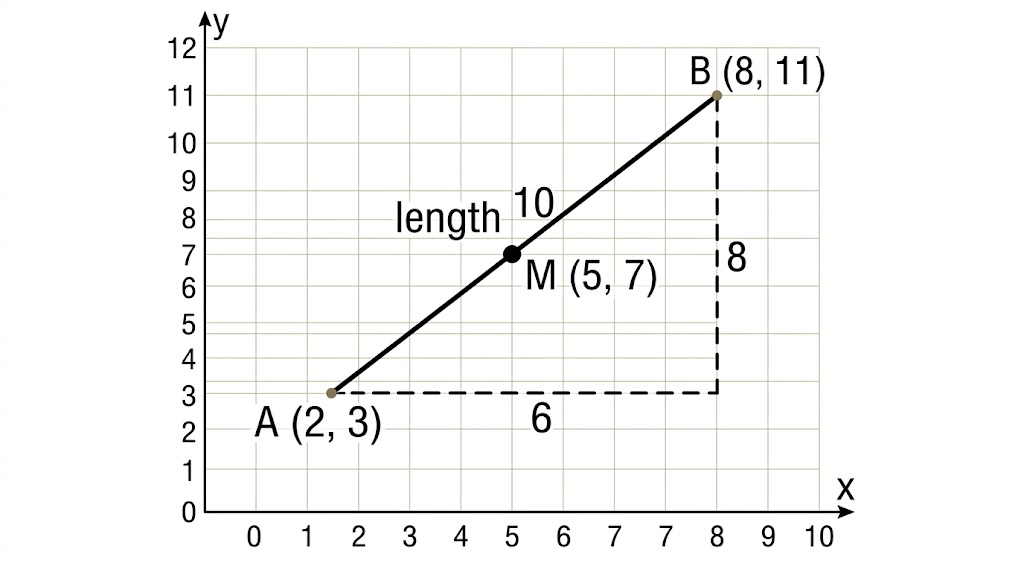
M is halfway across and halfway up: \((5, 7)\). The length is \(\sqrt{6^2 + 8^2} = 10\).
Finding the Other End
M\((3, 1)\) is the midpoint of the line segment AB. A is \((-1, 4)\). Find the coordinates of B.
Show the solutionHide the solution
- 1 From A to M \(x\): \(-1\) to 3 is \(+4\); \(y\): 4 to 1 is \(-3\)
- 2 Do the same again from M to B \(x\): \(3 + 4 = 7\); \(y\): \(1 - 3 = -2\)
- 3 Check the midpoint of A and B \(\left(\frac{-1 + 7}{2}, \frac{4 + (-2)}{2}\right) = (3, 1)\)
AnswerB\((7, -2)\)
The Perpendicular Bisector
It passes through the midpoint, and is perpendicular to the segment.
-
1
Midpoint
Find the midpoint of the segment.
-
2
Gradient of the segment
\(\dfrac{\text{change in } y}{\text{change in } x}\).
-
3
Perpendicular gradient
Take the negative reciprocal.
-
4
Find \(c\)
Substitute the midpoint into \(y = mx + c\).
A Perpendicular Bisector
A is \((1, 2)\) and B is \((5, 10)\). Find the equation of the perpendicular bisector of AB.
Show the solutionHide the solution
- 1 Midpoint \(\left(\frac{1 + 5}{2}, \frac{2 + 10}{2}\right) = (3, 6)\)
- 2 Gradient of AB \(\dfrac{10 - 2}{5 - 1} = \dfrac{8}{4} = 2\)
- 3 Perpendicular gradient \(-\dfrac{1}{2}\)
- 4 Substitute \((3, 6)\) \(6 = -\dfrac{1}{2} \times 3 + c\), so \(c = 7.5\)
Answer\(y = -\dfrac{1}{2}x + 7.5\), or \(x + 2y = 15\)
Hidden Square
Three corners of a square are \((1, 1)\), \((5, 2)\) and \((4, 6)\). (a) Find the midpoint of each diagonal you can draw. (b) Use the fact that the diagonals of a square bisect each other to find the fourth corner. (c) Find the length of one side.
1. Sketch the three points.
2. Decide which points are opposite corners.
3. Use the shared midpoint.
A good answer shows: (a) The diagonal from \((1, 1)\) to \((4, 6)\) has midpoint \((2.5, 3.5)\). (b) The other diagonal has the same midpoint, so the fourth corner is \((2 \times 2.5 - 5, 2 \times 3.5 - 2) = (0, 5)\). (c) \(\sqrt{4^2 + 1^2} = \sqrt{17} = 4.12\).
Can I...?
- 1Find the midpoint of a line segment.
- 2Find the length of a line segment.
- 3Find an end point from the midpoint and the other end.
- 4(Higher) Find the gradient perpendicular to a segment.
- 5(Higher) Find the equation of a perpendicular bisector.
Summary & Exam Focus
- Midpoint: the mean of the \(x\)s and the mean of the \(y\)s.
- Length: Pythagoras on the differences.
- Missing end: same step again from the midpoint.
- (Higher) Perpendicular bisector: midpoint plus negative reciprocal gradient.
Exam focus
M\((3, 1)\) is the midpoint of AB. A has coordinates \((-1, 4)\). Find the coordinates of B. (2 marks) (2 marks)
For a missing end point, don't halve anything: find the step from A to M, then take the same step again from M.
Key terms
The vocabulary this lesson expects you to use. Each one is linked from the first place it appears above.
- Line segment
- The part of a line between two end points.
- Midpoint
- The point exactly halfway along a line segment.
- Bisect
- Cut into two equal parts.
- Perpendicular bisector
- A line that cuts a segment in half at right angles.
Practice questions
Have a go at each one before you open its answer.
-
Question 1 Non-calculator 2 marks
Find the midpoint of the line segment joining \((-3, 5)\) and \((7, 1)\).
Show answerHide answer
Model answer
\(\left(\frac{-3 + 7}{2}, \frac{5 + 1}{2}\right) = (2, 3)\)
Mark scheme
- One coordinate correct — B1
- \((2, 3)\) — B1
-
Question 2 Non-calculator 4 marks
A is the point \((2, 3)\) and B is the point \((8, 11)\). (a) Find the midpoint of AB. (b) Work out the length of AB.
Show answerHide answer
Model answer
(a) \((5, 7)\) (b) \(\sqrt{6^2 + 8^2} = \sqrt{100} = 10\)
Mark scheme
- (a) \((5, 7)\) — B1
- (b) Differences 6 and 8 — M1
- (b) \(6^2 + 8^2\) — M1
- (b) 10 — A1
-
Question 3 Non-calculator 2 marks
M\((3, 1)\) is the midpoint of the line segment AB. A has coordinates \((-1, 4)\). Find the coordinates of B.
Show answerHide answer
Model answer
B = \((2 \times 3 - (-1), 2 \times 1 - 4) = (7, -2)\)
Mark scheme
- One coordinate correct — B1
- \((7, -2)\) — B1
-
Question 4 Non-calculator · Higher 4 marks
A is the point \((1, 2)\) and B is the point \((5, 10)\). Find an equation of the perpendicular bisector of AB.
Show answerHide answer
Model answer
Midpoint \((3, 6)\). Gradient of AB \(= 2\), so the perpendicular gradient is \(-\frac{1}{2}\). \(6 = -\frac{1}{2} \times 3 + c\), \(c = 7.5\). \(y = -\frac{1}{2}x + 7.5\)
Mark scheme
- Midpoint \((3, 6)\) — P1
- Gradient of AB = 2 — P1
- Perpendicular gradient \(-\frac{1}{2}\) used with the midpoint — P1
- \(y = -\frac{1}{2}x + 7.5\), or \(x + 2y = 15\) — A1
Quick check
-
What is the midpoint of \((0, 4)\) and \((6, 10)\)?
Show answerHide answer
B: \((3, 7)\)
\(\left(\frac{0 + 6}{2}, \frac{4 + 10}{2}\right) = (3, 7)\).
-
How long is the line segment from \((1, 2)\) to \((13, 7)\)?
Show answerHide answer
D: 13
Differences 12 and 5: \(\sqrt{144 + 25} = \sqrt{169} = 13\).
-
The midpoint of AB is \((4, 4)\) and A is \((1, 6)\). Where is B?
Show answerHide answer
C: \((7, 2)\)
From A to M: \(+3\) across, \(-2\) up. Again from M: \((7, 2)\).
Downloads
Free to keep, print and annotate.
- Line segments.pptx Built from the lesson script on 29 September 2026. View
- Line segments - Completed Notes.docx The full notes for the lesson, to revise from. Built from the lesson script on 29 September 2026. View
- Line segments - Exam Questions.docx Built from the lesson script on 29 September 2026. View
Something here looks wrong?
Tell us what and we will go and look. It goes to whoever writes these pages, nobody else, and we do not ask who you are — so there is nothing to sign and nothing comes back to you.