Viewing as
Teaching this? The teacher view adds 2 files, the mark schemes and the model answers.
Maths · Multiplicative reasoning
Compound measures
Use the formulae for speed, density and pressure, and convert between the units of compound measures.
Warm-up
Answer each one, then check.
-
1
How many metres in a kilometre?
Show answerHide answer
1000
-
2
How many seconds in an hour?
Show answerHide answer
3600
-
3
Work out \(240 \div 3\).
Show answerHide answer
80
-
4
How many cm³ in a litre?
Show answerHide answer
1000
-
5
What is the area of a rectangle 20 cm by 10 cm?
Show answerHide answer
200 cm²
Learning Objectives
- 1Use \(\text{speed} = \dfrac{\text{distance}}{\text{time}}\).
- 2Use \(\text{density} = \dfrac{\text{mass}}{\text{volume}}\).
- 3Use \(\text{pressure} = \dfrac{\text{force}}{\text{area}}\).
- 4Convert between units for compound measures.
Formula Triangles
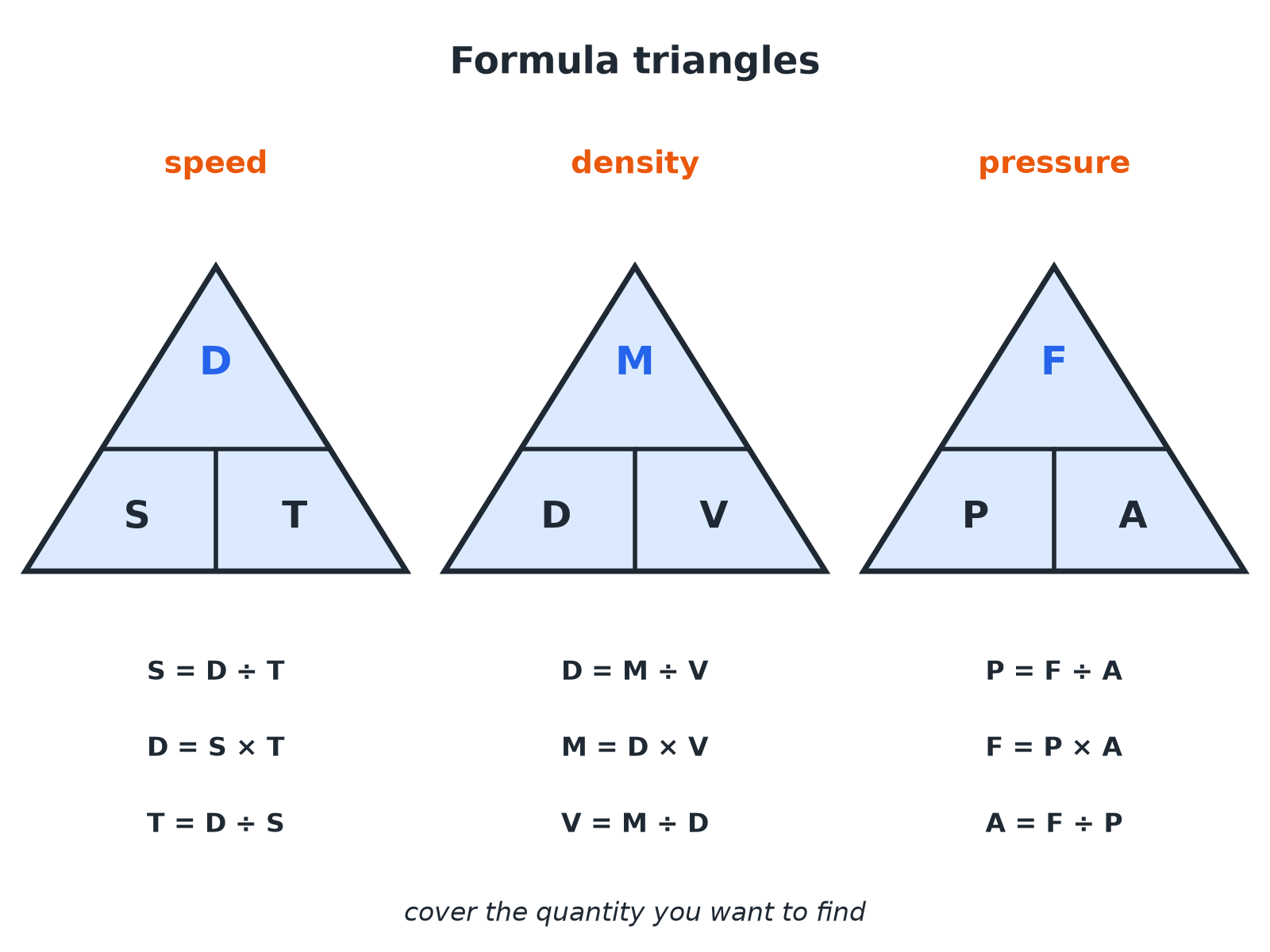
Cover what you want to find; what is left tells you what to do.
The Three Formulae
Know these and their units.
-
Speed
Formula: \(\dfrac{\text{distance}}{\text{time}}\). Typical units: km/h, m/s
-
Density
Formula: \(\dfrac{\text{mass}}{\text{volume}}\). Typical units: g/cm³, kg/m³
-
Pressure
Formula: \(\dfrac{\text{force}}{\text{area}}\). Typical units: N/m², Pa
Speed
A train travels 240 km in 3 hours. Find its average speed.
Show the solutionHide the solution
- 1 Speed \(= \dfrac{\text{distance}}{\text{time}}\) \(\dfrac{240}{3}\)
- 2 Work it out 80
Answer80 km/h
Density
A block of metal has mass 450 g and volume 60 cm³. Find its density.
Show the solutionHide the solution
- 1 Density \(= \dfrac{\text{mass}}{\text{volume}}\) \(\dfrac{450}{60}\)
- 2 Work it out 7.5
Answer7.5 g/cm³
Pressure
A force of 600 N acts on an area of 0.5 m². Find the pressure.
Show the solutionHide the solution
- 1 Pressure \(= \dfrac{\text{force}}{\text{area}}\) \(\dfrac{600}{0.5}\)
- 2 Work it out 1200
Answer1200 N/m² (1200 Pa)
Changing Units
Change 90 km/h into metres per second.
Show the solutionHide the solution
- 1 90 km is 90 000 m \(90 \times 1000\)
- 2 1 hour is 3600 s \(90\,000 \div 3600\)
- 3 Work it out 25
Answer25 m/s
Rearranging a Formula
Aluminium has density 2.7 g/cm³. Find the mass of a piece with volume 40 cm³.
Show the solutionHide the solution
- 1 Mass \(=\) density \(\times\) volume \(2.7 \times 40\)
- 2 Work it out 108
Answer108 g
Watch the Units
Units must match before you divide.
-
Time
Change minutes to hours before dividing by km per hour: 30 minutes is 0.5 hours.
-
Area
1 m² is 10 000 cm², so pressure in N/m² needs area in m².
-
Density
1 g/cm³ is 1000 kg/m³.
Which Metal?
A mystery block has mass 540 g and volume 200 cm³. Work out its density and use the table to decide which metal it is: aluminium 2.7 g/cm³, iron 7.9 g/cm³, copper 8.9 g/cm³.
1. Divide mass by volume.
2. Compare with the table.
A good answer shows: Density \(= 540 \div 200 = 2.7\) g/cm³, so the block is aluminium.
Can I...?
- 1Use \(S = D \div T\) in all three forms.
- 2Use \(D = M \div V\) in all three forms.
- 3Use \(P = F \div A\) in all three forms.
- 4Convert km/h to m/s.
- 5Convert minutes to hours.
- 6Use the correct units in an answer.
- 7Choose the right formula.
- 8Rearrange a formula.
Summary & Exam Focus
- Speed \(=\) distance \(\div\) time.
- Density \(=\) mass \(\div\) volume.
- Pressure \(=\) force \(\div\) area.
- Convert units before calculating.
Exam focus
A block of metal has weight 40 N. Its largest face has area 0.02 m². Work out the pressure on the ground when it rests on this face. (2 marks) (2 marks)
Pressure is force divided by area, so the smaller the area, the greater the pressure. Make sure the area is in m² if the answer is in N/m².
Key terms
The vocabulary this lesson expects you to use. Each one is linked from the first place it appears above.
- Compound measure
- A measure made from two other measures, such as speed.
- Speed
- Distance travelled per unit of time.
- Density
- Mass per unit of volume.
- Pressure
- Force per unit of area.
- Newton (N)
- The unit of force.
- Pascal (Pa)
- One newton per square metre.
Practice questions
Have a go at each one before you open its answer.
-
Question 1 Non-calculator 2 marks
A train travels 240 km in 3 hours. Work out its average speed.
Show answerHide answer
Model answer
\(240 \div 3 = 80\) km/h.
Mark scheme
- \(240 \div 3\) — M1
- 80 — A1
-
Question 2 Non-calculator 2 marks
A block of metal has a mass of 450 g and a volume of 60 cm³. Work out the density of the metal.
Show answerHide answer
Model answer
\(450 \div 60 = 7.5\) g/cm³.
Mark scheme
- \(450 \div 60\) — M1
- 7.5 — A1
-
Question 3 Non-calculator 2 marks
Change a speed of 90 km/h into metres per second.
Show answerHide answer
Model answer
\(90 \times 1000 \div 3600 = 25\) m/s.
Mark scheme
- \(90 \times 1000 \div 3600\) — M1
- 25 — A1
-
Question 4 Calculator 4 marks
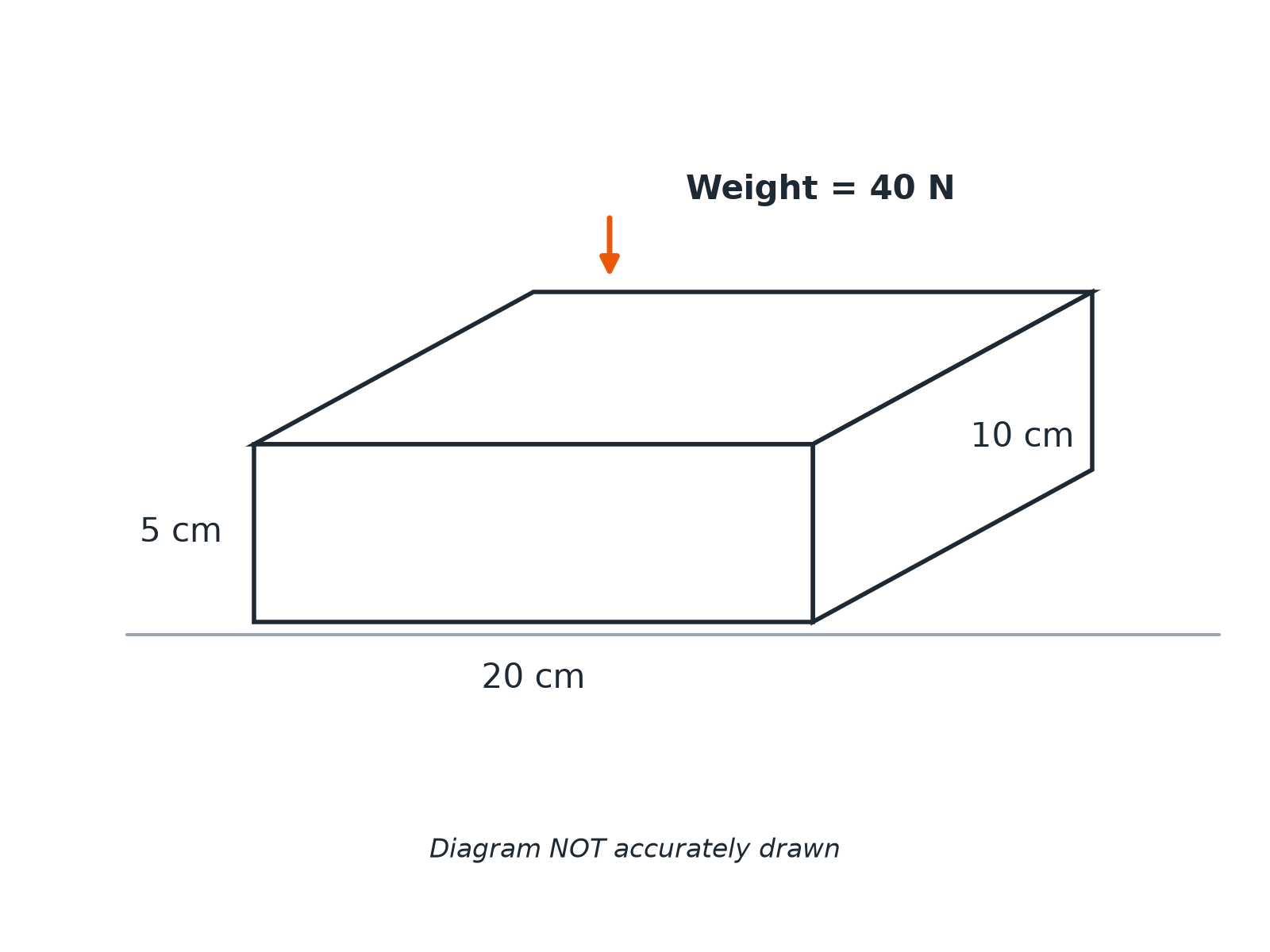
The diagram shows a solid block with a weight of 40 N. The block rests on a table. Work out the pressure on the table when the block rests (a) on its largest face and (b) on its smallest face.
Show answerHide answer
Model answer
(a) Largest face: \(0.2 \times 0.1 = 0.02\) m², so pressure \(= 40 \div 0.02 = 2000\) N/m². (b) Smallest face: \(0.1 \times 0.05 = 0.005\) m², so pressure \(= 40 \div 0.005 = 8000\) N/m².
Mark scheme
- (a) Area 0.02 m² — M1
- (a) 2000 — A1
- (b) Area 0.005 m² — M1
- (b) 8000 — A1
-
Question 5 Calculator 3 marks
A car travels at an average speed of 60 km/h. Work out how long it takes to travel 150 km. Give your answer in hours and minutes.
Show answerHide answer
Model answer
\(150 \div 60 = 2.5\) hours, which is 2 hours 30 minutes.
Mark scheme
- \(150 \div 60\) — M1
- 2.5 hours — A1
- 2 hours 30 minutes — A1
-
Question 6 Calculator 2 marks
Aluminium has a density of 2.7 g/cm³. Work out the mass of a piece of aluminium with a volume of 40 cm³.
Show answerHide answer
Model answer
\(2.7 \times 40 = 108\) g.
Mark scheme
- \(2.7 \times 40\) — M1
- 108 — A1
Quick check
-
A car travels 150 km in 3 hours. What is its speed?
Show answerHide answer
C: 50 km/h
\(150 \div 3 = 50\) km/h.
-
A rock has mass 300 g and volume 100 cm³. What is its density?
Show answerHide answer
B: 3 g/cm³
\(300 \div 100 = 3\) g/cm³.
-
A force of 50 N acts on 2 m². What is the pressure?
Show answerHide answer
A: 25 N/m²
\(50 \div 2 = 25\) N/m².
-
What is 36 km/h in m/s?
Show answerHide answer
D: 10 m/s
\(36 \div 3.6 = 10\).
-
Which change makes pressure larger for the same force?
Show answerHide answer
B: A smaller area
A smaller area gives a greater pressure.
-
A journey takes 45 minutes at 40 km/h. How far is it?
Show answerHide answer
C: 30 km
45 minutes is 0.75 hours, so \(40 \times 0.75 = 30\) km.
Downloads
Free to keep, print and annotate.
- Compound measures.pptx Built from the lesson script on 30 September 2026. View
- Compound measures - Completed Notes.docx The full notes for the lesson, to revise from. Built from the lesson script on 30 September 2026. View
- Compound measures - Exam Questions.docx Built from the lesson script on 30 September 2026. View
Something here looks wrong?
Tell us what and we will go and look. It goes to whoever writes these pages, nobody else, and we do not ask who you are — so there is nothing to sign and nothing comes back to you.